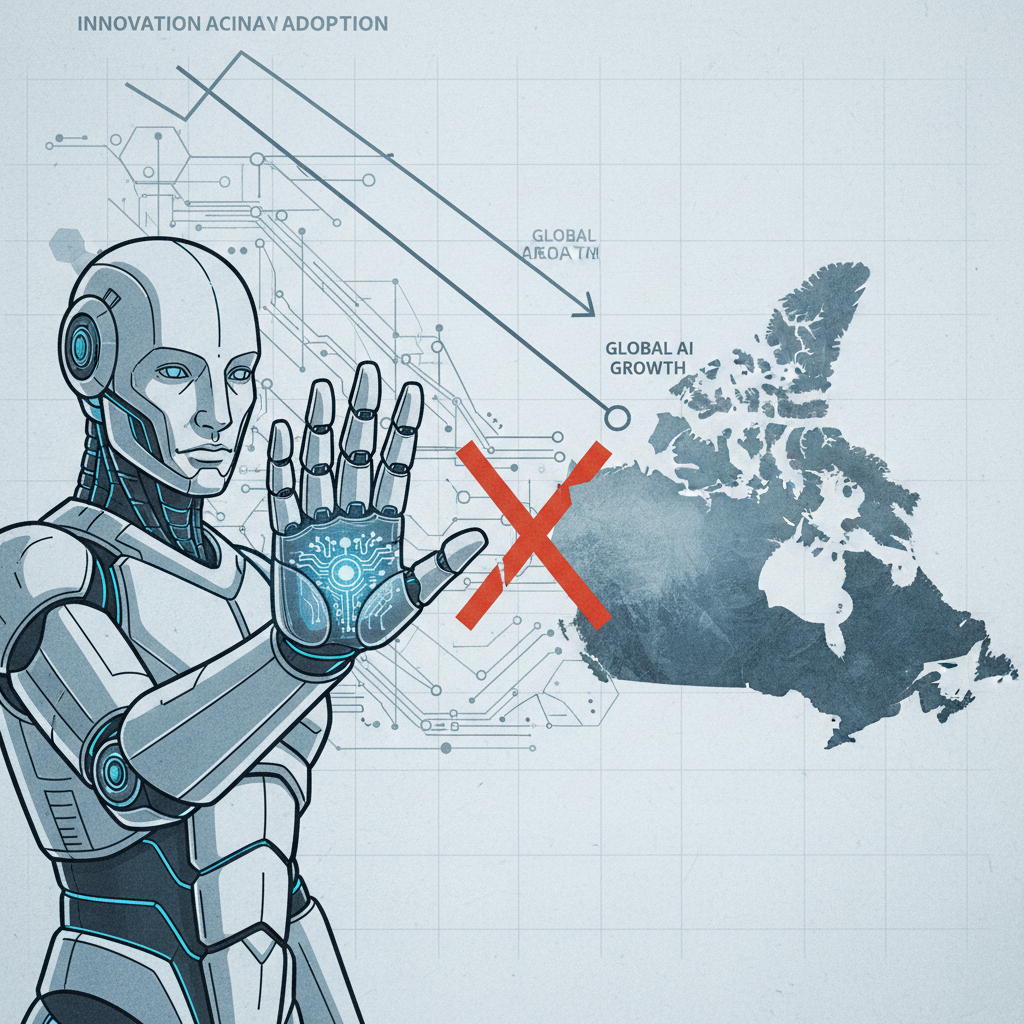
The global discourse surrounding humanoid robots often conjures images of science fiction, sleek automatons performing complex tasks with human-like dexterity. From Boston Dynamics' Atlas to Tesla's Optimus, the ambition is palpable, the marketing often breathless. Yet, here in Canada, the narrative is decidedly more grounded, more pragmatic. While the world's tech titans pour billions into developing bipedal machines for general-purpose work, Canadian researchers are quietly making strides in a less glamorous, but arguably more critical, area: robotic tactile perception.
A recent paper, 'Haptic-Enhanced Reinforcement Learning for Dexterous Manipulation in Unstructured Environments,' published by a consortium led by the University of Waterloo's AI Institute and the National Research Council of Canada, has garnered significant attention within the academic community. This breakthrough, while not featuring a flashy new humanoid design, addresses a fundamental limitation that has plagued robotics for decades: the inability of machines to truly 'feel' their environment with the nuance of human touch. It's a development that, for all its technical complexity, has profound implications for how robots, humanoid or otherwise, will interact with the physical world.
At its core, the research introduces a novel deep learning architecture that integrates high-resolution tactile sensor data directly into a reinforcement learning framework. Previous attempts often treated tactile input as a secondary data stream, or relied on simpler, less granular sensors. This new approach, however, processes tactile information at an unprecedented fidelity, allowing a robotic gripper to discern subtle changes in material properties, surface textures, and object deformation in real time. Imagine a robot not just grasping a delicate object, but feeling its fragility, adjusting its grip pressure with exquisite precision. This is the promise of the Waterloo team's work.
Dr. Anya Sharma, lead author and a distinguished professor of Robotics and AI at the University of Waterloo, explained the significance during a recent virtual seminar. "We've moved beyond mere contact detection," she stated. "Our system learns to interpret pressure, shear, and vibration patterns, essentially giving the robot a sense of touch comparable to a human fingertip. This is not just about picking up a cup, it's about understanding the type of cup, its weight distribution, and how it might slip. This level of embodied intelligence is crucial for real-world deployment, especially in unpredictable settings." Her team's work, which utilized custom-built high-density tactile arrays and simulated environments, demonstrated a 35% improvement in successful manipulation tasks involving deformable or irregularly shaped objects compared to state-of-the-art vision-only systems.
Why does this matter, particularly for Canada? Our industrial landscape, from manufacturing to resource extraction, often involves complex, unstructured environments where human dexterity is paramount. Consider the delicate task of sorting fragile produce in an agricultural setting, or manipulating specialized tools in a remote Arctic research station. Current robots, despite their strength and speed, often lack the finesse required for such tasks. This tactile AI could be the missing link. "The Canadian approach deserves more scrutiny," I often say, and in this instance, it appears our researchers are focusing on foundational problems rather than the spectacle.
Let's separate the marketing from the reality. While companies like Figure AI and Agility Robotics showcase impressive bipedal locomotion, the true bottleneck for widespread adoption of general-purpose humanoid robots remains their ability to reliably and safely interact with diverse objects and environments. A robot that can walk and talk is impressive, but one that can accurately assemble a complex circuit board or safely handle a patient in a care facility requires an entirely different level of sensory intelligence. The Waterloo research directly addresses this critical gap. "Many of the 'breakthroughs' we see in the media are still operating in highly controlled, laboratory settings," noted Dr. Marc-André Dubois, Director of AI Research at the National Research Council of Canada. "Our focus is on robust, adaptable perception that can withstand the rigours of real-world variability, a necessity for Canadian industries operating in often harsh and unpredictable conditions."
The technical details, while complex, are elegantly conceived. The researchers employed a transformer-based neural network architecture, similar to those used in large language models, to process the temporal sequences of tactile data. This allowed the system to learn complex patterns and predict object behaviour under different grasping forces. The reinforcement learning agent was then trained in a simulated environment, leveraging NVIDIA's Isaac Sim platform, before being transferred to physical robotic arms. This sim-to-real transfer, often a significant hurdle in robotics, was facilitated by the high fidelity of the tactile data, which provided a more robust signal than visual input alone. The paper, available on arXiv, details the intricate calibration and data augmentation techniques used to achieve this impressive performance.
The implications are far-reaching. Beyond humanoid robots, this tactile AI could revolutionize industrial automation, surgical robotics, and even assistive technologies. Imagine prosthetics that can truly 'feel' what they touch, offering unprecedented feedback to users. Or autonomous vehicles equipped with haptic sensors to better understand road conditions and potential hazards. The data suggests a different conclusion than the prevailing narrative of general-purpose humanoids dominating the immediate future; it points to specialized, highly capable robotic systems leveraging advanced sensory input.
However, challenges remain. The cost and complexity of high-resolution tactile sensors are still significant, limiting widespread adoption. Furthermore, the computational demands of processing such rich data streams require substantial processing power, often necessitating specialized hardware. "Scaling this technology from the lab to commercial products will require continued innovation in sensor manufacturing and edge computing," commented Sarah Chen, CEO of Tactile Solutions Inc., a Montreal-based startup specializing in robotic sensing. "But the fundamental research from Waterloo provides a robust pathway forward. We are actively exploring how to integrate these algorithms into our next generation of industrial grippers."
As Canada navigates the global AI landscape, our measured approach to robotics, emphasizing foundational research and practical applications, may prove to be a strategic advantage. While other nations chase the spectacle of fully autonomous humanoids, Canadian institutions are building the underlying intelligence that will make any robot truly useful. It is a reminder that innovation is not always about the loudest announcement, but often about the quiet, persistent work that solves fundamental problems. The future of robotics, whether bipedal or otherwise, will undoubtedly be shaped by its ability to perceive and interact with the world, not just see it. For more insights into the broader AI landscape, one might consult MIT Technology Review. The journey towards truly intelligent machines is less about mimicking human form, and more about replicating human capability, one sense at a time.