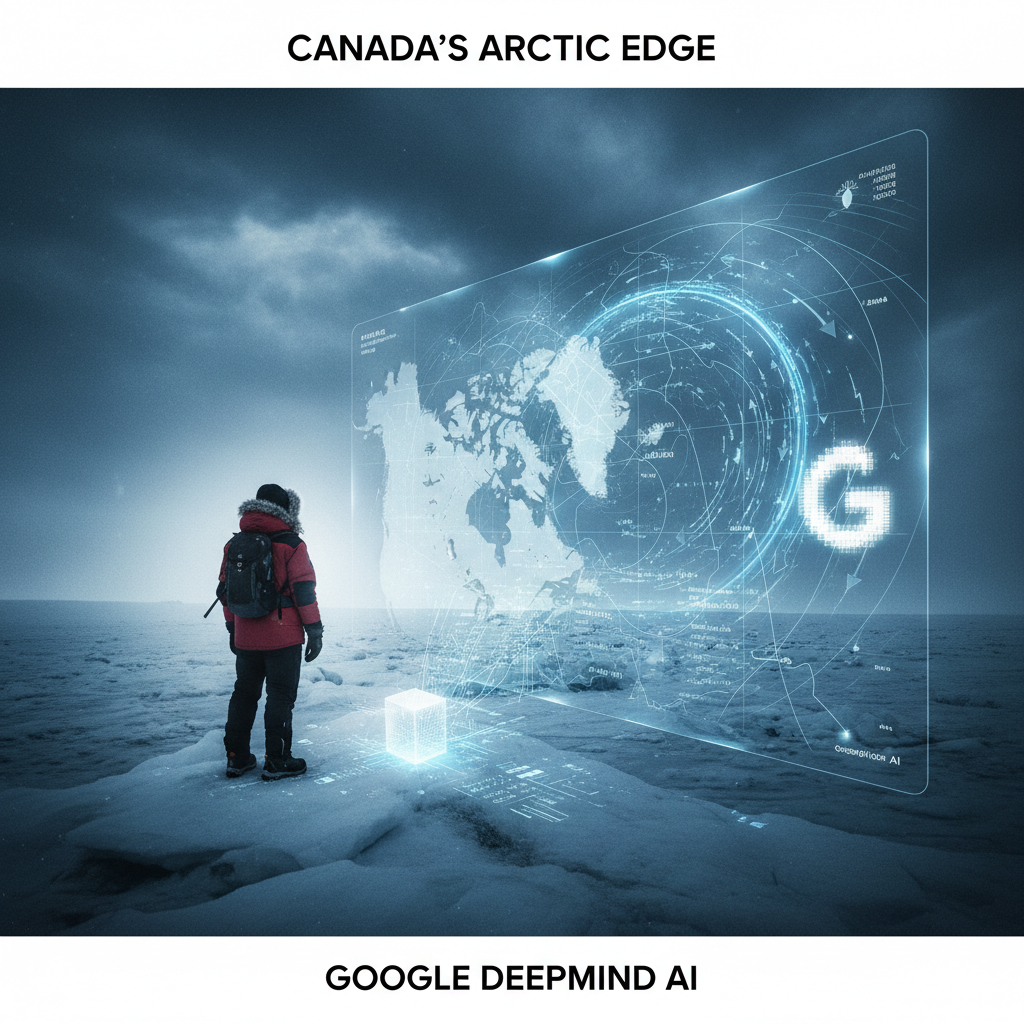

The Canadian North, a region often considered the bellwether for global climate change, has long presented an intractable challenge for meteorological prediction. Its vast, sparsely populated expanses and complex atmospheric dynamics have historically defied the most sophisticated forecasting models. Until now, perhaps. Today, in a development that could fundamentally alter our approach to climate adaptation, Google DeepMind announced the successful deployment of a novel AI model, codenamed 'Borealis,' capable of predicting extreme weather events in the Canadian Arctic with what they claim is unprecedented accuracy.
This is not merely an incremental improvement. Early reports suggest Borealis can forecast severe blizzards, sudden temperature drops, and rapid ice melt events up to two weeks in advance, outperforming traditional numerical weather prediction models by a significant margin. The project, a collaborative effort between Google DeepMind and researchers at the University of Waterloo and Environment and Climate Change Canada, has been quietly underway for the past three years. Its unveiling today, timed with the onset of what is anticipated to be another volatile spring thaw in the High Arctic, feels particularly urgent.
“The data suggests a different conclusion than what we’ve seen before,” stated Dr. Anya Sharma, lead Canadian researcher on the Borealis project, speaking from a virtual press conference this morning. “Our preliminary validation indicates that Borealis can identify the precursors to extreme events with a confidence level that was previously unimaginable for this region. This is not just about better forecasts; it is about providing communities with critical lead time, potentially saving lives and infrastructure.” Dr. Sharma emphasized the model's ability to integrate diverse data streams, from satellite imagery and ground-based sensors to historical climate records, processing them at speeds conventional supercomputers struggle to match.
The implications for Canada are profound. The Arctic is experiencing warming at a rate two to three times the global average, leading to more frequent and intense extreme weather. Indigenous communities, particularly those in remote areas, bear the brunt of these changes. Improved forecasting could mean more effective search and rescue operations, better planning for resupply missions, and enhanced safety for those reliant on traditional hunting and travel routes across ice and tundra. The Canadian approach deserves more scrutiny here, as our nation has a unique responsibility to these communities.
Official reactions have been swift and largely positive, albeit with a healthy dose of Canadian pragmatism. The Honourable Steven Guilbeault, Canada’s Minister of Environment and Climate Change, issued a statement acknowledging the potential. “This technology represents a significant step forward in our national climate resilience strategy,” the statement read. “We are committed to exploring how AI tools, like Borealis, can be integrated into our existing forecasting infrastructure to better protect Canadians and our natural environment. However, we must also ensure that such powerful tools are deployed responsibly, ethically, and with the full engagement of the communities they serve.” This sentiment echoes broader concerns about AI governance that are increasingly prevalent in Ottawa.
Expert analysis, however, offers a more nuanced perspective. While acknowledging the technical achievement, some question the long-term implications of relying on proprietary AI models developed by multinational corporations. “Let’s separate the marketing from the reality,” cautioned Dr. Jean-Luc Tremblay, a professor of Arctic policy at the Université Laval in Quebec City. “While the promise of accurate forecasting is compelling, we must ask about the ownership of this data, the algorithms, and the potential for a ‘black box’ scenario where critical life-saving predictions are generated by systems we do not fully understand or control. What happens if Google decides to prioritize other regions or shift its focus? The sovereignty of our data, particularly in a region of such strategic importance, cannot be overlooked.”
Indeed, the question of data sovereignty is paramount. The Borealis model, like many advanced AI systems, relies on vast datasets, many of which are collected by Canadian government agencies and academic institutions. The terms of data sharing and intellectual property between Google DeepMind and its Canadian partners have not been fully disclosed, leading to some unease among independent observers. According to a recent report in MIT Technology Review, the trend of private companies leveraging public data for AI development is accelerating globally, often outpacing regulatory frameworks.
What happens next? The immediate focus will be on integrating Borealis’s predictions into existing operational frameworks. Environment and Climate Change Canada will likely conduct extensive parallel testing, comparing Borealis’s outputs with their current models. There will also be a critical need for community engagement, particularly with Indigenous groups, to ensure the technology is culturally appropriate and genuinely meets their needs. This is not merely a technical deployment; it is a social one.
Furthermore, the success of Borealis could spur further investment in AI for climate science across Canada. Universities and startups, particularly those in hubs like Montreal and Toronto, are already exploring similar applications. The Canadian Institute for Advanced Research, for instance, has been a long-standing proponent of AI for social good, and this development could provide further impetus for their initiatives. This could also open doors for Canadian companies to develop complementary technologies, ensuring that the economic benefits of such innovations are not solely concentrated in Silicon Valley.
Yet, the underlying challenge remains: climate change itself. While better prediction offers crucial mitigation, it does not address the root cause. As Dr. Tremblay pointed out, “Predicting a storm is vital, but preventing it from becoming more severe due to a warming planet is the ultimate goal. This AI is a powerful tool for adaptation, but it must not distract us from the urgent need for aggressive emissions reductions.” The Canadian Arctic, with its rapidly changing landscape, serves as a stark reminder of this dual imperative.
This development from Google DeepMind and its Canadian collaborators marks a significant moment for climate science and AI. It offers a glimpse into a future where advanced algorithms can provide a critical shield against the ravages of a changing climate. However, as with all powerful technologies, its true impact will depend not just on its technical prowess, but on the wisdom, transparency, and equity with which it is deployed. As we navigate the complexities of this new era, the lessons learned in Canada’s North will resonate globally, shaping how humanity leverages AI to confront its most pressing environmental challenges. For more on the broader implications of AI in climate modeling, one might consult recent analyses on Reuters Technology. The path forward demands vigilance, collaboration, and a clear understanding of both the immense promise and the inherent risks of such powerful tools. The world is watching how Canada, with its unique geographic and social landscape, will integrate this cutting-edge predictive capability into its national fabric. The stakes, for our northern communities and indeed for the planet, could not be higher.