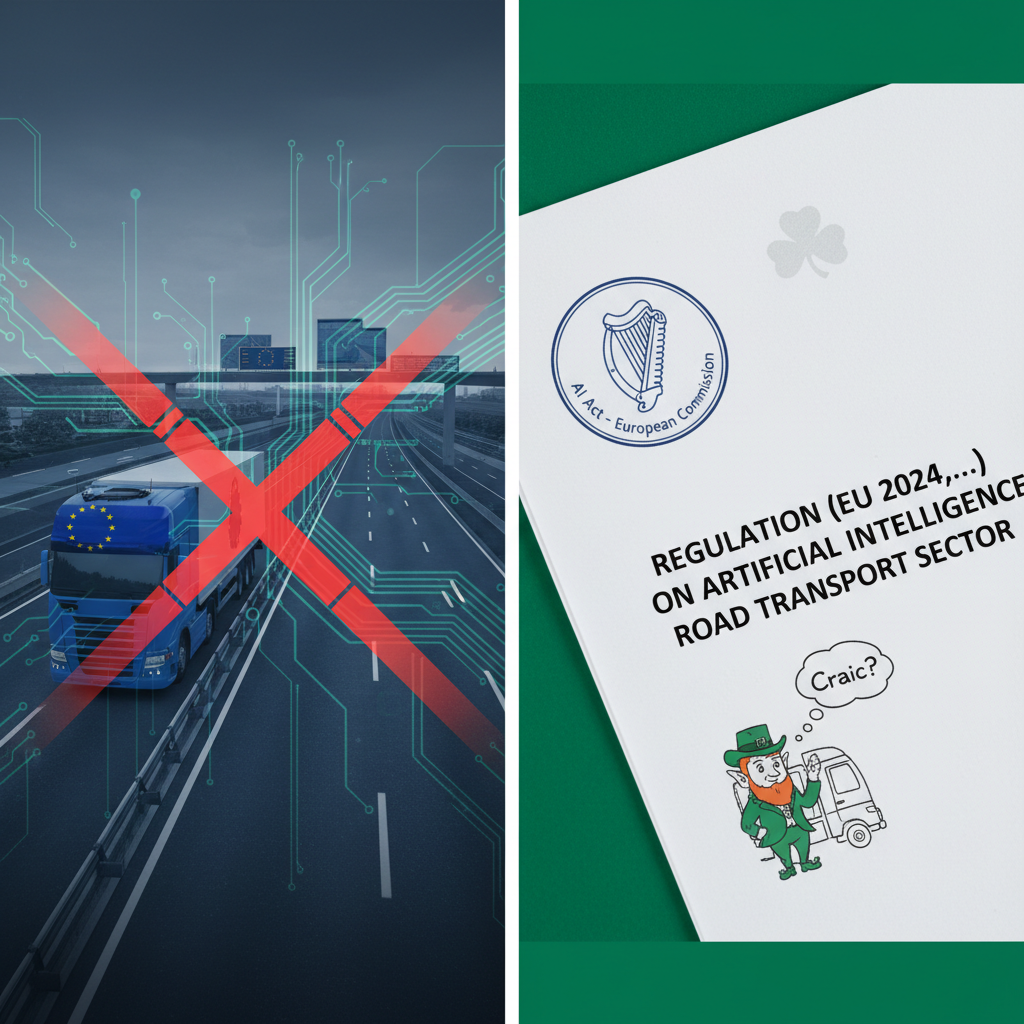

Well, isn't this just grand? Brussels, in its infinite wisdom, has decided to give the world a lesson in how to regulate artificial intelligence, and the ink is barely dry on the EU AI Act. Now, for us here in Ireland, nestled neatly on the edge of Europe and a crucial cog in the global logistics machine, this isn't just some abstract legal blather. This is about the very real prospect of self-driving trucks and autonomous delivery vans trundling down our motorways and through our towns, potentially reshaping an $800 billion logistics industry. And let me tell you, the craic is mighty in Irish AI discussions right now, especially when it comes to what this new rulebook means for the wheels on the road.
The policy move itself, the EU AI Act, is a landmark piece of legislation. It is the world's first comprehensive legal framework for artificial intelligence, categorizing AI systems by risk level, from minimal to unacceptable. High-risk systems, which include AI used in critical infrastructure like transport, face stringent requirements: mandatory human oversight, robust data governance, transparency, cybersecurity, and conformity assessments. This isn't just a suggestion, mind you, it is the law. The idea is to foster trust in AI while protecting fundamental rights, a noble goal if ever there was one. But as anyone who has ever tried to herd cats knows, good intentions and practical realities often part ways at the first sign of trouble.
So, who is behind this regulatory behemoth and why? Primarily, it is the European Commission, with the European Parliament and Council hammering out the details. Their motivation is clear: Europe wants to be a global leader in ethical and human-centric AI. They have watched the tech giants in Silicon Valley move fast and break things, and Europe, bless its heart, prefers to move cautiously and regulate everything. They are wary of the job displacement, algorithmic bias, and safety concerns that could arise from unchecked AI deployment. For autonomous vehicles, particularly heavy goods vehicles, the safety aspect is paramount. One wrong line of code, one sensor malfunction, and you have got a potential catastrophe on your hands. The Act aims to prevent that, ensuring that any AI system operating on European roads has been put through the wringer and certified as safe and trustworthy. It is a classic European approach: comprehensive, cautious, and sometimes, a tad slow.
What does this mean in practice for the likes of Tesla's Semi, Waymo's trucks, or any other autonomous delivery solution eyeing the European market? Well, it means a lot of paperwork, a lot of testing, and a lot of proving. Companies will need to demonstrate that their AI systems are not only technically sound but also comply with a myriad of requirements. This includes everything from ensuring the training data used for the AI is unbiased and high-quality, to having robust risk management systems in place, and providing clear instructions for human operators. For Ireland, with its strategic ports and position as a gateway to Europe, this could mean a bottleneck. Every autonomous vehicle, every drone delivery system, every automated warehouse robot will need to jump through these hoops. The Irish Road Safety Authority, for example, will likely have its work cut out for it, navigating these new complexities. As one senior official from the Department of Transport put it, "We welcome the focus on safety, but the implementation will require significant resources and collaboration across member states. It is not just about the tech, it is about harmonizing our approach to what is essentially a new species of road user." It is a fair point, because only in Ireland would you find us debating the legal status of a robot truck while stuck behind a tractor on a boreen.
Now, the industry reaction has been, shall we say, mixed. On one hand, companies like NVIDIA, which makes the powerful chips that fuel much of this AI, and logistics giants like Amazon, who are heavily invested in automation, appreciate the clarity that regulation can bring. A clear rulebook, even a strict one, is better than a patchwork of national laws. "Predictability is key for investment," stated a spokesperson for a major logistics firm operating out of Dublin. "We need to know the goalposts, even if they are a bit further apart than we'd like." However, there is also a palpable sense of frustration. The Act is seen by some as overly burdensome, potentially stifling innovation and delaying the deployment of technologies that promise greater efficiency and reduced costs. Startups, in particular, worry about the compliance costs. Developing cutting-edge AI is expensive enough, but adding layers of regulatory hurdles could make Europe a less attractive market. "The fear is that Europe will regulate itself out of the race," remarked a tech entrepreneur at a recent AI conference in Cork. "We need to innovate to compete, and this Act, while well-intentioned, could make that harder." Indeed, the concern is that while Europe is busy dotting every 'i' and crossing every 't', other regions will be zooming ahead with their autonomous fleets.
Civil society, on the other hand, is generally applauding the move. Consumer advocacy groups, trade unions, and privacy organizations have been vocal proponents of strong AI regulation. They see autonomous trucks not just as a marvel of engineering, but as a potential threat to jobs, privacy, and public safety. "The livelihoods of thousands of truck drivers across Europe are at stake," argued a representative from a European transport workers' union. "We need guarantees that this transition will be managed fairly, with retraining and support for those whose jobs are automated." Privacy advocates are also keenly aware of the vast amounts of data these vehicles will collect, from road conditions to pedestrian movements. The Act's emphasis on data governance and transparency is a welcome safeguard against potential misuse. Environmental groups also see a mixed bag, hoping that autonomous electric trucks could reduce emissions, but wary of the energy demands of AI infrastructure. It is a delicate balance, trying to embrace progress without leaving people or principles behind.
So, will it work? That, my friends, is the million-dollar question, or perhaps, the $800 billion question. The EU AI Act is undeniably ambitious. It sets a high bar for safety and ethics, which is commendable. For Ireland, it means that any autonomous vehicle operating here will have met some of the world's most stringent standards. This could be a selling point, a mark of quality that distinguishes European AI from its global counterparts. However, the proof will be in the pudding, as they say. The true test will be in the implementation: how effectively national authorities, like those in Ireland, can enforce these rules, how quickly the certification processes can be streamlined, and whether the regulations can adapt to the rapid pace of AI development. If it becomes too slow, too bureaucratic, or too expensive, then Europe risks falling behind. If it strikes the right balance, fostering innovation within a safe and ethical framework, then the EU AI Act could indeed become a global blueprint. But for now, as the autonomous trucks slowly make their way onto our roads, we will be watching, with a cup of tea in hand, to see if Brussels has truly paved the way for a smarter, safer future, or just created another layer of red tape. The journey, as always, promises to be an interesting one. For more on the evolving AI landscape, you can always check out TechCrunch's AI section or MIT Technology Review for deeper analysis of these complex issues.