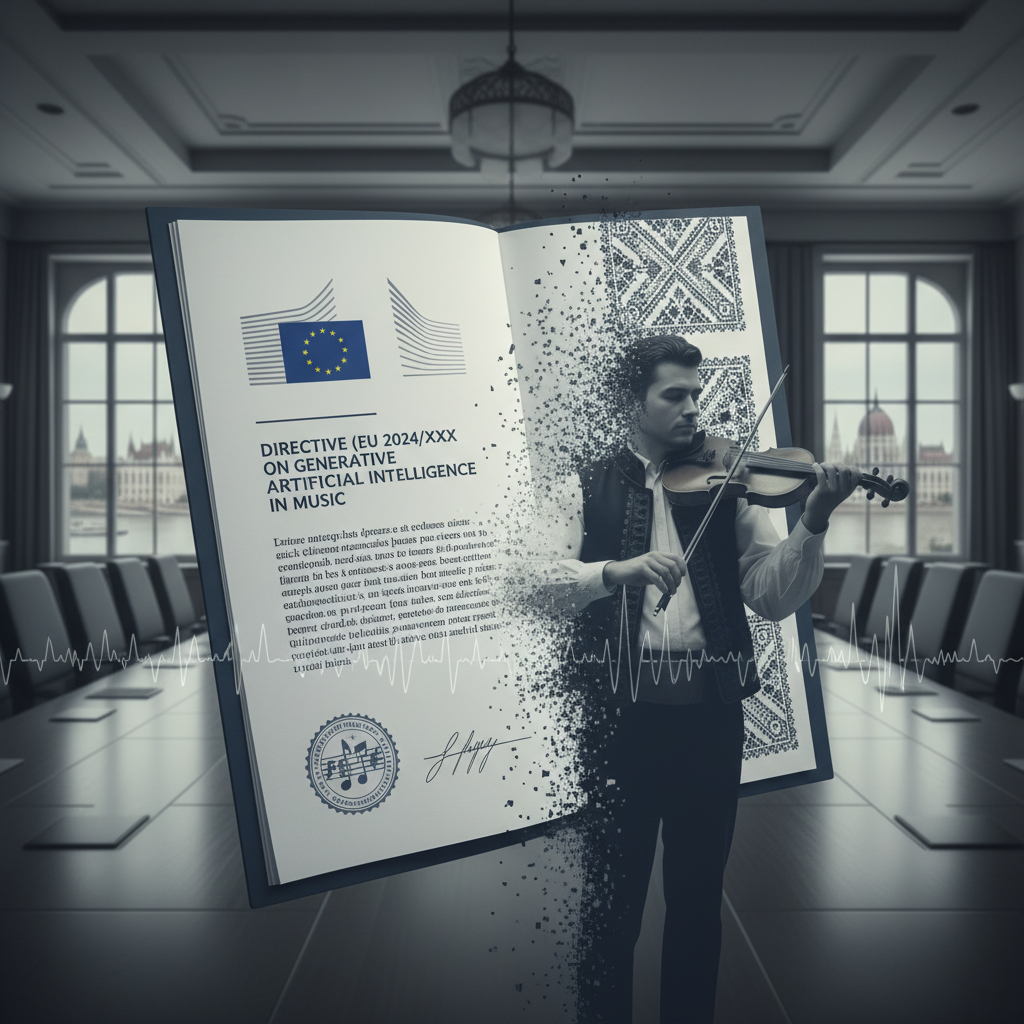

The air in Brussels, as always, is thick with good intentions and the faint scent of overregulation. This time, the target is not some obscure data privacy loophole, but the very soul of music itself. The European Parliament, in its infinite wisdom, has recently advanced a groundbreaking, some might say heavy-handed, legislative package aimed squarely at AI-generated music. This isn't just about copyright anymore; it's about existential dread in the recording studios, a fear that algorithms will soon out-sing and out-compose humanity. The proposed rules, largely an extension and refinement of the broader AI Act, seek to impose strict transparency requirements and liability frameworks on AI systems capable of generating musical works. They demand clear labeling of AI-created content, mandate detailed record-keeping of training data, and crucially, establish mechanisms for artists to claim fair compensation when their styles or works are used to train these new digital maestros. It's a bold move, a preemptive strike against a future where, some fear, the charts are dominated by synthetic pop stars and algorithmically perfect symphonies. The question, from my vantage point here in Budapest, is whether this grand European gesture will truly protect the human spirit of music, or simply create another bureaucratic labyrinth for artists and innovators alike.
Who is truly behind this regulatory push, and what fuels their fervor? Look no further than the established music industry giants, the major labels, and powerful artist collectives in Western Europe. They see the writing on the wall, or rather, the waveform on the screen. Universal Music Group, Sony Music Entertainment, and Warner Music Group, alongside organizations like the International Federation of the Phonographic Industry (ifpi), have been vocal proponents of stringent AI regulation. Their argument is simple: unchecked generative AI poses an immediate threat to intellectual property, artist livelihoods, and the very economic model of the music business. They point to instances where AI models, trained on vast datasets of existing music without explicit consent or compensation, can produce tracks eerily similar to popular artists. Imagine a new 'Hungarian Rhapsody' composed by an algorithm, indistinguishable from Liszt, yet owing nothing to his estate or the cultural legacy it draws from. This, they argue, is not innovation; it is digital theft at scale. Lawmakers, particularly those in France and Germany, have been particularly receptive, driven by a cultural protectionist impulse and a desire to assert European leadership in ethical AI development. They envision a 'European way' for AI, one that prioritizes human oversight and societal well-being over unbridled technological advancement. It's a noble sentiment, but one that often overlooks the practicalities, and the unique challenges, faced by smaller, less influential markets within the Union.
So, what does this actually mean in practice for the burgeoning field of AI music and for artists across the continent? For developers of generative AI music tools, it means a significant increase in compliance costs and legal scrutiny. They will need to meticulously document every piece of audio data used for training, obtain licenses where necessary, and implement robust watermarking or metadata systems to identify AI-generated content. This could stifle smaller startups, those without the legal departments and financial muscle of Google's DeepMind or OpenAI's music initiatives. For artists, the promise is greater protection. If their unique vocal style or compositional techniques are replicated by an AI, they would theoretically have legal recourse and a claim to royalties. But the devil, as always, is in the details. How do you prove an AI 'copied' a style rather than simply learned from a broad artistic tradition? How do you trace the lineage of a melody through layers of algorithmic transformation? These are questions that will undoubtedly bog down courts for years, creating a new gold rush for intellectual property lawyers. For consumers, it might mean a more transparent, albeit potentially less diverse, musical landscape, where the line between human and machine creativity is clearly drawn, perhaps to the detriment of truly experimental, hybrid forms.
The industry's reaction has been, predictably, bifurcated. The major labels and established artists, as mentioned, largely applaud the move. They see it as a necessary bulwark against an encroaching tide. “This legislation is crucial for preserving the value of human creativity,” stated Sir Lucian Grainge, Chairman and CEO of Universal Music Group, in a recent industry address. “Without clear rules, the digital wild west will consume the very artists who fuel our industry.” On the other hand, many independent artists, particularly those experimenting with AI as a creative tool, express deep reservations. They fear that the broad strokes of the law could inadvertently criminalize their innovative practices. A young Hungarian electronic musician, Eszter Kovács, who uses AI to generate novel soundscapes, told a local tech blog, “I'm not trying to steal; I'm trying to explore new frontiers. These rules could make it impossible for independent creators like me to even experiment, let alone publish.” AI music startups, many of them small and agile, are particularly concerned. They argue that the compliance burden will favor large tech companies who can afford the legal and technical overhead, effectively creating a regulatory moat that protects incumbents. This is the Hungarian perspective nobody wants to hear in Brussels, that regulations designed to protect can often crush the very innovation they claim to foster, especially in smaller, less capitalized markets. For us, innovation often means lean operations and rapid prototyping, not endless legal reviews.
Civil society groups, meanwhile, offer a mixed bag of opinions. Consumer protection advocates generally welcome the transparency requirements, arguing that listeners have a right to know if the music they consume was created by a human or a machine. Digital rights organizations, however, raise concerns about potential censorship and the chilling effect on artistic expression. They worry that overly broad definitions of 'AI-generated' could lead to human artists being unfairly flagged or restricted. Academics specializing in AI ethics also weigh in, emphasizing the need for nuanced approaches that balance protection with progress. Dr. Anna Szabó, a legal scholar at Eötvös Loránd University in Budapest, specializing in digital rights, cautioned, “While the intent is commendable, the practical implementation of these rules could become a quagmire. How do we define 'originality' in an age of algorithmic remixing? We risk stifling new art forms before they even have a chance to breathe, especially in cultures where folk music has always been about adaptation and reinterpretation.” She makes a valid point. Hungarian folk music, for example, thrives on variations and reinterpretations of traditional motifs. If an AI learns these motifs, is it stealing, or participating in a cultural evolution?
So, will it work? Will Brussels' latest regulatory salvo truly safeguard human artistry and prevent an existential crisis for the music industry? My answer, from the heart of Central Europe, is a resounding, yet qualified, no. The intent is admirable, the desire to protect human creativity from algorithmic encroachment is understandable. However, the legislation, in its current form, risks being both too broad and too narrow. It is too broad in its potential to stifle genuine innovation and create disproportionate burdens for smaller players, particularly those outside the Western European cultural hegemony. It is too narrow in its ability to truly address the fundamental shift that generative AI represents. The nature of creativity itself is being redefined. Algorithms are not just copying; they are learning, synthesizing, and creating novel works in ways that defy traditional copyright frameworks. Trying to fit this new paradigm into old legal boxes is like trying to catch mist in a sieve. Furthermore, enforcement across a continent with diverse legal traditions and varying technological capacities will be a nightmare. We've seen this with GDPR; the spirit is often lost in the labyrinthine application. Budapest has a message for Brussels: true protection for artists comes not just from regulation, but from fostering an ecosystem where human creativity is valued, compensated, and empowered to leverage new tools, not just fear them. The real challenge is not to ban AI music, but to integrate it ethically, to find new models of collaboration between human and machine. Contrarian? Maybe. Wrong? Prove it. The music industry's existential crisis won't be solved by simply drawing lines in the sand; it will be solved by building new bridges, and perhaps, by learning to dance with the algorithms, rather than trying to silence them. The future of sound, whether we like it or not, will be a duet between human ingenuity and artificial intelligence, and Europe needs to foster that harmony, not legislate it into dissonance. For more on the broader implications of AI policy, you might find this piece on AI judging contracts in Budapest [blocked] insightful. The regulatory challenges are universal, even if the specifics differ. The world watches as the EU attempts to legislate creativity, a task more complex than composing a perfect symphony. The true test will be whether this grand regulatory overture leads to a masterpiece, or merely a cacophony of unintended consequences. We need to be careful not to throw out the baby with the bathwater, especially when that baby might be the next great Hungarian composer, aided by a silicon muse. For further reading on the intersection of AI and culture, consider exploring articles on Wired's AI section, which often delves into these complex societal shifts.