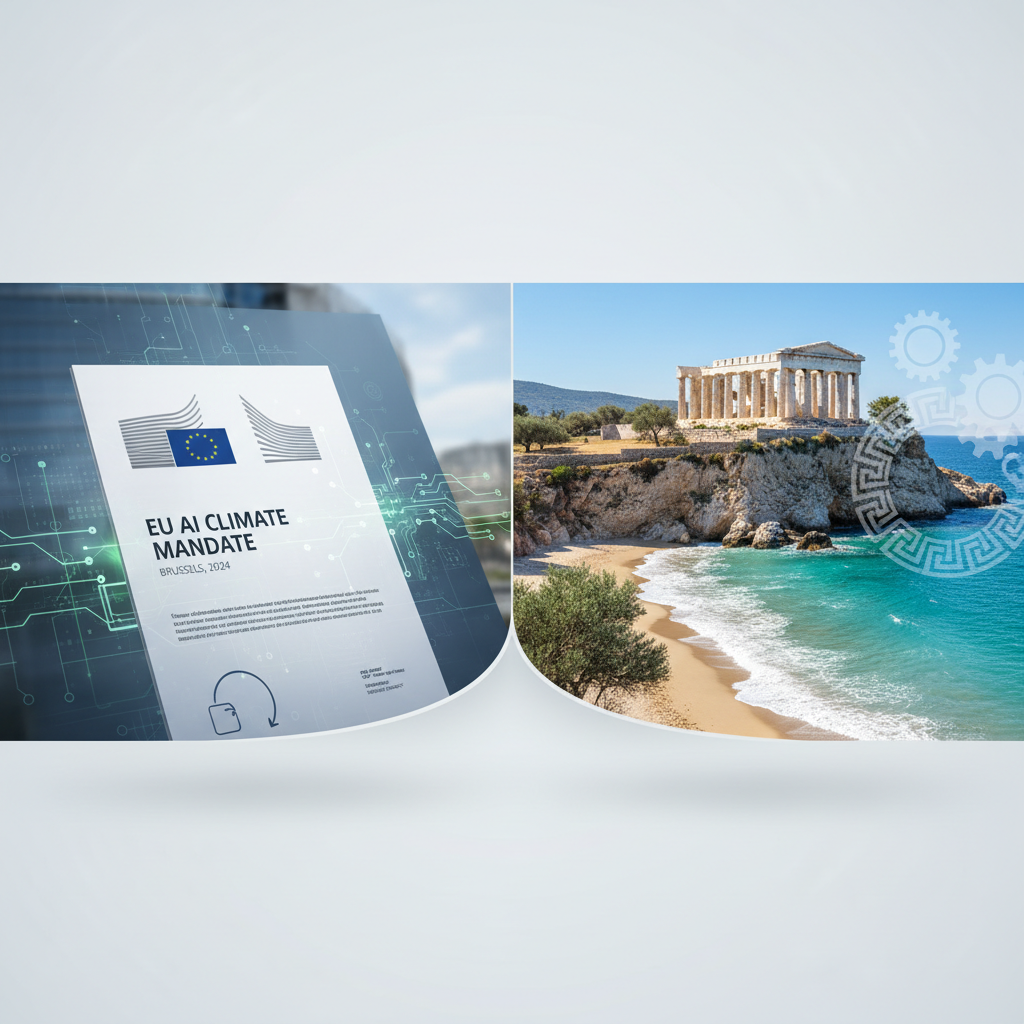

Ah, the eternal dance between grand pronouncements from afar and the gritty reality on the ground. This time, the stage is set for artificial intelligence, and the spotlight, rather uncomfortably, shines on our very own Mediterranean climate. Brussels, in its infinite wisdom, has just dropped a rather hefty package: a new regulatory framework specifically targeting AI applications in climate modeling. The goal, they say, is noble: to harness the immense power of AI to predict extreme weather events with unprecedented accuracy, thereby saving lives, livelihoods, and perhaps even a few ancient olive groves.
For us here in Greece, where the sun is usually a blessing but increasingly a harbinger of fire and flood, this isn't just academic. It's personal. We've seen the devastating wildfires sweep across Attica, the sudden, violent deluges in Thessaly, and the relentless heatwaves that turn our beautiful islands into furnaces. The promise of AI, of Google DeepMind's sophisticated algorithms or NVIDIA's powerful GPU clusters crunching terabytes of atmospheric data to give us a clearer picture of tomorrow's tempest, sounds like a modern-day oracle. But as any good Greek knows, even the oracles needed careful interpretation, and sometimes, their pronouncements were more trouble than they were worth.
This new policy, an extension of the broader EU AI Act, places AI systems used for climate modeling into the 'high-risk' category. This means stringent requirements for data quality, transparency, human oversight, robustness, and accuracy. The European Commission, particularly under the watchful eye of Commissioner Thierry Breton, has been pushing this agenda, arguing that the stakes are simply too high to leave these powerful predictive tools unregulated. Their rationale is clear: if an AI model predicts a mild summer when a catastrophic heatwave is brewing, the consequences are dire. Conversely, false alarms can lead to economic disruption and public distrust. It's about ensuring these digital seers are not just powerful, but also reliable and accountable.
What does this mean in practice for Greece, a nation disproportionately affected by climate change? Well, for starters, any Greek research institution, meteorological service, or private company developing or deploying AI for climate forecasting will now face a mountain of compliance. Imagine the Hellenic National Meteorological Service, already stretched thin, suddenly needing to audit their AI models for bias in satellite data or explain the probabilistic outputs of a complex neural network to a regulatory body in Brussels. It's not just about having the technology; it's about proving its trustworthiness. Data sets must be rigorously vetted, model outputs must be interpretable, and there must be clear human oversight mechanisms. This isn't just a software update; it's a paradigm shift in how we approach climate science, demanding a level of transparency that many AI models, by their very nature, struggle to provide.
Industry reaction, as you might expect, is a mixed bag. On one hand, companies like Google DeepMind, with their Project Isomorphic that aims to build digital twins of the Earth, welcome the push for responsible AI. "Accuracy and reliability are paramount when dealing with something as critical as climate prediction," stated Dr. Elara Vance, Head of AI Ethics at DeepMind, in a recent online forum. "We are committed to developing models that meet the highest standards of safety and transparency, and this EU framework provides a clear roadmap." You can find more on their work at DeepMind Google.
On the other hand, smaller startups and even some established players are grumbling about the potential for stifling innovation. "The compliance burden for a small team in Thessaloniki trying to build a localized wildfire prediction AI using open source models could be immense," lamented Dr. Kosta Petrou, CEO of Aegean Analytics, a Greek AI firm specializing in environmental data. "While we agree with the spirit of the regulation, the practical implementation could favor large corporations with dedicated legal and compliance departments, effectively creating barriers to entry for agile European innovators." He suggests that the EU needs to consider tiered approaches for smaller entities, otherwise, Greece to Silicon Valley: we invented logic, remember? We understand the need for rules, but they must be practical.
Civil society groups, particularly environmental organizations and those focused on disaster preparedness, are largely supportive, albeit with a healthy dose of skepticism. "For too long, we've been reacting to climate disasters, not proactively preparing," said Maria Antoniou, director of 'Mediterranean Resilience Now,' a Greek NGO. "If AI can genuinely give us a clearer picture of what's coming, allowing us to evacuate communities or deploy resources more effectively, then the regulatory effort is absolutely necessary. However, the devil is always in the details. We need assurances that these models are truly unbiased and that their predictions are accessible and understandable to local authorities and citizens, not just a select few experts." She emphasized the importance of local knowledge integrating with AI predictions, a blend of ancient wisdom and modern technology.
Will it work, then? Will this grand regulatory gesture from Brussels truly safeguard Greece and the wider EU from the increasing wrath of climate change, or will it simply add another layer of bureaucratic complexity to an already complex problem? The gods of Olympus would have loved this AI drama, I think. It has all the elements: human ambition, technological hubris, and the unpredictable forces of nature. The intention is certainly good. The need for accurate climate predictions, especially in vulnerable regions like ours, is undeniable. We cannot afford to be caught off guard by a sudden storm or a scorching heatwave. The economic impact alone of recent climate events in Greece has been staggering, estimated at over 1.5 billion euros in the last two years alone, according to the Ministry of Climate Crisis and Civil Protection.
However, the challenge lies in balancing rigorous oversight with the rapid pace of AI development. The 'high-risk' classification means that AI models for climate prediction will need to undergo conformity assessments, risk management systems, and post-market monitoring. This is a significant undertaking. There's a real danger that the regulatory machinery could become so cumbersome that it slows down the deployment of potentially life-saving technologies. We need to ensure that the regulatory framework is agile enough to adapt as AI capabilities evolve, and that it doesn't become a straitjacket for innovation.
Furthermore, the success of these AI models depends heavily on the quality and quantity of data available. While Europe has excellent meteorological data, integrating it seamlessly with AI systems, and ensuring its ethical use, is no small feat. There's also the question of infrastructure. Does every member state have the computing power, the skilled personnel, and the digital literacy to fully leverage these sophisticated AI tools and comply with the regulations? Here in Greece, we are making strides, but there's still a gap to bridge. The European Centre for Medium-Range Weather Forecasts, a key player in this field, already uses advanced models, but the integration of new, high-risk AI systems will require significant investment and training across the continent.
Ultimately, the success of Brussels' new AI climate mandate will hinge on its ability to be both robust and flexible. It needs to protect us from the potential harms of flawed AI, while simultaneously fostering the innovation that could genuinely offer solutions. It's a delicate balance, like walking a tightrope over the Aegean Sea. We Greeks are a pragmatic people. We will embrace the tools that work, but we will also question the decrees that seem to miss the mark. Pass the ouzo, this tech news requires it, because the future of our climate, and the AI that tries to predict it, is anything but clear. For more insights into AI policy, you might find this article on AI ethics relevant.