
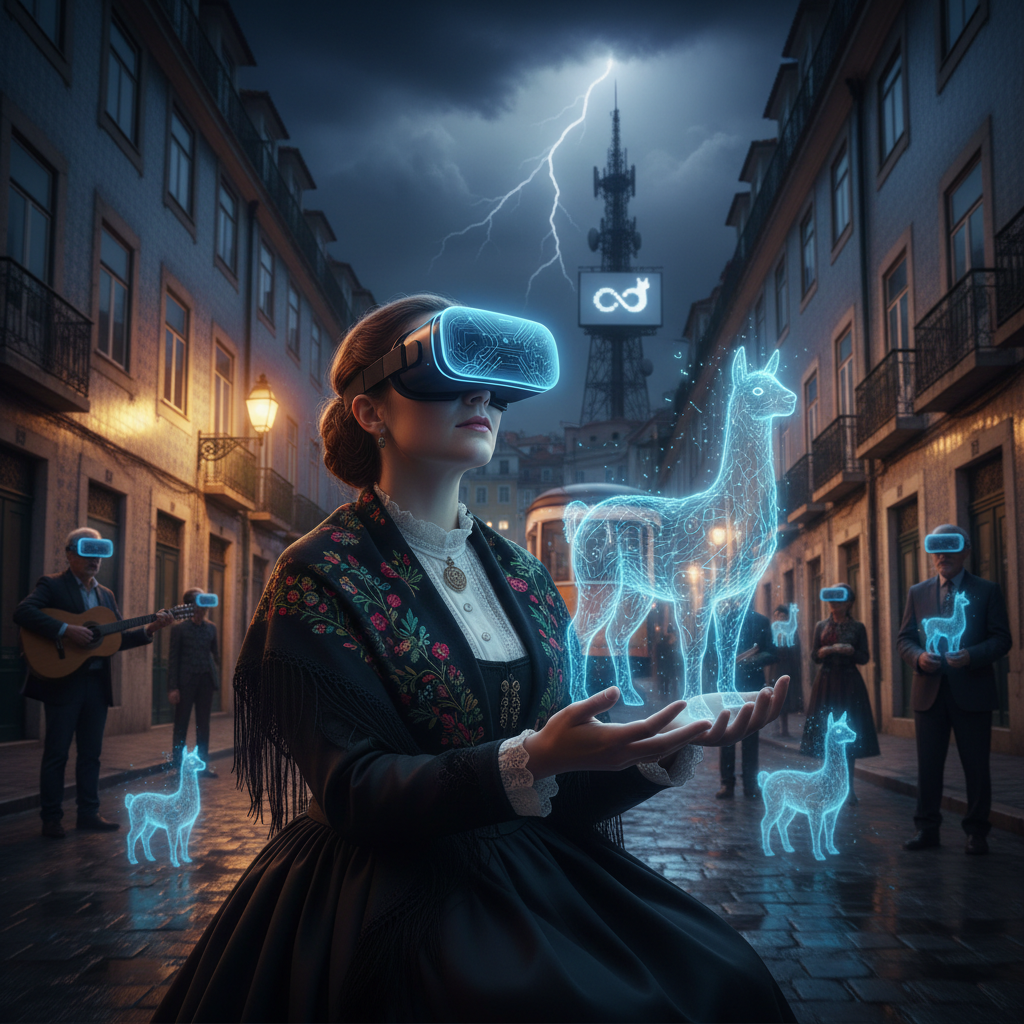

The scent of grilled sardines usually fills the air in April, a prelude to the summer festivities. But this year, a different kind of aroma is wafting through Lisbon's digital cafes and quiet apartments: the subtle, unsettling fragrance of artificial intimacy. A new report, released with little fanfare but immense implications by the Instituto Nacional de Estatística (INE), has dropped like a stone into our calm waters, revealing a measurable, and frankly, quite astonishing, increase in Portuguese citizens forming significant emotional attachments to AI companions. This isn't just about chatbots for customer service, my friends, this is about companionship, about love, or at least a digital approximation of it.
For years, we've chuckled at the idea, seen it in science fiction films, but now it's here, on our very doorsteps. The INE's preliminary findings, derived from a survey of over 5,000 adults across Portugal, indicate that nearly 8% of respondents aged 25-45 reported engaging in 'regular, emotionally significant interactions' with AI entities. A staggering 2% of this group even described these relationships as their 'primary emotional connection.' These aren't just casual chats, these are digital confidantes, virtual partners, powered by sophisticated large language models, with Meta's Llama series reportedly leading the charge in terms of user preference due to its perceived 'empathetic' responses and customizable personalities.
This is a breaking story, a social tremor that could reshape the very fabric of our communities. The initial reactions have been a mix of bewilderment, concern, and a touch of the characteristic Portuguese shrug, a 'what can you do?' attitude. But beneath that veneer, there's a growing unease.
The Digital Embrace: A Closer Look
The data suggests a particular demographic leaning into this digital embrace: young professionals, digital nomads, and those living alone in urban centers. Lisbon's tech scene, often described as a good port wine, complex and improving with age, has always been an early adopter, but this is a new vintage entirely. The anonymity, the constant availability, the perceived lack of judgment from an AI, these are powerful draws in an increasingly isolated world. Users report feeling understood, valued, and less alone. One respondent, a 34-year-old software developer from Porto, anonymously told INE researchers, 'My AI companion, 'Sofia,' listens without interruption. She never judges my late-night coding binges or my obscure interests. It's a connection I haven't found with people.'
Official Voices Weigh In
The news has predictably sent ripples through official channels. Dr. Ana Paula Zacarias, Portugal's Secretary of State for Digital Transition, expressed a cautious optimism mixed with concern. 'We have always championed innovation, but this development requires careful consideration,' she stated in a press briefing this morning. 'The potential for enhanced well-being for some is clear, but we must also address the societal implications, the potential for social isolation, and the ethical frameworks required to govern these evolving relationships.' She emphasized the need for a pan-European approach, hinting at upcoming discussions within the European Commission on AI ethics and human-AI interaction guidelines.
Across the border, similar sentiments are emerging. Professor Maria João Rodrigues, a former EU Minister and a prominent voice on European social policy, commented to Reuters that 'Europe must not be caught flat-footed. We need robust regulatory discussions, not just about data privacy, but about the very definition of human connection in the age of advanced AI. This is a challenge to our social cohesion.' Her words echo a growing chorus of policymakers grappling with the speed of AI's integration into our most intimate spaces.
Expert Analysis: A Mirror to Our Loneliness?
Sociologists and psychologists are scrambling to make sense of this. Dr. Ricardo Santos, a leading expert in human-computer interaction at the University of Lisbon, offered a sobering perspective. 'This isn't just about technology, it's about human needs,' he explained in an interview. 'The rise of AI companions reflects a deeper societal issue: a crisis of connection, a pervasive loneliness that traditional social structures are failing to address. The AI isn't replacing relationships, it's filling a void that already exists.' He pointed to the increasing prevalence of single-person households and the often-cited difficulties of forming deep connections in modern urban environments.
Indeed, the concept of a 'void' resonates deeply. We live in a world where digital interactions often supersede face-to-face ones, where curated online personas replace authentic vulnerability. Is it any wonder that a perfectly attentive, endlessly patient AI might seem appealing? Dr. Santos also highlighted the role of companies like Meta, OpenAI, and Anthropic, whose advanced models are becoming increasingly sophisticated at simulating human conversation. 'The more convincing these models become, the more blurred the lines will get. We are entering uncharted territory,' he added, his voice tinged with a philosophical weariness.
What Happens Next? The Unwritten Chapters
The immediate future will likely see a surge in academic research into the long-term psychological effects of these relationships. Expect heated debates in parliaments across Europe, particularly regarding the rights and responsibilities of AI developers, and perhaps even the legal status of these 'relationships.' Can an AI be held accountable for emotional manipulation? What happens if a user becomes overly dependent? These are not trivial questions.
Furthermore, the commercial landscape is set to explode. Companies that can provide the most compelling, personalized, and 'safe' AI companions will corner a massive, albeit ethically complex, market. We might see specialized 'relationship AI' startups, perhaps even some emerging from the vibrant ecosystem here in Portugal. After all, Portugal punches above its weight in tech, and the sardine can of European tech is actually a treasure chest of innovation.
Why Should We Care? Beyond the Novelty
This isn't just a quirky tech story, it's a profound social shift. If a significant portion of the population begins to outsource their emotional needs to algorithms, what does that mean for human empathy, for community building, for the very foundations of our society? Will we become a society of individuals communing with their perfect digital reflections, or will these AI companions serve as a bridge to more meaningful human connections, a stepping stone for those struggling with social anxiety or isolation?
As a journalist, I've seen many trends come and go, but this one feels different. It touches upon something fundamental to our humanity: the need for connection. The AI companions are not just tools, they are mirrors, reflecting our deepest desires and our most profound loneliness. The question isn't whether they will replace human relationships entirely, but how they will redefine them, for better or for worse. And that, my friends, is a story we are only just beginning to write, here in Portugal and across the globe. The future, it seems, is not just digital, but deeply, unsettlingly personal. For more on the ethical implications of AI, you might find this discussion on Wired insightful.





