The global conversation surrounding artificial intelligence in education often oscillates between two extremes: a looming cheating crisis or a transformative educational revolution. From my vantage point in La Paz, observing the realities of our educational system, this binary seems overly simplistic, a luxury of perspectives detached from the ground. For Bolivia, a nation grappling with its own unique set of infrastructural and pedagogical challenges, the advent of AI chatbots like OpenAI's ChatGPT and Google's Gemini presents not just a dilemma but a profound opportunity, provided we approach it with pragmatism and a clear understanding of our local context.
Globally, the initial panic over students using AI to generate essays has begun to subside, replaced by a more nuanced discussion. Major educational institutions, once quick to ban, are now exploring integration. A recent report from Unesco, for instance, highlighted that while 80% of surveyed teachers expressed concerns about academic dishonesty, nearly 60% also saw potential for AI to personalize learning and reduce administrative burdens. This shift reflects a growing realization that these tools are here to stay, and outright prohibition is rarely an effective long-term strategy for technological advancement.
In Bolivia, the discussion takes on additional layers. Our educational landscape is diverse, ranging from urban centers with nascent digital infrastructure to remote Andean communities where electricity and internet access remain intermittent luxuries. The idea of every student having seamless access to a sophisticated AI chatbot, as implicitly assumed in many Western discussions, is simply not our reality. According to data from the Bolivian Agency for Electronic Government and Information and Communication Technologies, as of late 2024, only about 65% of the population had internet access, with significant disparities between urban and rural areas. This fundamental gap means that any 'educational revolution' driven by AI must first confront the digital divide.
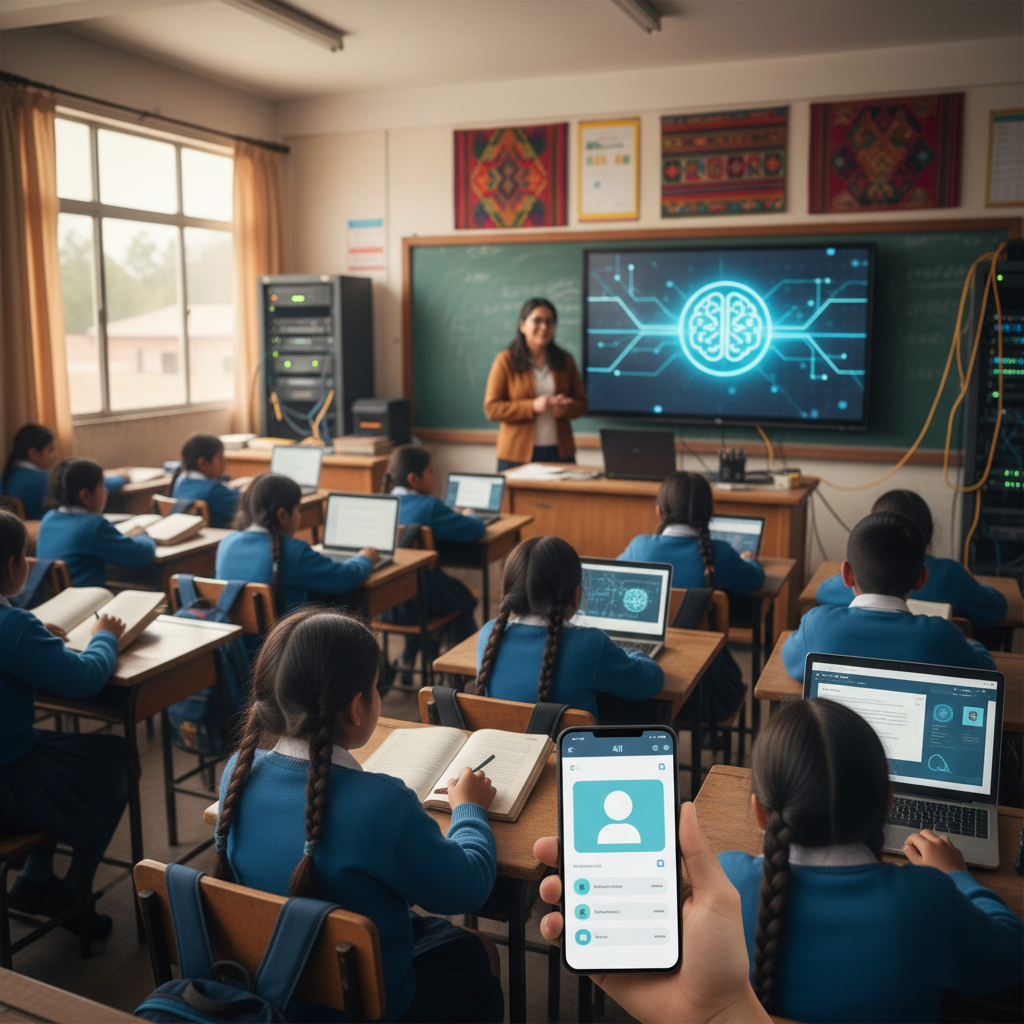
Consider the practical application. In a classroom in El Alto, where resources are often stretched thin, a teacher might oversee 40 or 50 students. The introduction of an AI assistant could, in theory, offer individualized tutoring, language support for indigenous students, or help in understanding complex scientific concepts. However, this presupposes devices, reliable connectivity, and teachers trained not just in using the AI, but in integrating it pedagogically. "The challenge is not the AI itself, but the ecosystem around it," stated Dr. Ana María Flores, a prominent educational technologist at the Universidad Mayor de San Andrés, during a recent symposium. "We must ensure that these tools do not exacerbate existing inequalities, but rather help to diminish them." Her point resonates deeply; Bolivia's challenges require Bolivian solutions.
The narrative of a 'cheating crisis' also needs re-evaluation through our lens. While academic integrity is universally important, the primary goal of education in many Bolivian communities is fundamental literacy, critical thinking, and practical skills that can lead to tangible improvements in livelihoods. If an AI can help a student in a rural school grasp a concept more quickly, enabling them to progress, is that not a net positive, even if the method deviates from traditional rote learning? The focus shifts from preventing cheating to fostering understanding and skill development.
Companies like Google and Microsoft are actively investing in educational AI tools. Google's suite of educational products, including Workspace for Education, is increasingly integrating AI functionalities to assist teachers with lesson planning and provide students with research aids. Microsoft's Copilot, embedded within its productivity apps, offers similar capabilities. These tools, while powerful, are largely designed for environments with robust digital infrastructure and a certain level of digital literacy. Adapting them for contexts where a single computer might serve an entire classroom, or where internet speeds are measured in kilobytes, requires significant local innovation and adaptation.
Furthermore, the ethical considerations extend beyond plagiarism. The data privacy of students, particularly minors, is a significant concern. Who owns the data generated by student interactions with AI? How is it stored, and who has access? These are not trivial questions, especially in a region where data governance frameworks are still evolving. The Ministry of Education, in collaboration with local tech experts, must develop clear guidelines that protect our students while allowing for responsible experimentation with these new technologies. "We cannot simply import solutions; we must build our own frameworks that reflect our values and legal realities," emphasized Ricardo Mamani, a cyber-security analyst working with the Bolivian government.
Some promising initiatives are emerging. Local startups, often working with limited budgets but immense ingenuity, are exploring offline AI models or simplified interfaces designed for low-bandwidth environments. These efforts, though small scale, demonstrate that let's talk about what actually works at 4,000 meters. They are not waiting for Silicon Valley to solve our problems but are actively engineering solutions tailored to our unique constraints. This is where the true 'educational revolution' might begin for us: not in a wholesale adoption of foreign models, but in a localized, iterative process of adaptation and innovation.
The role of educators cannot be overstated. Teachers, often underpaid and overburdened, are at the forefront of this technological shift. Providing them with adequate training, resources, and a supportive environment to experiment with AI tools is crucial. This means more than just a brief workshop; it requires ongoing professional development that empowers them to critically evaluate AI, understand its limitations, and integrate it effectively into their pedagogy. The National Institute for Educational Innovation, for example, has begun pilot programs in Cochabamba and Santa Cruz, training teachers on the responsible use of generative AI in classroom settings, focusing on critical evaluation and ethical considerations rather than mere technical proficiency.
The conversation around AI chatbots in schools is indeed a complex one, touching upon ethics, equity, access, and pedagogy. For Bolivia, it is less about a 'cheating crisis' and more about a 'development opportunity' that must be seized with caution and strategic intent. The altitude of innovation here demands a different kind of foresight, one that prioritizes inclusivity and addresses foundational challenges before chasing the latest technological trend. If we can harness these tools to empower our teachers and students, bridging the gaps that have long hindered our progress, then perhaps, what began as a global panic can indeed become a local revolution. The path is not easy, but the potential rewards for our nation's future are immense. For more insights into the broader impact of AI in education, one might consult resources like The Verge's AI section. The journey will be long, but it is one we must undertake with open eyes and a pragmatic spirit. We have seen enough hype to know what is real, and what truly works for our people.