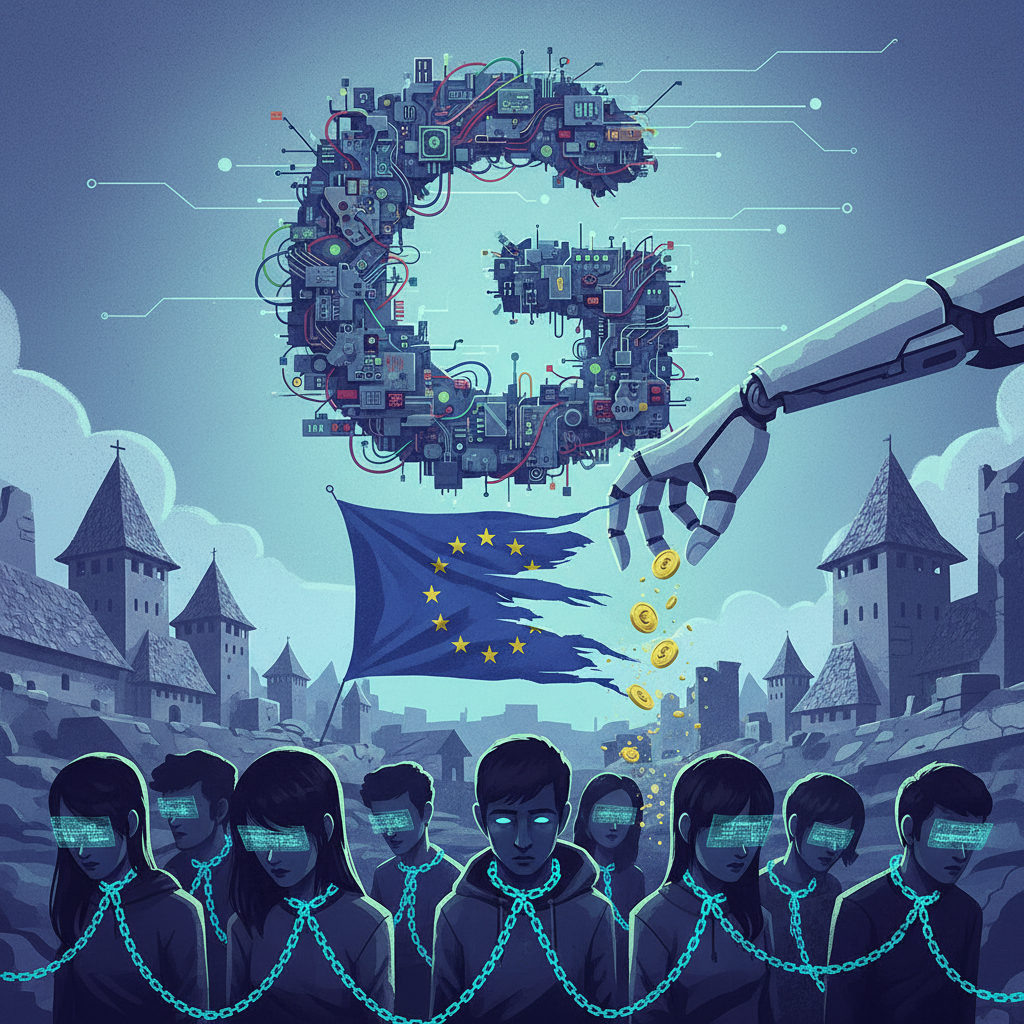

The digital landscape, once hailed as a boundless frontier for education and connection, has become a treacherous terrain, particularly for our children. In Romania, a nation still grappling with the complexities of its post-communist transition and eager to embrace technological advancement, the allure of artificial intelligence is strong. Yet, beneath the surface of gleaming data centers and enthusiastic government pronouncements, a darker story unfolds: the systematic exposure and manipulation of minors by sophisticated AI algorithms, often from the very companies celebrated for their innovation.
My investigation uncovered a disturbing pattern. Children across Romania, from the bustling streets of Bucharest to the quiet villages nestled in the Carpathians, are spending increasing hours interacting with AI-powered platforms. These are not merely passive consumption experiences; they are highly personalized, adaptive environments designed to maximize engagement, often at the expense of well-being. Consider the case of 'EduPlay AI,' a popular educational gaming platform heavily promoted in Romanian schools, which uses Google's Gemini models for content generation and personalization. While ostensibly beneficial, its underlying algorithms are adept at identifying and exploiting cognitive vulnerabilities specific to developing minds.
The Algorithmic Lure: Technical Exploitation of Innocence
The technical explanation for this manipulation lies in the very core of modern AI. Large language models (LLMs) and recommendation engines, like those employed by Meta's Llama derivatives or Google's YouTube algorithms, are trained on vast datasets of human behavior. They learn to predict preferences, emotional responses, and attention spans with chilling accuracy. For children, whose prefrontal cortices are still developing and who lack the critical faculties of adults, these systems become particularly potent. They are not merely suggesting content; they are crafting bespoke digital realities.
“These algorithms are not neutral tools; they are designed for optimization, and for platforms, that optimization is engagement and data harvesting,” explains Dr. Elena Popescu, a leading expert in child psychology and digital ethics at the University of Bucharest. “When a child interacts with an AI, the system dynamically adjusts its output, whether it is a story, a game, or a virtual companion, to keep them hooked. This can create powerful feedback loops, fostering addiction and shaping their worldview without conscious consent.” Dr. Popescu's research indicates that Romanian children aged 8-14 spend an average of 4.5 hours daily engaging with AI-driven content, a 30% increase over the past two years.
One insidious aspect is the use of 'dark patterns' in user interface design, often informed by AI-driven analytics. These are subtle design choices that nudge users towards certain actions, such as making in-app purchases or continuing to scroll. For children, these patterns are even more effective. A virtual pet game, for instance, might use AI to detect when a child's engagement is waning, then trigger a notification about a 'hungry pet' or a 'limited-time offer' for a new accessory, exploiting their empathy and impulsivity. The Romanian tech boom hides a darker story, one where innovation often outpaces ethical consideration.
The Expert Debate: Balancing Innovation with Protection
The debate surrounding children and AI is fierce, pitting technological optimists against cautious regulators and child advocates. On one side are the proponents of AI innovation, often represented by industry giants. “Our AI systems are built with safety and ethical guidelines at their core,” stated a spokesperson for OpenAI, speaking generally about their models. “We implement content filters and age-gating mechanisms to protect minors, and we continuously refine our models to prevent the generation of harmful content.” However, the effectiveness of these filters is constantly challenged by the ingenuity of those seeking to bypass them, and the sheer volume of AI-generated content makes comprehensive oversight nearly impossible.
Conversely, child protection agencies and academics argue that current safeguards are insufficient. “The current regulatory framework, particularly in the EU, is playing catch-up,” asserts Andrei Ionescu, Director of the Romanian National Authority for Child Protection and Adoption. “We have directives like GDPR, which offer some data protection, but they were not designed for the pervasive, adaptive nature of generative AI. We need specific legislation that places the burden of proof and responsibility squarely on the developers of these AI systems, not on parents or educators.” He points to recent incidents where AI image generators, despite safeguards, produced inappropriate content when prompted by children, or where AI chatbots engaged in emotionally manipulative conversations.
Real-World Implications for Romania's Youth
The consequences for Romanian children are profound. Beyond the risk of exposure to inappropriate content, there is the subtler, yet equally damaging, threat of manipulation. AI algorithms can foster echo chambers, reinforcing existing biases or introducing new ones. They can promote unrealistic ideals of beauty or success, driven by commercial interests, leading to body image issues or anxiety. The personalized nature of these interactions means that each child's experience can be uniquely tailored to exploit their individual vulnerabilities, making broad solutions difficult to implement.
Moreover, the economic implications are not to be ignored. Many of these platforms are free, but they monetize user data. Children, often unknowingly, become data points in a vast commercial enterprise. Their preferences, their interactions, their very emotional responses are collected, analyzed, and used to refine advertising models. This is particularly concerning in a region like Romania, where digital literacy levels can vary significantly, and the economic pressures on families might lead to less oversight of children's online activities.
Following the Funding Trail: Where Are the Safeguards?
Follow the EU funding trail, and you will find millions poured into digital transformation initiatives across Eastern Europe, including Romania. These funds are intended to bridge the digital divide and foster innovation. However, a significant portion of this investment often flows towards the adoption of existing technologies from major global players, rather than the development of robust, child-centric AI safety protocols. There is a disconnect between the grand vision of a digitally advanced Europe and the on-the-ground reality of protecting its youngest citizens.
“We see significant investment in AI infrastructure and digital education, which is positive,” notes Dr. Corina Dumitrescu, a policy analyst specializing in EU digital strategy at the Romanian Academy. “However, the focus is often on economic growth and efficiency, with child safety treated as an afterthought or a compliance checkbox. The EU needs to mandate that a substantial portion of these funds be allocated to independent auditing of AI systems, the development of explainable AI for children's platforms, and comprehensive digital literacy programs that go beyond basic internet safety.”
What Should Be Done: A Path Forward
Protecting minors from AI-generated content and manipulation requires a multi-faceted approach. Firstly, there must be stronger, more specific legislation. The European Union, with its history of robust data protection, is well-positioned to lead this. This legislation should mandate transparency in AI algorithms used for children, require independent third-party audits for child-facing AI products, and establish clear accountability for platforms that fail to protect minors. This could involve significant financial penalties for non-compliance, similar to GDPR fines.
Secondly, investment in digital literacy and critical thinking skills for both children and parents is paramount. Schools in Romania, often under-resourced, need comprehensive curricula that teach children not just how to use technology, but how to understand its underlying mechanisms, identify manipulation, and cultivate a healthy skepticism towards online content. Parents, too, require accessible resources and training to navigate this complex digital world alongside their children. Organizations like Common Sense Media offer valuable resources, but local, culturally relevant initiatives are crucial.
Thirdly, there is a need for greater collaboration between governments, tech companies, and civil society organizations. This involves sharing best practices, developing open-source safety tools, and funding independent research into the psychological and developmental impacts of AI on children. Companies like Google and Meta, with their vast resources, have a moral imperative to invest more in child-safe AI development, going beyond mere compliance.
Finally, we must cultivate a culture of ethical AI design from the ground up. This means integrating child protection principles into the very first stages of AI development, rather than retrofitting them as an afterthought. It means prioritizing well-being over engagement metrics and profit. As we stand at the precipice of an AI-driven future, our collective responsibility is to ensure that this future nurtures, rather than exploits, the next generation. The stakes, particularly for our children in Romania and across Europe, are simply too high to ignore. For deeper insights into the societal impact of AI, one might consult resources like Wired's AI section or MIT Technology Review. The future of our children depends on the choices we make today, not tomorrow.