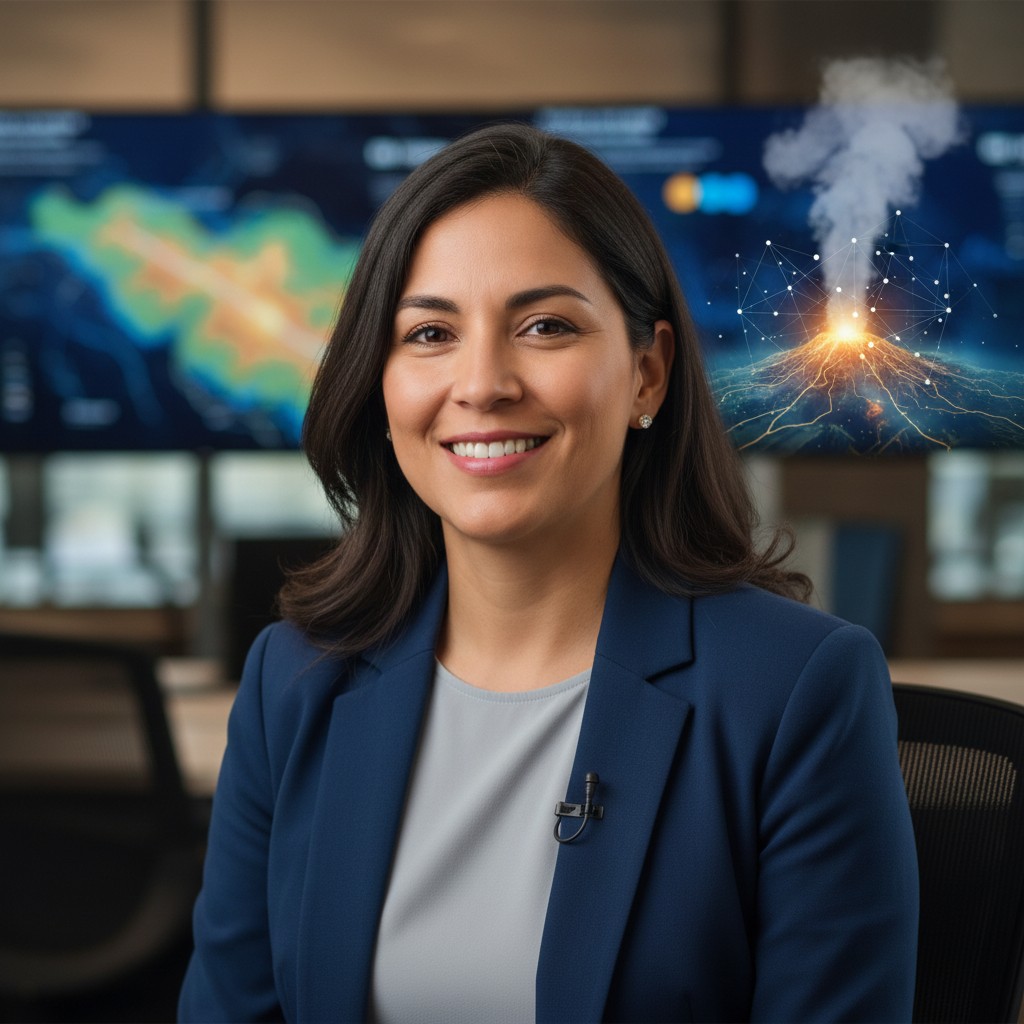
The air in San José, even in April, carries a certain humidity, a reminder of the lush green that defines our small nation. I found Dr. Elena Rojas not in a sterile lab, but in a bustling café near the University of Costa Rica, her laptop open, displaying complex geological maps overlaid with vibrant data points. She wore a simple, practical blouse, her dark hair pulled back, and her eyes, though tired, held a spark of intense focus. Dr. Rojas is not your typical tech CEO; she is a geophysicist by training, a woman who understands the earth from the inside out, and now, she is using artificial intelligence to redefine how we interact with it.
“For too long, our approach to natural resources has been about brute force, about digging and hoping,” she began, taking a sip of her strong Costa Rican coffee. “But the earth, Carlòs, it speaks to us. We just need better ears to listen.” Her company, GeoInteligencia CR, is building those ears. They are deploying AI, specifically leveraging Google’s advanced geospatial AI models, to analyze seismic data, satellite imagery, and soil composition readings to identify potential geothermal reservoirs with unprecedented accuracy. This is not about mining for gold or copper, which Costa Rica largely avoids due to environmental concerns, but about harnessing the clean, renewable energy beneath our feet.
Geothermal energy is a sleeping giant in Costa Rica, a nation blessed with volcanic activity. The traditional exploration methods are costly, time-consuming, and often involve extensive drilling that can disturb delicate ecosystems. Dr. Rojas explained that GeoInteligencia CR’s AI models, trained on decades of geological data from Central America and beyond, can predict the likelihood of viable geothermal sites with over 85% accuracy before a single drill touches the ground. This is a significant leap from the 50-60% success rate of conventional methods, a statistic she cited from a recent report by the International Renewable Energy Agency.
“We are not just looking for heat, but for the precise geological structures that can sustain a geothermal plant for decades,” Dr. Rojas emphasized. “Our AI analyzes patterns in microseismic activity, thermal anomalies from satellite data, and even subtle changes in vegetation that indicate subsurface heat. It’s like giving our geologists X-ray vision.” She showed me a simulation on her screen, a vibrant 3D model of a volcanic region near Miravalles, where the AI had highlighted several promising zones. The precision was astonishing, a stark contrast to the generalized maps I was used to seeing.
Her journey into AI began not in a coding bootcamp, but out of frustration. “I saw too many promising geothermal projects stalled because of prohibitive exploration costs or environmental impact assessments that dragged on for years,” she recounted. “I thought, there has to be a smarter way.” She taught herself Python, devoured papers on machine learning, and eventually connected with a team of data scientists from the University of Costa Rica. “It was a classic case of a domain expert seeing the potential of a new tool,” she said with a wry smile. “Costa Rica proves you don't need Silicon Valley to drive this kind of innovation; you just need a clear problem and the will to solve it.”
One of the key revelations from our conversation was the focus on safety and environmental stewardship. Unlike traditional mining, which often carries a heavy ecological footprint, geothermal exploration with AI aims to minimize disruption. “Our models help us avoid critical biodiversity areas and reduce the need for extensive road building,” Dr. Rojas explained. “We can pinpoint the optimal drilling locations, reducing the number of wells needed and thus minimizing our physical footprint. This is the pura vida approach to AI, where technology serves our planet, not exploits it.” She mentioned that their algorithms even incorporate data on local flora and fauna distribution, allowing for predictive environmental impact assessments before fieldwork even begins.
I asked her about the challenges. “Data,” she replied without hesitation. “Good, clean, labeled geological data is like gold itself. We’ve spent years digitizing old geological surveys, seismic records, and even historical weather patterns. It is painstaking work, but it is the foundation for everything.” She acknowledged the immense computational power required, noting their reliance on cloud-based AI platforms like Google Cloud’s Vertex AI for model training and deployment. “We don’t have NVIDIA’s supercomputers here, but we can access them virtually, and that levels the playing field.”
Dr. Ricardo Vargas, head of the Geosciences Department at the National University, echoed Rojas’s sentiments in a separate conversation. “What Elena and her team are doing is transformative,” he told me over the phone. “They are not just finding energy; they are setting a new standard for responsible resource exploration globally. Their predictive models have already reduced exploratory drilling costs by an estimated 30% in pilot projects, a figure that is hard to ignore.”
Another surprising moment came when she spoke about community engagement. “Technology is not just about algorithms; it’s about people,” she asserted. “We work closely with local communities, presenting our AI-generated maps and explaining the process. Transparency builds trust, and trust is essential when you are talking about developing land.” GeoInteligencia CR employs local community members for ground truth verification and data collection, ensuring that the benefits of this technological leap are shared broadly. “It’s practical innovation in paradise, where technology empowers local knowledge.”
Her vision for the future extends beyond geothermal. “Imagine applying this same AI-driven exploration to sustainable agriculture, identifying optimal zones for specific crops based on microclimates and soil health, or even predicting water table fluctuations to manage our precious water resources more effectively,” she mused. She believes that AI can be a powerful tool for conservation, not just extraction. “We are already exploring partnerships with local conservation groups to use similar AI models for biodiversity monitoring and illegal deforestation detection,” she added, citing recent advances in satellite imagery analysis powered by Meta’s open-source AI models, which could be adapted for these purposes. For more on how AI is changing resource management, one can look at TechCrunch’s AI section.
As our conversation wound down, the café began to fill with students. Dr. Rojas packed her laptop, a quiet determination in her movements. She is a testament to the fact that groundbreaking innovation does not always come from the loudest voices or the biggest budgets. Sometimes, it comes from a quiet determination to solve a real-world problem, driven by a deep understanding of one’s environment and a commitment to a sustainable future. Her work reminds us that AI, when applied with wisdom and a clear purpose, can truly be a force for good, especially in a nation like Costa Rica, which has long championed environmental protection. It is a future where technology and nature can coexist, guided by intelligence and respect for the earth. I believe her work is a prime example of how Central America can lead in green tech and AI, showing the world a different path. For more on sustainable tech, consider reading this article on climate tech [blocked].