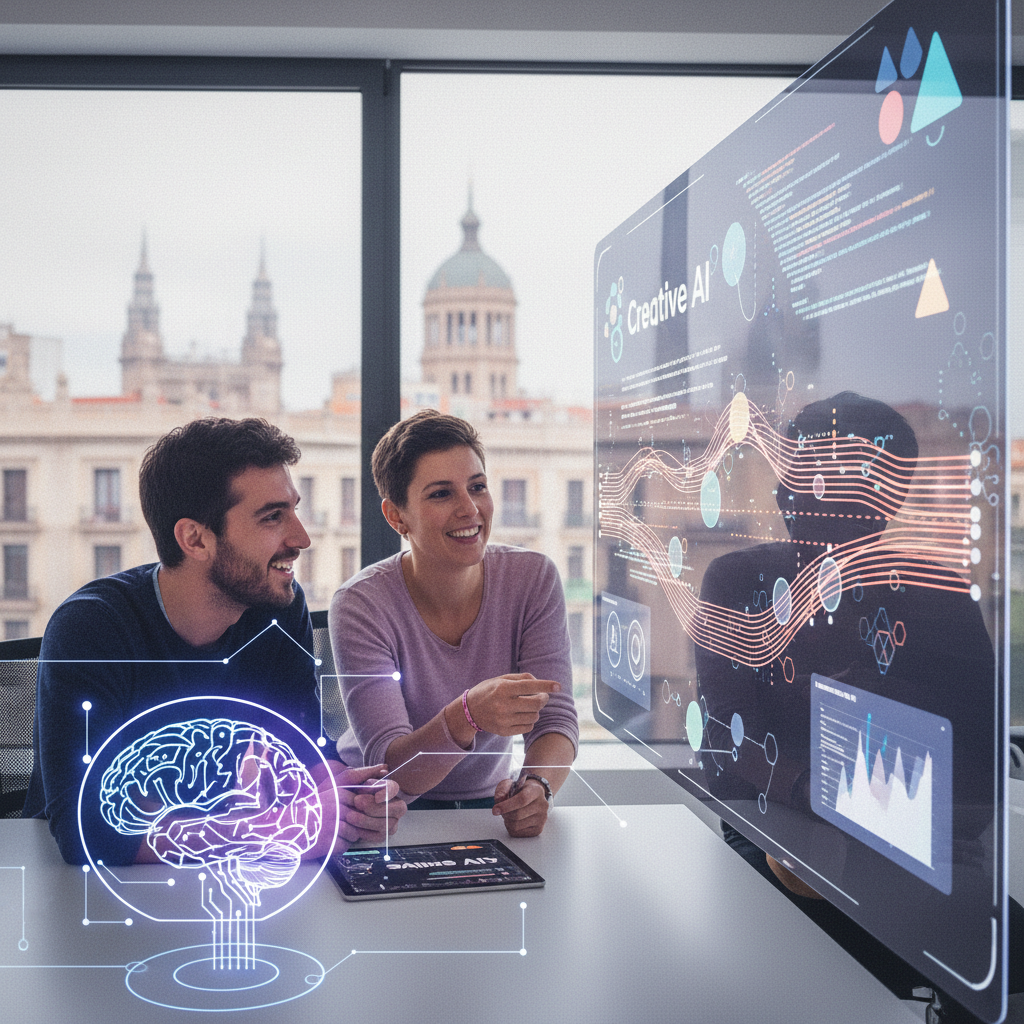

¡Hola, amigos! Marisolò Garcíà here, and let me tell you, the air in Barcelona is buzzing with an energy you can almost taste. It is not just the spring sunshine or the aroma of fresh churros; it is the electrifying hum of innovation, especially in the world of artificial intelligence. For too long, AI has been a magnificent mimic, a master of pattern recognition, but now, something truly transformative is happening. We are witnessing the birth of AI architectures that go beyond mere matching, teaching machines to reason and understand in ways that feel almost, well, human.
This is not a subtle shift, my friends; it is a seismic one. For years, the dominant paradigm in AI, particularly with large language models, has been about scaling up. More data, more parameters, more computational power. And yes, that has given us incredible capabilities, from writing poetry to generating code. But deep down, many researchers knew there was a ceiling. These models, for all their brilliance, were fundamentally statistical engines. They could predict the next word with uncanny accuracy, but could they truly reason about cause and effect, or understand abstract concepts like fairness or intent? The answer, increasingly, was no, not without a new approach.
Enter the era of symbolic AI's resurgence, but with a modern twist. We are seeing exciting hybrid models that blend the power of deep learning with explicit knowledge representation and logical reasoning. Think of it like this: traditional neural networks are like a child learning to paint by seeing millions of paintings. They get good at replicating styles. But these new architectures are like giving that child a set of brushes, paints, and also a book on color theory and perspective. They learn not just to mimic, but to understand why certain strokes work and how to create new compositions based on principles.
One of the most exciting developments I have been following is the work coming out of places like the Artificial Intelligence Research Institute (iiia-csic) in Bellaterra, near Barcelona. Researchers there have long been pioneers in symbolic AI, and now they are finding new ways to integrate these classical techniques with contemporary deep learning. Dr. Carles Sierra, a leading figure at Iiia-csic, often speaks about the need for AI to move beyond correlation to causation. “We need systems that can explain their decisions, not just provide an answer,” he told me recently. “This requires embedding a deeper understanding of the world, not just statistical associations. It is about moving from 'what' to 'why'.” This push for explainability and robustness is exactly what these new reasoning architectures promise.
And it is not just academia. Spain's AI moment has arrived, and startups are seizing this opportunity with both hands. Take for example, LogiCore AI, a Madrid-based startup that is developing AI systems for complex industrial optimization. Their approach integrates neural networks with knowledge graphs and constraint programming, allowing their AI to not only predict equipment failures but to reason about the optimal maintenance schedule based on a vast array of operational parameters and logical rules. They are not just finding patterns in sensor data; they are building a model of the factory floor that understands relationships between components and processes. This is a game-changer for efficiency and safety in manufacturing across Europe.
Another fascinating example is SemanticMind, a small but mighty team in Valencia, focusing on legal tech. Their platform uses advanced reasoning engines to analyze complex legal documents, not just for keywords, but for the underlying logical structure of arguments and precedents. This allows lawyers to quickly identify inconsistencies, predict outcomes, and even draft more robust contracts. It is a far cry from simple document search; it is about understanding the meaning and implications of legal text, a truly challenging reasoning task that traditional AI has struggled with. Their CEO, Dr. Elena Navarro, a former judge, emphasized this to me: “The law is built on logic and precedent. Our AI is designed to understand that logic, to think like a junior lawyer, not just a super-fast paralegal.”
The global tech giants are, of course, also heavily invested. Google DeepMind has been a long-time proponent of combining deep learning with reinforcement learning and symbolic reasoning, showcasing impressive results in areas like game playing and scientific discovery. OpenAI, while renowned for its large language models, is also exploring methods to imbue its next-generation models with more robust reasoning capabilities, moving beyond sheer scale. Anthropic, with its focus on AI safety, sees reasoning as crucial for developing trustworthy and aligned AI systems. Dario Amodei, CEO of Anthropic, has often spoken about the need for AI to develop a