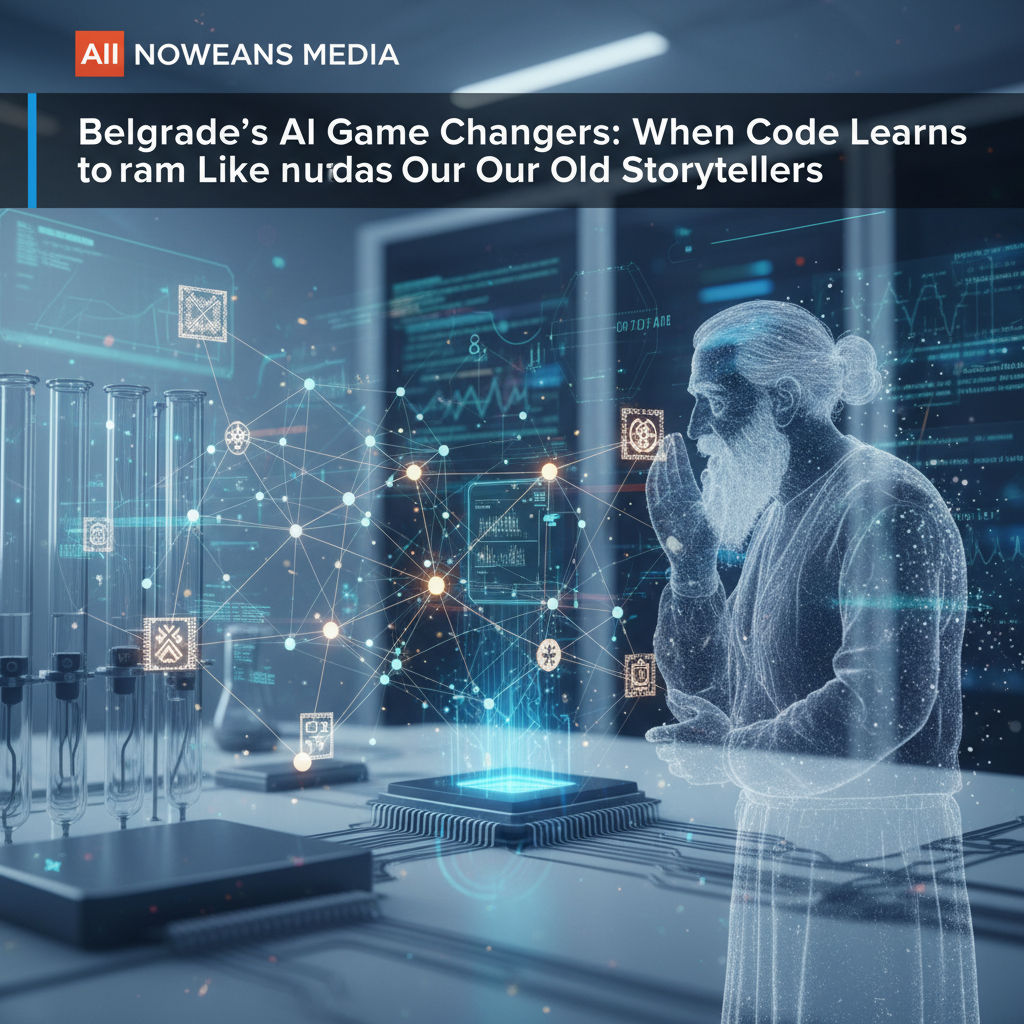

You hear a lot of noise these days about artificial intelligence, especially in gaming. Every other week, some big tech company announces a new AI that will ‘revolutionize’ how we play. Most of it is just marketing fluff, a shiny new coat of paint on the same old algorithms. But sometimes, just sometimes, you see something that makes you stop and think, something that feels genuinely new. I found one of those moments recently, not in some glossy presentation from California, but in a rather unassuming paper from our own University of Belgrade.
The breakthrough, if you can call it that, comes from the Department of Computer Science at the Faculty of Electrical Engineering, specifically from a team led by Dr. Elena Petrović. Their latest work, titled “Generative Adversarial Networks for Dynamic Narrative Synthesis in Interactive Entertainment,” published in a recent issue of Nature Machine Intelligence, isn't about making prettier pixels or smarter enemy AI. It’s about something far more fundamental: making games tell stories that truly adapt, learn, and even surprise the players in ways we’ve only dreamed of. You can find similar research discussions here.
In plain language, Dr. Petrović’s team has developed a novel approach using a type of AI called Generative Adversarial Networks, or GANs, to create game narratives that are not just branching paths, but genuinely evolving stories. Imagine a game where the non-player characters, the world events, and even the overarching plot points aren't pre-scripted, but generated on the fly, responding to your actions, your choices, and even your emotional state as perceived by the AI. It's like having a master storyteller, a guslar from our folklore, improvising an epic tale just for you, every time you play.
Why This Matters: Beyond the Hype
Why should anyone care about this, beyond a few academics and hardcore gamers? Because the current state of AI in gaming, frankly, is often quite limited. We have impressive graphics, complex physics engines, and even AI that can beat grandmasters at chess or Go. But narrative AI, the ability for a game to tell a compelling, dynamic story that feels unique to each player, has largely remained a holy grail. Most games still rely on meticulously handcrafted narratives, with a few branching choices that ultimately lead to a finite number of outcomes. This new approach from Belgrade changes that equation.
“For too long, AI in games has been about optimization, about making things more efficient or visually stunning,” explained Dr. Petrović when I spoke with her last week. “Our focus was different. We wanted to capture the essence of human storytelling, the unpredictability, the emotional resonance, and inject that into an interactive medium. It’s not just about generating text; it’s about generating meaning within a dynamic world model.”
This isn't just about making games more fun, although that's certainly a part of it. It has implications for educational simulations, for training environments, and even for therapeutic applications where personalized, adaptive narratives could be incredibly powerful. The Balkans have a different relationship with technology, often focusing on practical applications and solving real problems, and this research fits that mold perfectly.
The Technical Details: A Glimpse Under the Hood
Now, for those who like to peek under the hood, the Belgrade team didn't just stumble upon this. Their GAN architecture, which they've dubbed 'NarrativeGen,' uses two primary neural networks: a generator and a discriminator. The generator creates narrative sequences, character interactions, and world events based on a vast dataset of existing stories, folklore, and player interaction logs. The discriminator, on the other hand, tries to distinguish between these AI-generated narratives and human-authored ones. Through this adversarial process, the generator learns to produce increasingly coherent, engaging, and human-like stories.
What makes NarrativeGen particularly clever is its integration with a 'Player State Model.' This model continuously tracks player actions, choices, and even inferred emotional responses, feeding this data back into the GAN. This allows the AI to dynamically adjust the narrative in real-time, creating truly personalized experiences. For example, if a player consistently avoids conflict, the AI might generate quests that emphasize diplomacy or stealth. If a player shows a preference for certain character archetypes, the AI can introduce new characters that align with those preferences, or evolve existing ones.
“It’s a constant dance between predictability and surprise,” said Marko Jovanović, a lead researcher on the project, during our chat over strong Turkish coffee. “We’re not trying to replace human writers, but to give them a tool that can expand the canvas of their creativity exponentially. Imagine a game where the villain you thought you knew suddenly reveals a hidden motive, or an ally betrays you, not because it was scripted from the start, but because the AI learned your expectations and chose to subvert them.”
Who Did the Research: Belgrade's Quiet Powerhouse
The team at the University of Belgrade is not a newcomer to the AI scene. For years, they've been quietly pushing boundaries, often with fewer resources than their Western counterparts, but with a tenacity born of necessity. Dr. Elena Petrović, a graduate of the same university, returned to lead the lab after stints at DeepMind and NVIDIA, bringing a wealth of experience and a deep understanding of both theoretical AI and practical application. You can follow developments from leading AI labs like DeepMind here.
“Belgrade’s tech scene is real, not hype,” Dr. Petrović stated with characteristic Serbian directness. “We don’t have the same venture capital flowing through our streets, so we have to be smarter, more efficient. Our talent pool is exceptional, and we’re focused on foundational research that can truly make a difference, not just chase the latest trend.”
The project received significant funding from the Serbian Ministry of Education, Science and Technological Development, along with grants from the European Union's Horizon Europe program, recognizing the potential for this technology to boost the region's burgeoning gaming industry. Several Serbian game development studios, like Eipix Entertainment and Nordeus, have already expressed keen interest in integrating NarrativeGen into their future titles.
Implications and Next Steps: What Comes Next?
The immediate implications are clear: a new era of interactive storytelling where games can offer unparalleled replayability and emotional depth. Imagine a role-playing game where your choices genuinely matter, not just in the short term, but in how the entire world and its inhabitants evolve around you. This could mean a significant shift in how games are designed, moving away from rigid scripts towards more dynamic, procedural content generation that is deeply informed by player interaction.
But the potential goes further. This kind of adaptive narrative AI could be used to create personalized educational experiences, where learning paths and stories are tailored to individual student needs and interests. It could also power advanced simulations for training in complex fields, allowing professionals to practice decision-making in scenarios that dynamically adapt to their performance.
Of course, there are challenges. Ensuring ethical AI behavior, preventing the generation of harmful or biased narratives, and maintaining creative control for human developers are all critical considerations. The team is already working on robust moderation frameworks and human-in-the-loop systems to address these concerns. “We need to make sure the AI is a creative partner, not an unchecked dictator,” Jovanović quipped.
As I left Dr. Petrović’s lab, walking past the historic buildings of Belgrade, I thought about the centuries of storytelling embedded in our culture, from ancient myths to modern novels. It seems fitting that a new chapter in narrative, powered by artificial intelligence, is being written right here. Let's talk about what's actually working, and this, my friends, is certainly something to watch. It’s a testament to the fact that innovation isn't confined to a few well-trodden paths; sometimes, the most profound breakthroughs come from places you least expect, driven by a quiet determination to build something real. The future of gaming, and perhaps even storytelling itself, just got a lot more interesting, thanks to a few dedicated minds on the banks of the Sava and Danube. For more on the broader landscape of AI in startups, you can check out TechCrunch's AI section.