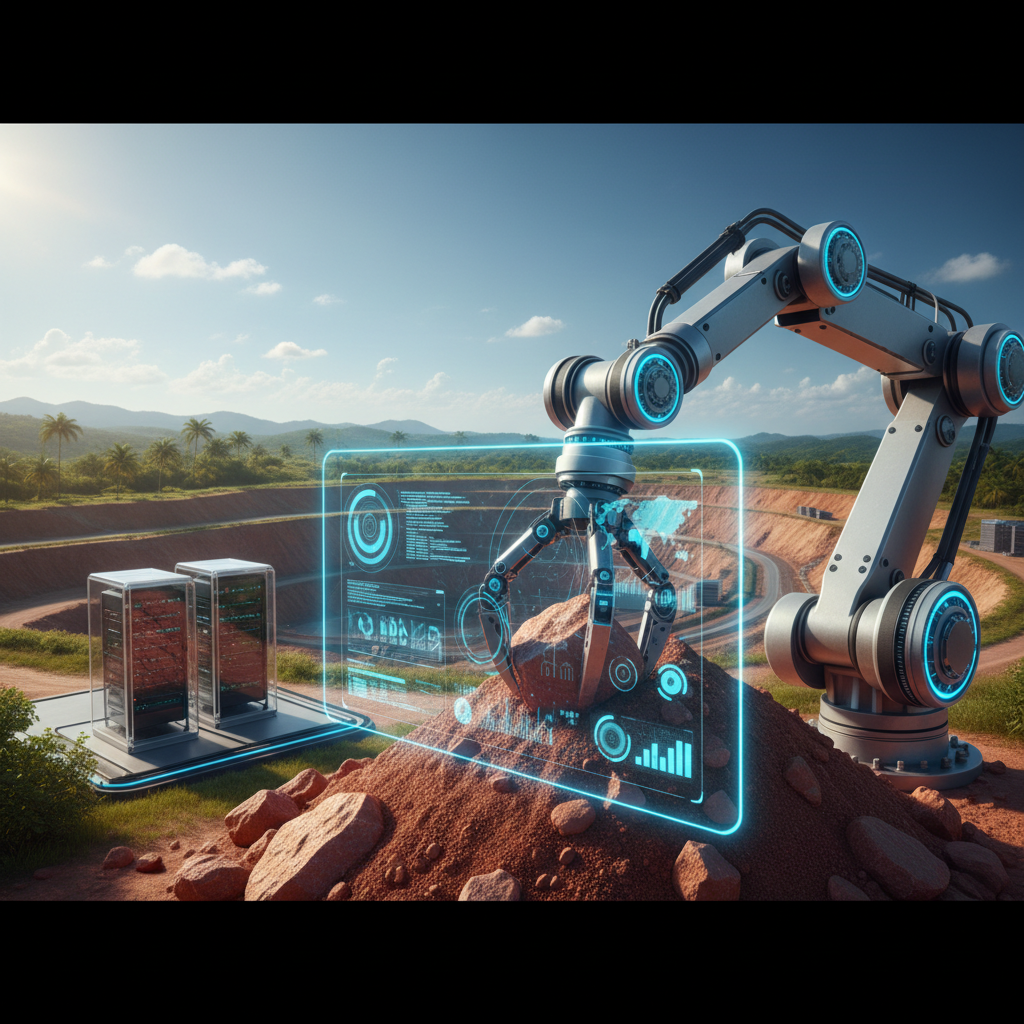

Alright, listen up, because while everyone's busy chasing the latest chatbot craze in California, some serious brainpower is being applied to the very ground beneath our feet. I'm talking about AI in mining and natural resources, a field that sounds about as glamorous as a tax audit, but trust me, the implications for places like Jamaica are nothing short of transformative. We're not just talking about digging holes; we're talking about precision, safety, and efficiency that could redefine an entire industry. And let's be real, when you're a small island, big ideas are what keep you competitive.
The Technical Challenge: More Than Just Rocks
For decades, mining has been a game of educated guesses, geological surveys, and a whole lot of heavy machinery. The problems are complex: where to find the good stuff, how to get it out without wasting resources or risking lives, and how to do it all sustainably. Traditional methods, while robust, often suffer from high operational costs, environmental impact, and significant safety hazards. The sheer volume of data generated, from seismic readings to sensor data from machinery, is overwhelming for human analysis. This is where AI steps in, not as a replacement for human expertise, but as a super-powered assistant that can see patterns and make predictions far beyond our capabilities.
Architecture Overview: The Digital Mine Blueprint
Imagine a digital twin of a mine, constantly updated with real-time data, where every rock, every tremor, every piece of equipment is monitored and analyzed. That's the vision. The architecture for an AI-driven mining operation typically involves several integrated layers:
- Data Acquisition Layer: This is the sensory nervous system of the mine. It includes IoT sensors on drilling equipment, autonomous vehicles, geological probes, drones for aerial mapping, seismic sensors, and even satellite imagery. Data types range from structured (sensor readings, GPS coordinates) to unstructured (geological reports, video feeds).
- Edge Computing Layer: Processing data close to the source is crucial, especially in remote mining locations with limited bandwidth. Edge devices perform initial data cleaning, aggregation, and anomaly detection, reducing latency and bandwidth requirements for transmission to central servers. Think NVIDIA Jetson modules deployed on mining vehicles, handling real-time object detection for safety.
- Data Lake/Warehouse: A centralized repository, often cloud-based (AWS S3, Google Cloud Storage, Azure Data Lake), stores all raw and processed data. This allows for massive scale and flexible querying. Data is typically stored in formats like Parquet or ORC for efficient analytical processing.
- ai/ml Platform: This is the brain. It hosts various machine learning models for different tasks. Popular choices include platforms like Google Cloud AI Platform, AWS SageMaker, or custom Kubernetes clusters running TensorFlow or PyTorch. This layer handles model training, deployment, and monitoring.
- Analytics and Visualization Layer: Tools like Tableau, Power BI, or custom dashboards provide actionable insights to engineers, geologists, and managers. This layer translates complex model outputs into understandable visualizations, enabling data-driven decision-making.
- Actuation Layer: In highly automated mines, AI outputs can directly influence operational systems, such as adjusting drilling parameters, rerouting autonomous haul trucks, or triggering safety protocols. This requires robust integration with Scada systems and industrial control networks.
Key Algorithms and Approaches: The Smart Stuff Underneath
Different mining challenges call for different algorithmic approaches:
- Exploration (Finding the Gold, or Bauxite):
- Convolutional Neural Networks (CNNs): For analyzing seismic data, satellite imagery, and geological maps to identify potential mineral deposits. CNNs excel at spatial pattern recognition. Imagine feeding a CNN years of geological survey data, and it highlights areas with a high probability of bauxite, far more accurately than a human eye could discern. The output might be a heat map indicating prospectivity.
- Generative Adversarial Networks (GANs): Can be used to generate synthetic geological data, augmenting sparse real-world datasets for more robust model training. This is particularly useful when drilling is expensive and data is limited.
- Pseudocode Concept for Exploration:
 function predict_mineral_prospectivity(geological_data):
 # geological_data: 3D seismic cubes, drill core images, geochemical assays
 preprocessed_data = normalize(geological_data)
 cnn_model = load_trained_cnn('exploration_model.h5')
 prospectivity_map = cnn_model.predict(preprocessed_data)
 return post_process(prospectivity_map) # e.g., apply threshold, identify regions
 function predict_mineral_prospectivity(geological_data):
 # geological_data: 3D seismic cubes, drill core images, geochemical assays
 preprocessed_data = normalize(geological_data)
 cnn_model = load_trained_cnn('exploration_model.h5')
 prospectivity_map = cnn_model.predict(preprocessed_data)
 return post_process(prospectivity_map) # e.g., apply threshold, identify regions
- Extraction Optimization (Getting it Out Efficiently):
- Reinforcement Learning (RL): For optimizing the pathing of autonomous haul trucks, scheduling of excavators, and blending of ore. An RL agent learns optimal strategies by interacting with a simulated mine environment, maximizing throughput while minimizing fuel consumption and wear-and-tear. Companies like Caterpillar and Komatsu are already deploying RL-driven autonomous fleets.
- Predictive Maintenance (PM): Using time-series forecasting models (LSTMs, Transformers) on sensor data (vibration, temperature, pressure) from heavy machinery to predict equipment failures before they occur. This reduces costly downtime and extends asset lifespan. Think of a sensor on a crusher in a bauxite plant predicting a bearing failure weeks in advance.
- Pseudocode Concept for Predictive Maintenance:
 function predict_equipment_failure(sensor_data_history):
 # sensor_data_history: time series of vibration, temperature, current, etc.
 preprocessed_sequence = scale_and_window(sensor_data_history)
 lstm_model = load_trained_lstm('pm_model.h5')
 failure_probability = lstm_model.predict_next_n_timesteps(preprocessed_sequence)
 if max(failure_probability) > Threshold:
 return 'high_risk', time_to_failure_estimate
 else:
 return 'low_risk', None
 function predict_equipment_failure(sensor_data_history):
 # sensor_data_history: time series of vibration, temperature, current, etc.
 preprocessed_sequence = scale_and_window(sensor_data_history)
 lstm_model = load_trained_lstm('pm_model.h5')
 failure_probability = lstm_model.predict_next_n_timesteps(preprocessed_sequence)
 if max(failure_probability) > Threshold:
 return 'high_risk', time_to_failure_estimate
 else:
 return 'low_risk', None
- Safety (Protecting Our People):
- Computer Vision (CV): For monitoring worker safety, detecting unsafe acts (e.g., not wearing PPE, entering restricted zones), and identifying potential hazards (e.g., rockfall detection, unstable slopes). Drones equipped with CV models can inspect hard-to-reach areas. This is particularly relevant in Jamaica's bauxite mines, where safety is paramount.
- Natural Language Processing (NLP): Analyzing incident reports, safety manuals, and communication logs to identify common risk factors and improve training programs. An NLP model can highlight patterns in near-miss reports that human analysts might miss.
- Pseudocode Concept for Safety Monitoring:
 function detect_unsafe_conditions(video_stream):
 # video_stream: real-time feed from surveillance cameras or drone
 frame = capture_frame(video_stream)
 object_detector = load_yolo_model('ppe_detector.pt')
 detections = object_detector.detect(frame)
 for obj in detections:
 if obj.label == 'person' and not obj.has_ppe:
 alert_supervisor('Unsafe PPE detected at coordinates', obj.bbox)
 if obj.label == 'restricted_zone' and obj.person_inside:
 alert_supervisor('Intruder in restricted zone', obj.bbox)
 return detections
 function detect_unsafe_conditions(video_stream):
 # video_stream: real-time feed from surveillance cameras or drone
 frame = capture_frame(video_stream)
 object_detector = load_yolo_model('ppe_detector.pt')
 detections = object_detector.detect(frame)
 for obj in detections:
 if obj.label == 'person' and not obj.has_ppe:
 alert_supervisor('Unsafe PPE detected at coordinates', obj.bbox)
 if obj.label == 'restricted_zone' and obj.person_inside:
 alert_supervisor('Intruder in restricted zone', obj.bbox)
 return detections
Implementation Considerations: The Nitty-Gritty
Deploying AI in mining isn't just about fancy algorithms; it's about robust engineering. Data quality is king; garbage in, garbage out applies tenfold here. Sensor calibration, data fusion from disparate sources, and handling missing data are constant battles. Model interpretability is also critical. When an AI suggests a costly drilling operation or a safety shutdown, engineers need to understand why to trust the recommendation. Explainable AI (XAI) techniques are becoming indispensable.
Latency is another beast. For real-time safety alerts or autonomous vehicle control, millisecond response times are non-negotiable. This pushes more processing to the edge. Security is also paramount; mining infrastructure is critical, and cyberattacks could have devastating consequences. Robust encryption, access control, and anomaly detection for network traffic are essential.
Benchmarks and Comparisons: How We Stack Up
Compared to traditional methods, AI offers significant improvements. For exploration, AI models can reduce the number of exploratory drills by 10-30%, saving millions of dollars. In predictive maintenance, AI can cut unplanned downtime by 20-50% and extend asset life by 15-25%. Safety incidents can be reduced by proactively identifying risks. For example, Barrick Gold has reported substantial operational efficiencies and safety improvements through its AI initiatives.
Traditional statistical methods like regression analysis or simple rule-based systems often struggle with the complexity, non-linearity, and sheer volume of mining data. Deep learning models, with their ability to learn intricate patterns from high-dimensional data, offer a clear advantage, especially when combined with domain expertise to guide feature engineering and model selection.
Code-Level Insights: Tools of the Trade
For most of these applications, Python is the lingua franca. Libraries like TensorFlow and PyTorch are the backbone for deep learning. For data processing, Pandas and NumPy are indispensable. Geopandas extends Pandas for geospatial data, crucial for mapping and exploration. For real-time processing at the edge, frameworks like TensorFlow Lite or PyTorch Mobile are used, often deployed on specialized hardware like NVIDIA's Jetson series or Google's Coral TPUs. Docker and Kubernetes are standard for deploying and managing models at scale, both on-premise and in the cloud.
Real-World Use Cases: Where the Rubber Meets the Ore
- Rio Tinto's Autonomous Haulage System: In Australia, Rio Tinto operates fully autonomous haul trucks, guided by AI, that transport iron ore 24/7. This system, developed with partners like Komatsu and Caterpillar, has significantly improved safety and efficiency, reducing operational costs and increasing throughput. The AI handles path planning, obstacle avoidance, and dynamic routing in complex mine environments.
- BHP's Predictive Maintenance: BHP has implemented AI-driven predictive maintenance across its global operations. By analyzing sensor data from hundreds of thousands of pieces of equipment, their models predict failures, allowing for proactive maintenance and reducing unscheduled downtime by double-digit percentages. This directly impacts their bottom line and ensures consistent production.
- Gold Fields' Smart Mining Initiative: Gold Fields, a global gold producer, uses AI for optimizing drilling and blasting, improving ore recovery, and enhancing safety. Their systems analyze geological data to determine optimal blast patterns, reducing waste and improving fragmentation, which then makes subsequent processing more efficient. They also use computer vision for real-time monitoring of worker safety in underground operations.
- Jamaica's Bauxite Sector (Potential): While not yet at the scale of the global giants, the potential for Jamaica's bauxite industry is immense. Imagine AI-powered drones mapping bauxite deposits with unprecedented accuracy, reducing the need for extensive, environmentally impactful exploratory drilling. Or AI optimizing the energy-intensive alumina refining process, cutting costs and emissions. This isn't just about foreign companies; local startups could develop specialized AI solutions for our unique geological challenges. The Caribbean has entered the chat, and we're bringing our own flavour of innovation.
Gotchas and Pitfalls: The Bumpy Road Ahead
Implementing AI in mining isn't a smooth ride. Data silos are a common problem, with operational technology (OT) and information technology (IT) systems often not communicating effectively. The harsh operating environment, with dust, vibrations, and extreme temperatures, can challenge sensor reliability and hardware longevity. The talent gap is also real; finding data scientists and AI engineers with deep domain expertise in mining is tough. And let's not forget the initial capital investment, which can be substantial. Plus, there's the human element: resistance to change from a workforce accustomed to traditional methods. Proper change management and training are crucial for adoption.
Resources for Going Deeper: Digging Further
For those looking to get their hands dirty, I recommend exploring academic papers on geostatistics and machine learning, particularly those from conferences like KDD or NeurIPS that touch on spatio-temporal data. Companies like Palantir and Seeq offer industrial AI platforms that are relevant. You can also find valuable insights from organizations like the International Council on Mining and Metals (icmm) on best practices for technology adoption. For a more general overview of AI in industry, MIT Technology Review often publishes excellent pieces.
The bottom line is this: AI isn't just for social media algorithms or self-driving cars. It's a powerful tool that can fundamentally reshape foundational industries like mining, making them safer, more efficient, and more sustainable. And for a country like Jamaica, with its rich natural resources, embracing this technology isn't just an option; it's a strategic imperative. We have the brains, we have the drive, and we certainly have the bauxite. Now, let's connect the dots with some smart AI.