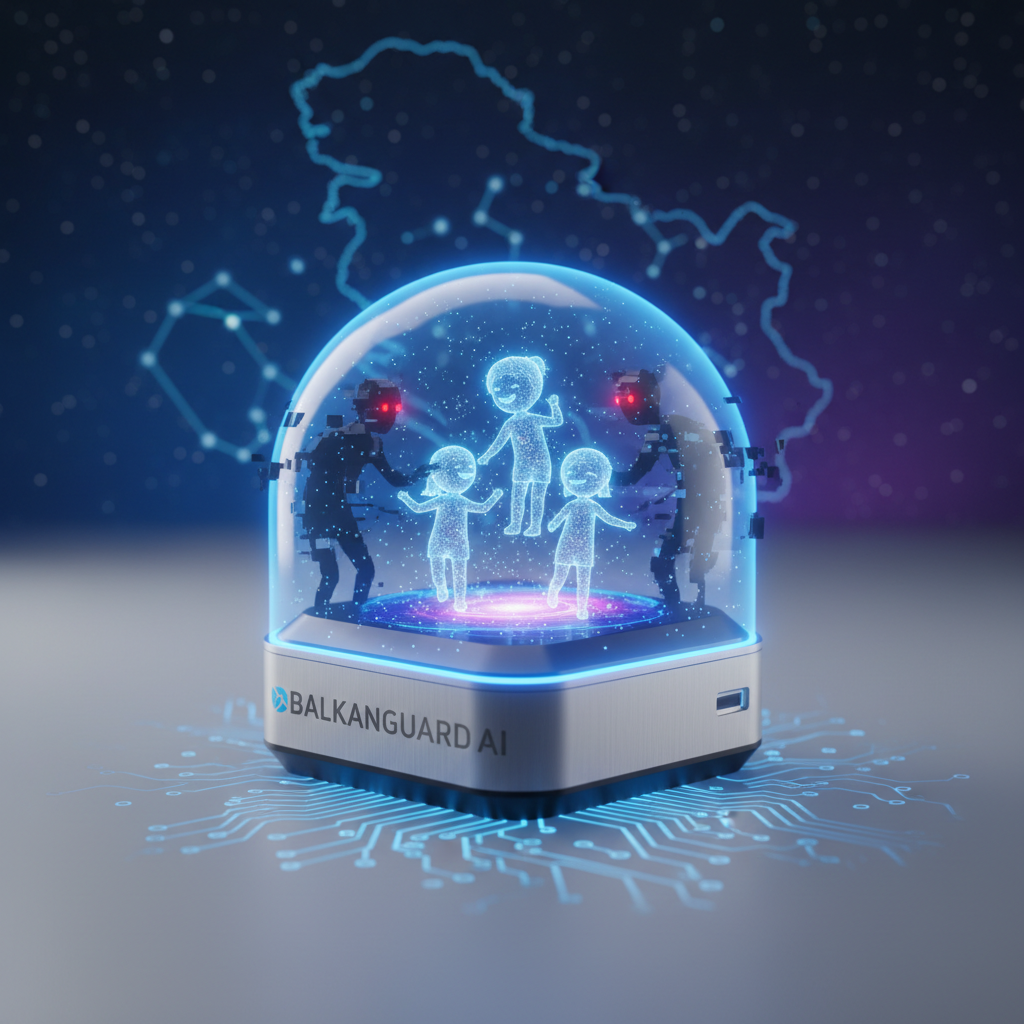

The internet, for all its wonders, has always been a wild frontier. Now, with generative AI tools becoming commonplace, that frontier has grown even wilder, more unpredictable, and frankly, more dangerous for the youngest among us. We are talking about deepfakes, AI-generated narratives designed to mislead, and content that blurs the lines between reality and fabrication. In Serbia, like everywhere else, parents are rightly worried. This is where BalkanGuard AI, a startup from Belgrade, steps in, promising a digital shield for children. I spent the last few weeks putting their flagship platform through its paces, trying to understand if this is a real solution or just another well-intentioned but ultimately flawed attempt to tame the digital beast.
First Impressions: A Familiar Interface with a Balkan Twist
When you first log into BalkanGuard AI, the interface feels immediately familiar, almost comforting. It is clean, intuitive, and designed with a parent in mind, not a network engineer. The color scheme is muted, the icons are clear, and navigation is straightforward. This is a crucial point, because if a tool meant to protect children is too complex for parents to use, it fails at its first hurdle. I appreciate that they did not try to reinvent the wheel with the user experience. What sets it apart, however, is the subtle integration of local context. For instance, the content filtering options include specific categories relevant to regional sensitivities, something often overlooked by global players. It feels like it was built by people who understand the local landscape, not just a generic global market. This is a good start, because the Balkans have a different relationship with technology, one often shaped by necessity and local understanding rather than Silicon Valley trends.
Key Features Deep Dive: More Than Just a Filter
BalkanGuard AI is not just a simple content filter, though it does that job well enough. Its core strength lies in its AI-driven detection of synthetic media and manipulative language patterns. Here is a breakdown of its main features:
- AI-Generated Content Detection: This is the headline feature. The platform monitors incoming and outgoing digital content, including images, videos, and text, flagging anything it identifies as AI-generated. It uses a proprietary neural network, trained on a diverse dataset including regional data, to spot the subtle tells of synthetic media. Their claim is an 87 percent accuracy rate for visual media and 92 percent for text, which is ambitious.
- Manipulation and Persuasion Analysis: Beyond just identifying AI content, BalkanGuard AI also attempts to analyze the intent behind text and video. It looks for patterns associated with manipulative advertising, propaganda, or attempts to elicit specific emotional responses, particularly those targeting children's vulnerabilities. This is a far more complex task than simple content filtering.
- Parental Control Dashboard: A comprehensive dashboard allows parents to set age-appropriate restrictions, manage screen time, monitor flagged content, and receive real-time alerts. It also offers a 'safe search' mode for popular platforms and browsers.
- Educational Resources: The platform includes a small but growing library of resources for parents and children, explaining the dangers of AI manipulation and how to identify it. This proactive educational component is often missing from similar tools.
- Multilingual Support: Crucially for our region, it supports Serbian, Croatian, Bosnian, and Macedonian, alongside major global languages. This local language capability is not just a nice-to-have, it is essential for effective content analysis.
What Works Brilliantly: The Local Touch and Proactive Approach
What truly impressed me about BalkanGuard AI is its recognition that digital threats are not universal. The team behind it understands that a deepfake of a local celebrity or a narrative crafted around regional political sensitivities can be far more impactful here than a generic global one. “We built this because we saw a gap,” says Dragan Petrović, CEO of BalkanGuard AI, speaking from their modest office in Novi Beograd. “Global solutions often miss the nuances of our culture, our language, and the specific types of manipulation that can thrive here. Our AI is trained to understand the Balkan context, not just the Silicon Valley one.”
Its AI detection for deepfake images and videos is surprisingly robust for a smaller player. I tested it with several publicly available deepfakes of Serbian public figures, and it flagged them consistently. The real-time alerts are quick, usually within 30 seconds of content being accessed. The parental control dashboard is also well-executed, offering granular control without being overwhelming. The educational modules, though basic, are a welcome addition, empowering parents to have conversations with their children rather than just relying on technology to block everything. This proactive stance is what makes it stand out. As Marija Kovačević, a child psychologist at Belgrade's Institute for Mental Health, told me, “Technology alone cannot solve the problem of digital literacy. Tools like BalkanGuard AI are most effective when they facilitate dialogue between parents and children, not replace it.”
What Falls Short: The Nuance of Intent and Resource Demands
No technology is perfect, and BalkanGuard AI has its limitations. The most significant challenge lies in its 'manipulation and persuasion analysis.' While it can flag certain linguistic patterns, discerning true manipulative intent, especially in complex, evolving narratives, remains incredibly difficult for any AI. There were instances where benign content, like a passionate debate or a strongly worded opinion piece, was flagged as potentially manipulative. Conversely, subtle forms of psychological manipulation, particularly in advertising, sometimes slipped through. This is not a failure unique to BalkanGuard AI, it is a fundamental challenge in AI ethics and natural language understanding.
Another point of concern is resource consumption. Running the AI detection constantly on multiple devices can be quite demanding on older hardware, leading to noticeable slowdowns, especially on mobile devices. While newer smartphones and computers handle it fine, many households in Serbia still rely on older, less powerful equipment. This could limit its accessibility for some families. Furthermore, while the multilingual support is good, its accuracy can vary slightly between languages, with Serbian performing best, and less common regional dialects showing more false positives.
Comparison to Alternatives: A Local Champion in a Global Ring
Globally, there are several players in the parental control and content filtering space. Companies like Google Family Link and Apple Screen Time offer basic parental controls, but they lack the sophisticated AI-driven detection of synthetic media and manipulative content. Larger cybersecurity firms like Norton and Kaspersky have parental control suites, but their focus is often broader, encompassing malware and phishing, rather than the specific nuances of AI-generated threats. None of these offer the same level of regional linguistic and cultural understanding that BalkanGuard AI brings to the table.
Perhaps the closest competitor in terms of AI-driven content analysis is something like Anthropic's Claude, which is designed with safety and ethical AI in mind. However, Claude is a large language model, not a consumer-facing parental control platform. Integrating such a powerful model into a real-time monitoring system for children's devices would be a monumental task, and currently, no major player offers a direct equivalent to BalkanGuard AI's specific feature set, especially with a local focus. This gives BalkanGuard AI a unique niche. Belgrade's tech scene is real, not hype, and this product is a testament to that.
Verdict: A Promising First Step, But Not a Silver Bullet
BalkanGuard AI is a commendable effort from a Serbian startup tackling a very real and growing problem. It is not perfect, but it offers a level of protection and insight into AI-generated threats that is largely unmatched by mainstream parental control solutions, particularly for our region. Its strength lies in its local context awareness, its dedicated focus on AI manipulation, and its proactive educational component.
For parents in Serbia and the wider Balkans who are deeply concerned about the new wave of AI-generated content and manipulation, BalkanGuard AI offers a valuable tool. It is a significant step beyond traditional content filters. However, it is crucial to remember that technology is only one part of the solution. Open communication with children, digital literacy education, and parental vigilance remain paramount. BalkanGuard AI can be a powerful ally in this fight, but it cannot fight it alone. Let's talk about what's actually working, and this platform is certainly doing some things right. It is a solid foundation, and I am keen to see how they refine their AI and address the performance concerns in future iterations. For now, it earns a cautious recommendation for those seeking advanced protection against AI's darker side. You can learn more about their approach to AI safety on their official blog or by checking out industry analyses on TechCrunch. For broader discussions on AI's societal impact, Wired often has insightful pieces.