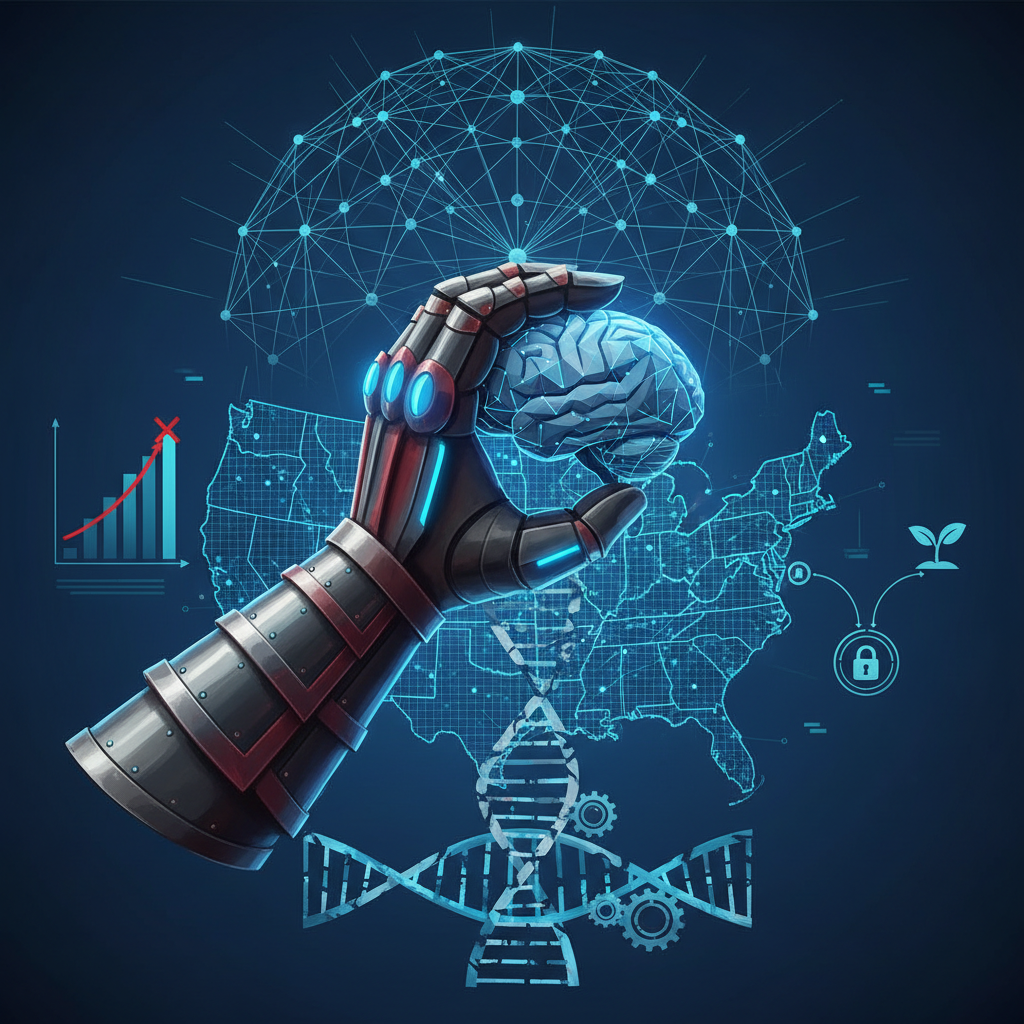
Let's be real for a minute. While folks here in the USA are busy debating whether OpenAI's GPT-5 is going to write better poetry or steal our jobs, over in China, they're building an entirely different kind of AI future. It's a future where innovation isn't just encouraged; it's commanded, and the state's watchful eye is less a bug and more a feature. We're talking about China's AI governance model: innovation with state control. And the question isn't just whether it's a fad or the new normal, but what it means for everyone else, especially us.
For years, the narrative has been that Western democracies, with their emphasis on individual freedom and open markets, would naturally out-innovate authoritarian regimes. That's the story we tell ourselves, right? But China, particularly under the leadership of companies like Baidu and ByteDance, is challenging that conventional wisdom in a big way. They've shown a remarkable ability to push AI boundaries, often with a speed and scale that makes Silicon Valley look like it's still running on dial-up. Yet, every algorithm, every dataset, every groundbreaking paper is ultimately tethered to the state's strategic objectives. It's a paradox that keeps me up at night.
Think back to the early 2010s. China was seen as a copycat, a manufacturing hub, not a tech innovator. Fast forward to today, April 2026, and they're not just competing; they're setting the pace in areas like facial recognition, autonomous driving, and large language models. Baidu's Ernie Bot, for instance, has demonstrated capabilities that rival some of the best Western models, but it operates within a regulatory framework that is fundamentally different from what Google or Anthropic navigate. This isn't just about censorship; it's about a national strategy that integrates technological advancement directly into national governance and social control. It's a top-down, centralized approach that contrasts sharply with the more decentralized, often chaotic, innovation cycles we see in the West.
Here's what the tech bros don't want to talk about: the sheer scale of data available to Chinese AI developers. With less stringent privacy laws and a massive population, companies can collect and process data at a volume that would make most American firms blush. This data advantage, combined with massive state investment, creates a powerful feedback loop for AI development. "The West talks about data privacy as a fundamental right; China views data as a strategic national asset, a resource to be leveraged for national strength," explains Dr. Anya Sharma, a senior fellow at the Center for Digital Policy in Washington D.C. "This fundamental difference in philosophy underpins their entire AI ecosystem, allowing for rapid iteration and deployment of AI systems across various sectors, from smart cities to national defense."
But what's the cost? Uncomfortable truth time: while the speed of innovation is undeniable, the implications for human rights and individual liberties are profound. We've seen how AI is deployed in Xinjiang, for example, creating a surveillance state that is both chilling and highly effective. This isn't just an abstract concern for human rights organizations; it's a blueprint for how powerful AI can be when unchecked by democratic norms. "The efficiency of China's AI development comes at a price that many in the democratic world would find unacceptable," states Professor David Chen, an expert in East Asian studies at Georgetown University. "The trade-off between innovation speed and ethical considerations is stark, and it forces us to confront what kind of AI future we truly want."
From an economic standpoint, this model also creates a formidable competitor. Chinese tech giants, backed by state resources and operating in a protected domestic market, can scale rapidly and then look outwards. This impacts American companies not just in terms of market share, but also in the race for talent and technological supremacy. "Silicon Valley has a blind spot the size of Texas when it comes to understanding how deeply integrated the Chinese state is with its tech sector," says Maria Rodriguez, a venture capitalist specializing in AI startups. "They see the products, the patents, the investment, but they often miss the underlying political architecture that makes it all possible. This isn't just capitalism with Chinese characteristics; it's a whole new ballgame."
So, is China's AI governance model a fad or the new normal? My take is it's rapidly becoming the new normal, at least for them. And it's forcing a reckoning for the rest of the world. We're seeing other nations, particularly those with more authoritarian leanings, looking to China's model as a potential path to rapid technological advancement without the messy constraints of democratic oversight. This isn't just about copying code; it's about adopting a systemic approach to AI development and deployment.
Consider the implications for global standards. As China pushes its AI systems and governance philosophies internationally, particularly through initiatives like the Digital Silk Road, it challenges the Western-led norms around data governance, privacy, and algorithmic accountability. "The global AI landscape is increasingly bifurcated," notes Dr. Jamal Adebayo, a technology policy analyst at the Atlantic Council. "On one side, you have the open, albeit sometimes chaotic, innovation of the West. On the other, a highly controlled, state-directed model from China. Both are powerful, but they represent fundamentally different visions for humanity's relationship with AI. The question for American policymakers and tech leaders is how to compete without compromising our own values."
This isn't just a geopolitical chess match; it's a struggle for the soul of AI. Do we prioritize speed and efficiency at any cost, or do we build AI that is accountable, transparent, and respectful of individual rights? The Chinese model, while undeniably effective in certain metrics, offers a stark warning about the dangers of unchecked technological power. For us in the USA, it means we can't afford to be complacent. We need to invest heavily in our own AI research, foster a diverse and inclusive tech ecosystem, and, crucially, lead by example in developing ethical AI frameworks. Because if we don't, the alternative is already being built, brick by digital brick, and it looks a whole lot like control, not freedom.
We need to understand that the competition isn't just about who builds the fastest chip or the smartest algorithm; it's about whose values are embedded in the very fabric of future technologies. And right now, while we're still figuring out how to make AI fair and unbiased, China is already deploying systems that bake in state control. That's a trend that demands our full attention, not just a passing glance. For more insights into the global AI landscape, check out reporting from Reuters Technology or MIT Technology Review. You can also find deep dives into specific company strategies on TechCrunch. The future of AI, and perhaps global power, hangs in the balance.