
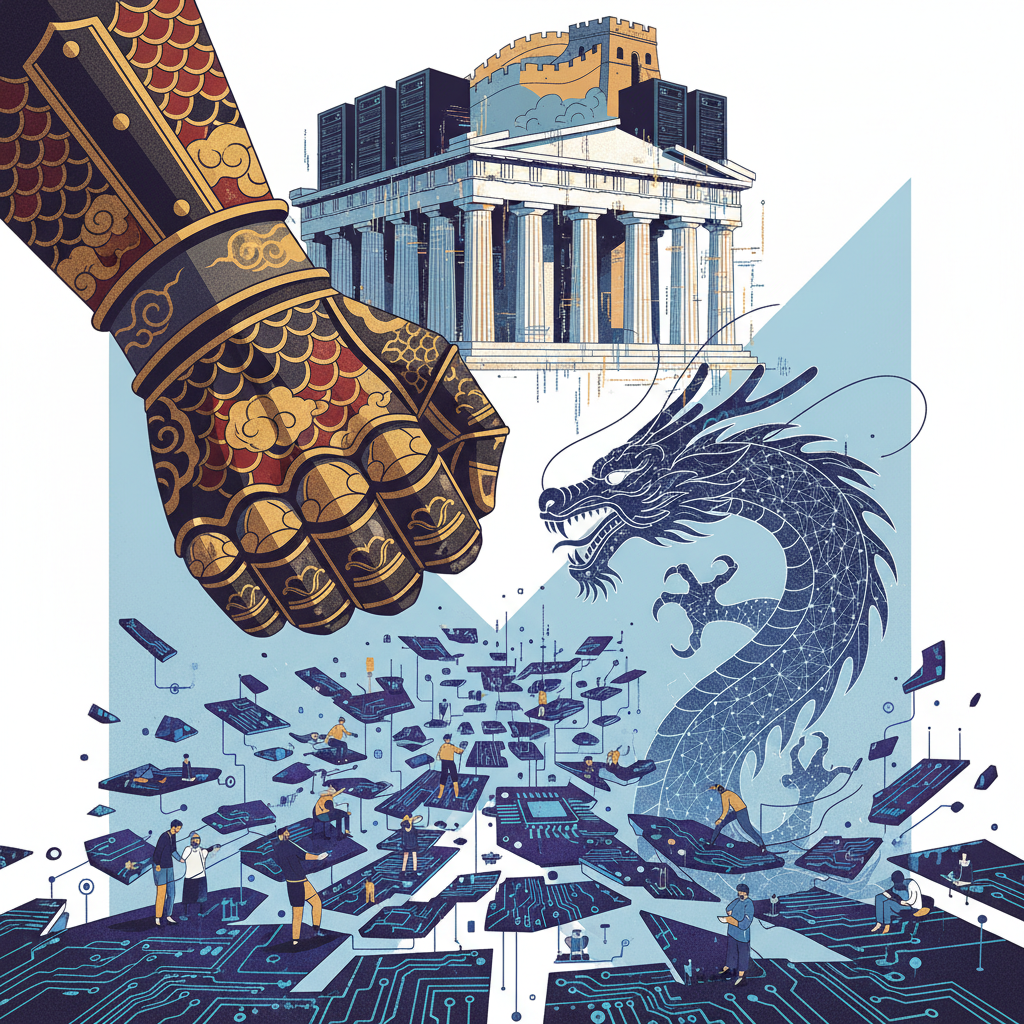

We in the West, particularly those of us observing from the ancient crossroads of Europe, often look at China's technological ascent with a mixture of awe and apprehension. Their speed, their scale, their sheer ambition in artificial intelligence is undeniable. Companies like Baidu, Alibaba, and Tencent are not merely competing; they are setting their own course, often with the full, unwavering backing of the state. But this is where the philosophical divergence begins, a chasm as wide as the Aegean Sea, separating our Hellenic ideals of individual liberty from Beijing's collective imperative.
For decades, the narrative has been that innovation thrives in freedom, in the messy, often chaotic, crucible of democratic societies. Yet, China presents a formidable counter-argument, at least on the surface. Their AI governance model is not just about regulation; it is about strategic direction, resource allocation, and a pervasive, top-down control that seeks to harness AI for national objectives. This is not a Silicon Valley startup culture of 'move fast and break things'; it is 'move strategically and build things that serve the state.'
Consider the sheer volume of data. China's vast population and the interconnectedness of its digital ecosystem provide an unparalleled training ground for AI models. Every transaction, every social media post, every movement captured by an urban camera feeds into a colossal data ocean. This data, often aggregated and managed by state-affiliated entities, fuels the rapid development of sophisticated algorithms for everything from facial recognition to predictive policing. "China's approach to AI development is fundamentally different because it integrates national strategy with technological advancement in a way that Western democracies, with their emphasis on individual privacy and market forces, simply cannot replicate," stated Dr. Kai-Fu Lee, a prominent AI venture capitalist and author, in a recent interview. He acknowledges the efficiency of this model, even as he points to its ethical complexities.
This state-led approach has undeniably yielded impressive results. Baidu, for instance, has made significant strides with its Ernie Bot, a large language model that rivals some of the best from OpenAI or Google. Their autonomous driving efforts are equally ambitious, with cities like Shenzhen becoming testing grounds for robotaxis on a scale unimaginable in many Western nations. The state provides massive subsidies, preferential policies, and a unified vision that cuts through bureaucratic red tape. When the government decides AI is a national priority, every lever of power is pulled to ensure its success.
But what is the cost of this efficiency, this centralized control? From my vantage point in Athens, a city that was the birthplace of democracy, now it's reimagining AI governance, the questions surrounding individual autonomy and the potential for surveillance are paramount. The Mediterranean approach to AI is fundamentally different; it emphasizes human-centric design, ethical safeguards, and robust public debate. We are wary of any technology that could erode the very foundations of our democratic societies. In China, the lines between state security and technological advancement are blurred, if not entirely erased.
Critics argue that this model, while accelerating certain types of innovation, stifles true creativity and critical thinking. If every AI project must align with state objectives, does it not inherently limit the scope of inquiry, the audacity of independent thought? Can a truly general artificial intelligence, one that can explore novel concepts and challenge existing paradigms, emerge from a system designed for control? I have my doubts. Innovation, in its purest form, often springs from rebellion, from questioning the established order. A system that punishes dissent, even algorithmic dissent, might inadvertently cap its own potential for genuine breakthroughs.
Some might counter that the West's fragmented approach, with its myriad regulations, privacy concerns, and market competition, is simply too slow, too inefficient to keep pace. They might point to the European Union's arduous journey with the AI Act as an example of how democratic processes can hinder rapid deployment. They might argue that a unified national strategy, even with its trade-offs, is necessary to win the global AI race. And indeed, there is a kernel of truth to the idea that consensus building can be slow. However, speed at the expense of fundamental values is a dangerous bargain.
My rebuttal is simple: true progress is not just about speed, but about direction and destination. What kind of future are we building? A future where AI serves humanity, or one where humanity serves the AI, and by extension, the state that controls it? The West, for all its perceived slowness, is grappling with these profound ethical questions precisely because we value individual rights and democratic principles. We are attempting to build AI that is accountable, transparent, and fair, even if it means a longer, more deliberative path. This is not a weakness; it is a strength, a testament to our commitment to human dignity.
Consider the words of Ursula von der Leyen, President of the European Commission, who has consistently championed a human-centric approach to AI. "We want to make sure that AI is trustworthy, that it respects our values and our rules," she stated, emphasizing the EU's commitment to ethical AI development. This sentiment resonates deeply here in Greece, where the very concept of logos, of reason and discourse, underpins our understanding of societal progress. We understand that technology is a tool, and its ultimate impact depends on the hands that wield it and the values that guide those hands.
Furthermore, the long-term sustainability of innovation under such tight state control is questionable. While the initial surge might be impressive, will the ecosystem remain vibrant without the free exchange of ideas, without the ability for startups to challenge incumbents, and without the safeguard of intellectual property rights that are not beholden to state interests? The history of innovation suggests that true breakthroughs often come from unexpected places, from individuals and small teams operating outside the strictures of large, centralized institutions. MIT Technology Review has extensively covered the challenges faced by Chinese AI researchers in accessing cutting-edge Western hardware and software, highlighting how geopolitical tensions can impact even state-backed innovation.
Ultimately, the Chinese AI governance model is a grand experiment, a testament to the power of centralized planning and a clear vision. It is building an AI future, but perhaps one that many in the democratic world would find deeply uncomfortable. We must not be complacent, but neither should we blindly emulate. Instead, we must double down on our own strengths: open collaboration, robust ethical frameworks, and a steadfast commitment to individual freedoms. Wired often explores the societal impact of AI, and it's clear that the choices made today about governance will echo for decades.
Greece has something Silicon Valley doesn't: millennia of philosophical inquiry into what it means to be human, what constitutes a just society. We must bring this wisdom to the forefront of the AI debate, advocating for models that empower, not control. The race for AI dominance is not just a technological one; it is a philosophical contest for the future of humanity. And in that contest, the values we embed in our algorithms will matter far more than their raw processing power.




