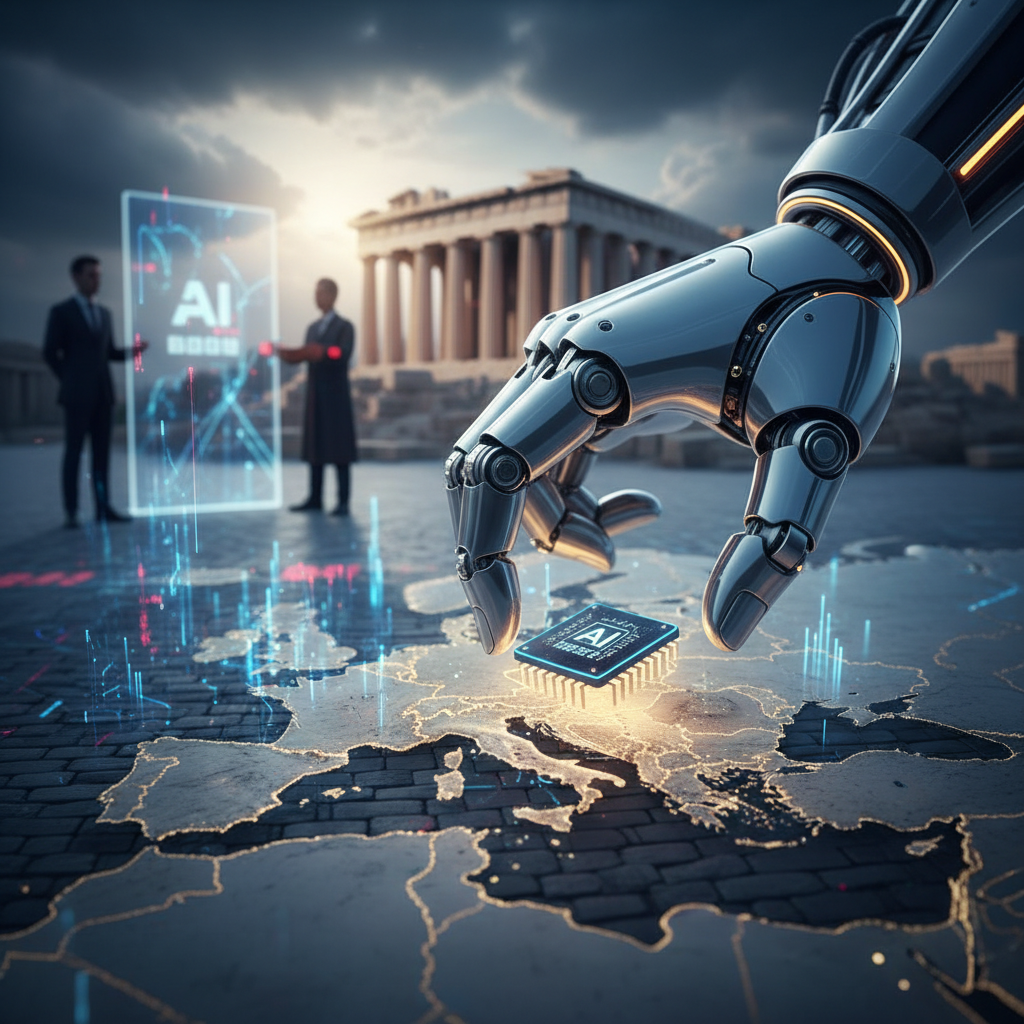

The Aegean sun, even in April, casts long shadows across the ancient stones of the Acropolis, much like the shadow of China's AI ambitions stretches across the global technological landscape. We in Greece, inheritors of philosophical traditions that champion individual liberty and democratic discourse, look at Beijing's approach to artificial intelligence with a mixture of awe and apprehension. It is a model of innovation with state control, a paradox that begs the question: Can true progress flourish under such a tightly managed hand, and what lessons, if any, does it hold for a democratic Europe?
For years, the West has viewed China's tech sector through a lens of intellectual property concerns and human rights issues. Yet, we cannot deny the sheer velocity of its AI development. Companies like Baidu, Tencent, and Alibaba are not merely replicating Western innovation, they are forging their own paths, often at a scale and speed that leaves Silicon Valley breathless. Baidu, in particular, has emerged as a titan, not just in search, but in autonomous driving with Apollo, and in large language models with Ernie Bot. Its recent advancements in multimodal AI, integrating vision, language, and speech, are reportedly on par with, and in some specialized benchmarks, even surpassing, Western counterparts like Google's Gemini or OpenAI's GPT models. This is not just about catching up, it is about setting the pace.
But this innovation is inextricably linked to the state. The Chinese government's 'New Generation Artificial Intelligence Development Plan,' unveiled in 2017, explicitly outlines a national strategy to become the world leader in AI by 2030. This is not a suggestion, it is a directive. Billions of dollars in state funding, preferential policies, and a vast domestic market provide an unparalleled ecosystem for growth. The recent unveiling of Baidu's latest iteration of Ernie Bot, for example, was not just a corporate announcement, it was a national event, lauded by state media as a triumph of Chinese technological prowess. This fusion of corporate ambition and state mandate is profoundly different from the fragmented, often competitive, approach seen in Europe or the US.
Here in Greece, where the very concept of democracy was born, this centralized model presents a philosophical quandary. Our European Union partners are grappling with the AI Act, a landmark piece of legislation aiming to regulate AI based on risk. It is a slow, deliberative process, reflecting our values of transparency, accountability, and fundamental rights. We prioritize the 'how' as much as the 'what.' China, it seems, prioritizes the 'what' above all else: rapid deployment, economic growth, and national security. "The Chinese model demonstrates that centralized planning can accelerate technological adoption," observed Dr. Kai-Fu Lee, a prominent AI venture capitalist and author, in a recent interview. "However, the long-term implications for individual freedoms and open innovation remain a critical debate." His words echo a sentiment often heard in our academic halls in Athens.
Consider the data. China's sheer volume of data, collected from its vast population and integrated across various state and private platforms, fuels its AI algorithms with an intensity unmatched elsewhere. Facial recognition, social credit systems, and pervasive surveillance technologies are not just tools, they are foundational elements of the AI ecosystem. While these applications raise significant ethical concerns in Europe, they are presented in China as essential for social stability and economic efficiency. The contrast could not be starker. For us, data privacy is a fundamental right, enshrined in GDPR. For them, data is a national resource, a strategic asset.
This divergence creates a complex geopolitical chessboard. As Europe seeks to establish its 'digital sovereignty,' it must navigate the dual pressures of competing with China's state-backed giants and safeguarding its democratic values. We cannot simply copy Beijing's model, nor should we. The Mediterranean approach to AI is fundamentally different. We seek to build AI that serves humanity, not controls it. Our focus is on ethical frameworks, explainability, and human oversight. We believe in fostering innovation through collaboration and open standards, not through top-down mandates.
Yet, the commercial realities are undeniable. Chinese companies are expanding globally, bringing their AI solutions to markets in Africa, Latin America, and parts of Asia. Their infrastructure projects, often bundled with AI capabilities, offer attractive packages that Western firms struggle to match without state-level coordination. This is where Europe, and Greece within it, must find its own strength. We must leverage our unique advantages: our strong regulatory environment, which fosters trust; our rich academic traditions, which encourage critical thinking; and our commitment to international cooperation.
Take the example of maritime AI, a sector particularly relevant to Greece with its long seafaring history. While Chinese firms are investing heavily in autonomous shipping and port automation, often with state subsidies, European initiatives are focusing on safety, environmental sustainability, and interoperability. Our Hellenic Centre for Marine Research, for instance, is collaborating with universities across Europe on AI systems for oceanographic data analysis and sustainable fisheries, prioritizing responsible innovation. This is where Greece has something Silicon Valley doesn't: a deep, historical connection to the sea, and a cultural imperative to protect it, which translates into a unique ethical lens for AI development.
We must also acknowledge the allure of China's efficiency. In a world grappling with complex problems like climate change and resource scarcity, the idea of a unified, state-directed approach to technological solutions can seem appealing. But history teaches us that progress without freedom is often a hollow victory. "The challenge for democratic nations is to demonstrate that open, ethical AI development can outcompete authoritarian models in the long run, not just technologically, but in terms of societal benefit and human flourishing," stated Ursula von der Leyen, President of the European Commission, in a recent address to the European Parliament, highlighting the core European dilemma.
As we look ahead to the next decade, the interplay between China's AI governance model and Europe's democratic ideals will define much of the global technological landscape. Can Europe, with its diverse member states and deliberative processes, move with enough agility to foster its own AI champions while upholding its values? Or will the sheer momentum of Beijing's state-backed innovation prove too powerful to resist? The answer will not be found in replicating China's model, but in forging our own, one that marries innovation with a profound respect for human dignity and democratic principles. Athens was the birthplace of democracy, now it is reimagining AI governance, not as a tool of control, but as an extension of human potential, guided by wisdom and foresight. The journey will be long, but the destination, a truly human-centric AI, is worth every step. For more on the global regulatory landscape, consider reading Washington's AI Chess Match: How Brussels and Beijing's Regulations Are Forcing America's Hand, and Who Profits [blocked]. The stakes are nothing less than the future of our societies. The conversation has just begun. For further insights into AI's global impact, visit Reuters Technology.