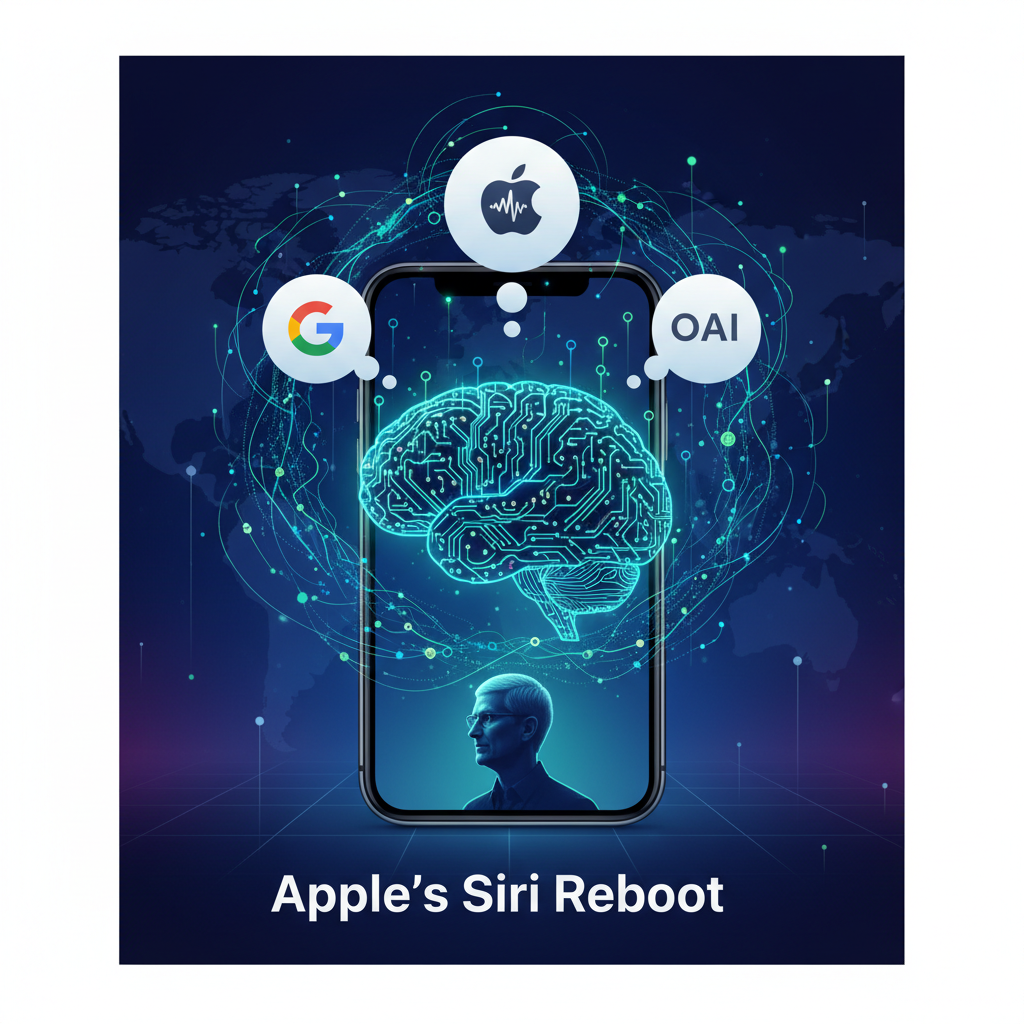

Let's be honest, for a long time, asking Siri for help felt a lot like trying to have a deep conversation with a particularly uninspired vending machine. It could tell you the weather, set a timer, or call your mom, but anything beyond those basic functions often resulted in a blank stare or a frustrating web search. Meanwhile, the world was moving at warp speed, captivated by the conversational prowess of ChatGPT and the expansive knowledge of Google Assistant. For a company as innovative as Apple, headquartered right here in Cupertino, California, this AI gap felt less like a minor oversight and more like a glaring chasm.
But the tides are turning. Whispers have grown into a roar, and now, Apple is finally making its grand play in the generative AI arena. The question on everyone's mind, especially for us here in the States who live and breathe our iPhones, is whether this overhaul will allow Siri to not just catch up, but to truly compete. Is this a genuine paradigm shift, or just another attempt to polish a tarnished apple?
To understand the magnitude of Apple's challenge, we need a quick trip down memory lane. When Siri first launched in 2011, it was revolutionary. It was the first widely adopted voice assistant, a true pioneer. But while Google invested heavily in natural language processing and vast knowledge graphs, and OpenAI burst onto the scene with large language models that could write poetry and debug code, Siri remained largely tethered to a more traditional, rule-based system. It was like comparing a meticulously crafted, but ultimately fixed, mechanical robot to a rapidly evolving, learning organism. The architecture tells the real story here. Siri's original design was not built for the kind of fluid, contextual understanding that defines modern generative AI. It was a command interpreter, not a conversational partner.
Fast forward to today, April 2026. The AI landscape is unrecognizable from even two years ago. OpenAI's GPT models continue to push boundaries, with their latest iterations demonstrating remarkable reasoning capabilities. Google's Gemini family of models is deeply integrated across its ecosystem, offering multimodal interactions that feel genuinely futuristic. According to a recent report by Reuters, the market for conversational AI is projected to reach hundreds of billions of dollars globally within the next five years, and Apple, despite its immense market cap, has been a relatively quiet player in this specific segment.
So, what's actually happening inside Apple's notoriously secretive labs? From what I've gathered through industry contacts and patent filings, Apple's strategy is multi pronged and, crucially, deeply rooted in its core philosophy: privacy and on-device processing. Instead of relying solely on massive cloud-based models, Apple is reportedly focusing on a hybrid approach. This means smaller, highly optimized generative AI models running directly on your iPhone, iPad, and Mac, supplemented by cloud-based intelligence for more complex tasks. This is a significant technical hurdle, requiring immense efficiency gains in model architecture and chip design. Think of it like training a world-class athlete to perform at their peak in a tiny apartment gym, rather than a sprawling Olympic facility. It requires incredible optimization.
This on-device focus isn't just about speed; it's a direct response to the privacy concerns that have become a major talking point in the AI world. When you chat with ChatGPT or Google Assistant, your data often travels to their servers. Apple wants to keep as much of that interaction local as possible. "Apple's commitment to privacy has always been a differentiator, and bringing generative AI on-device aligns perfectly with that," explained Carolina Milanesi, a principal analyst at Creative Strategies, in a recent interview. "It's a harder engineering problem, but it could be a significant trust advantage for consumers." This is a perspective I hear often from folks in Silicon Valley; the privacy angle is a powerful one, especially in a post-Cambridge Analytica world.
However, the challenge for Apple is immense. The sheer scale of data and compute power that companies like Google and OpenAI have poured into training their foundational models is staggering. "Catching up in raw model capability is going to be incredibly difficult for Apple," stated Dario Amodei, CEO of Anthropic, in a recent tech conference keynote. "The race for frontier models is often won by those with the most compute and the most data, and that's a high bar." This isn't just about throwing money at the problem; it's about years of iterative research and development, building vast datasets, and optimizing training pipelines.
Another critical aspect is the integration with third-party apps. ChatGPT and Google Assistant have made significant strides in connecting with a multitude of services, from booking flights to ordering food. Siri's past limitations in this area have been a major pain point. Apple's new AI strategy reportedly includes a more robust framework for developers to integrate their apps with the enhanced Siri, potentially opening up a new ecosystem of intelligent interactions. This is where the rubber meets the road for everyday usability. If Siri can seamlessly manage my calendar, draft an email, and then order my favorite coffee from a local cafe in San Francisco, all with natural language, that's a game changer.
Let me decode this for you. Imagine you're planning a trip to Yosemite National Park. Instead of opening multiple apps to check weather, book lodging, and find hiking trails, a truly intelligent Siri could handle all of it with a few conversational prompts, drawing on information from various sources while keeping your personal data secure on your device. This is the vision Apple is reportedly chasing, a deeply personalized, proactive, and private AI assistant that anticipates your needs rather than just reacting to commands.
My verdict? Apple is not just trying to catch up; they are trying to redefine the playing field. They are betting that their unique strengths, hardware software integration, a massive user base, and an unwavering commitment to privacy, can create an AI experience that surpasses what cloud-first competitors offer. It's a bold gamble, one that requires significant breakthroughs in on-device AI and a more open approach to developer integration than we've seen from Apple in the past. If they succeed, Siri could evolve from a digital assistant to a true personal AI, deeply embedded in our lives and devices. If they falter, they risk being permanently relegated to a niche player in the most important technological race of our generation. The next 12 to 18 months will be crucial, and I for one, will be watching very closely from my perch here in the USA, eager to see if Apple can finally deliver the AI assistant we've always dreamed of. For more insights into the evolving AI landscape, you can always check out The Verge.
This isn't just about features; it's about trust. In an era where data privacy is paramount, Apple's approach could resonate deeply with consumers who are increasingly wary of handing over their digital lives to large corporations. The company's historic control over its ecosystem, while sometimes criticized, could now become its greatest asset in delivering a truly secure and integrated AI experience. It's a long shot, but if anyone can pull off a late-stage comeback in the tech world, it's Apple. After all, they've done it before, turning around their fortunes multiple times. The question isn't just if Siri can catch up, but if Apple can convince us that their way is the better way, building on their legacy of user experience and privacy, a legacy that has always resonated strongly with American consumers.