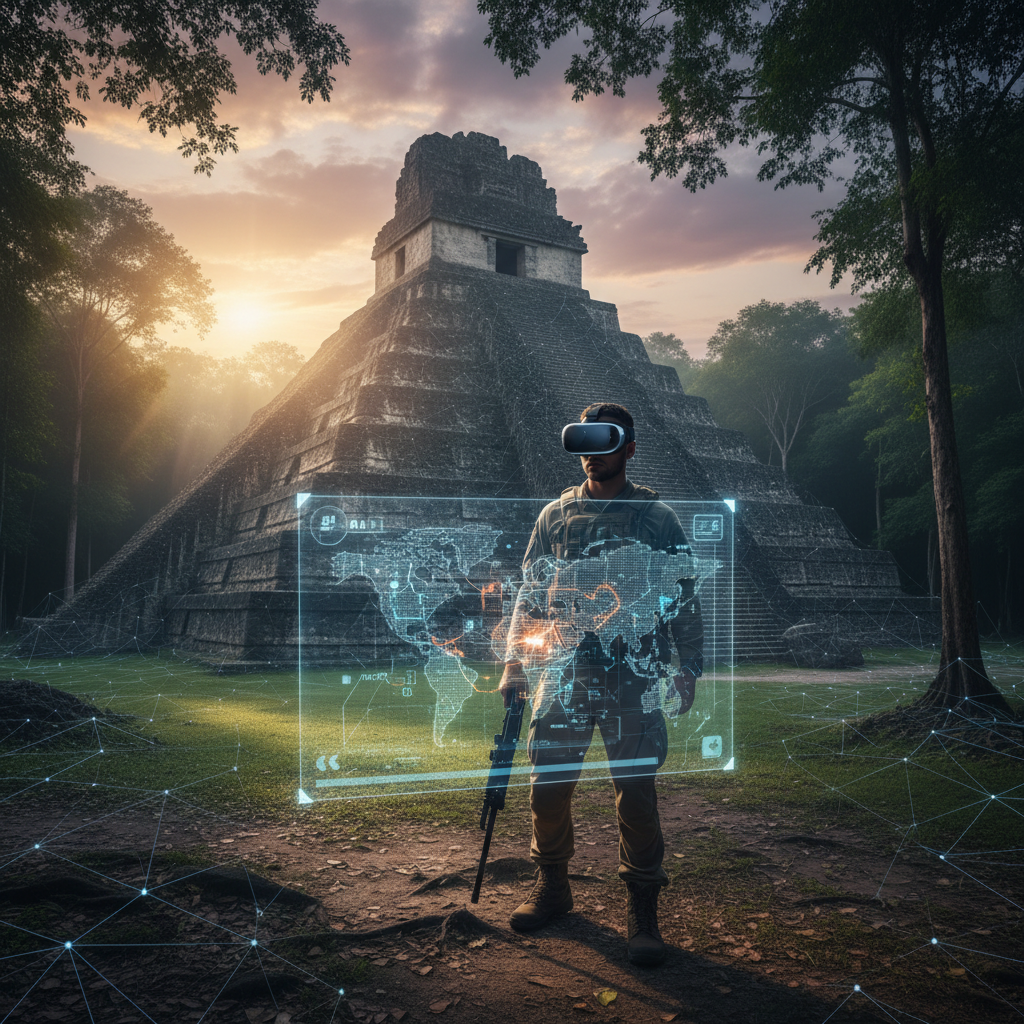

The air in Petén, Guatemala, usually hums with the sounds of howler monkeys and the rustling leaves of the rainforest, a timeless symphony guarding the secrets of the ancient Maya. But recently, a new sound has joined the chorus: the quiet whir of advanced technology. Apple Vision Pro, with its sophisticated AI capabilities for spatial computing, has made an unprecedented entry into the heart of the Maya biosphere, mapping archaeological sites with breathtaking precision. This is not just a technological marvel, it is a story about resilience and a moment that forces us to ask: who truly benefits when cutting-edge AI meets ancestral lands?
The news broke just hours ago, sending ripples through archaeological circles, indigenous communities, and government offices alike. A collaborative project, spearheaded by a consortium of international researchers and a private foundation, utilized Apple Vision Pro headsets and custom AI algorithms to create hyper-realistic, three-dimensional digital twins of several lesser-known Maya ruins. These aren't just pretty pictures, they are intricate data models, capturing every stone, every glyph, every contour of the jungle-reclaimed structures with millimeter accuracy. The potential for preservation, study, and even virtual tourism is immense.
Dr. Elena Morales, a leading archaeologist at the Universidad del Valle de Guatemala, expressed a mix of awe and caution. "For decades, we have battled the elements, looters, and the sheer scale of the jungle to understand these sites," she told DataGlobal Hub earlier today. "To have a tool like Apple Vision Pro, capable of processing such vast amounts of spatial data with its integrated AI, it is a game-changer for conservation. Imagine, we can monitor erosion in real time, plan restoration with unparalleled accuracy. It is a dream for many of us who have dedicated our lives to protecting this heritage." She emphasized the speed and detail, noting that what would take years of manual photogrammetry and lidar scanning could now be accomplished in weeks, thanks to the AI's ability to interpret and reconstruct complex environments from multiple perspectives.
However, the excitement is tempered by significant concerns, particularly from the indigenous Maya communities whose ancestors built these very cities. "Our ancestors' wisdom is etched into these stones, into the very land," said Don Pedro Ixbalanqué, a respected elder and community leader from a nearby K'iche' village. His voice, usually calm and measured, carried a note of urgency. "When technology comes from far away, from another world, and scans our sacred places, we must ask: what happens to this knowledge? Who owns these digital copies? Will our children be able to access them, or will they be locked behind foreign companies and paywalls?" Don Pedro's questions cut to the core of a dilemma many developing nations face when advanced technology arrives: the balance between progress and cultural sovereignty.
The project, which has been operating under wraps for several months, reportedly involved a team of over 50 specialists, including Apple engineers, archaeologists, and local field assistants. The AI at the heart of Apple Vision Pro's spatial computing capabilities allows it to not only map physical spaces but also to understand and interact with them in ways traditional cameras cannot. This means the digital models are not static images, but dynamic environments that can be explored, analyzed, and even virtually rebuilt. The AI's ability to perform real-time object recognition and environmental understanding is crucial for navigating dense jungle foliage and identifying subtle architectural features.
Guatemalan Minister of Culture, Licenciada Sofía García, acknowledged the dual nature of this development. "We welcome innovation that helps us protect our invaluable heritage," she stated in a press conference this afternoon. "The Ministry is currently reviewing the legal frameworks surrounding digital cultural property and data ownership. We need to ensure that any data collected on Guatemalan soil, especially concerning our ancestral sites, remains under the sovereign control of Guatemala and benefits its people, particularly our indigenous communities. We are in active discussions with the project leaders to establish clear protocols for data access, usage, and intellectual property rights." She highlighted that the economic potential for virtual tourism could be significant, but only if managed ethically and inclusively.
Experts agree that this incident underscores a growing global challenge: how to regulate and manage the immense data generated by spatial computing and advanced AI, especially when it pertains to cultural heritage. "The Apple Vision Pro is a powerful tool, but like any powerful tool, its impact depends entirely on how it is wielded," explained Dr. Kenji Tanaka, a specialist in digital ethics from MIT Technology Review. "The AI models created from these scans are incredibly rich datasets. They could be used to educate millions, to inspire new generations of archaeologists, or they could be commercialized without proper consent, potentially leading to new forms of exploitation. The concept of 'digital repatriation' is becoming as critical as physical repatriation of artifacts." He stressed the need for international agreements and local policies that prioritize community benefit and ethical data governance.
What happens next is critical. The Ministry of Culture has called for an immediate meeting with the project's international partners and representatives from indigenous councils to establish a clear framework. There is talk of creating a national digital archive, managed by Guatemala, where these spatial computing models would reside. The hope is to develop open-source tools and platforms that allow local researchers and community members to engage directly with the data, rather than relying solely on external entities. This is a crucial step towards ensuring that the technology serves the people, not the other way around. The conversation must shift from simply 'what can AI do?' to 'what should AI do, and for whom?'
For communities like Don Pedro's, the stakes are profoundly personal. Her grandmother's wisdom meets machine learning in this moment, a convergence of ancient knowledge and futuristic technology. The worry is that the digital copies, however perfect, might further distance them from the tangible, spiritual connection to their heritage. The challenge is to bridge this gap, to ensure that the digital preservation enhances, rather than replaces, the living cultural traditions. As this breaking news unfolds, it serves as a powerful reminder that technology, no matter how advanced, is always intertwined with human stories, human values, and human rights. The world watches to see if Guatemala can forge a path where spatial computing empowers, rather than overshadows, its rich, ancient soul. You can learn more about the broader implications of AI in cultural contexts on Wired. For those interested in the technical aspects of spatial computing, The Verge often covers new developments. The dialogue around these technologies is only just beginning, and its outcome will shape not just the future of archaeology, but the future of indigenous sovereignty in a digitally interconnected world.