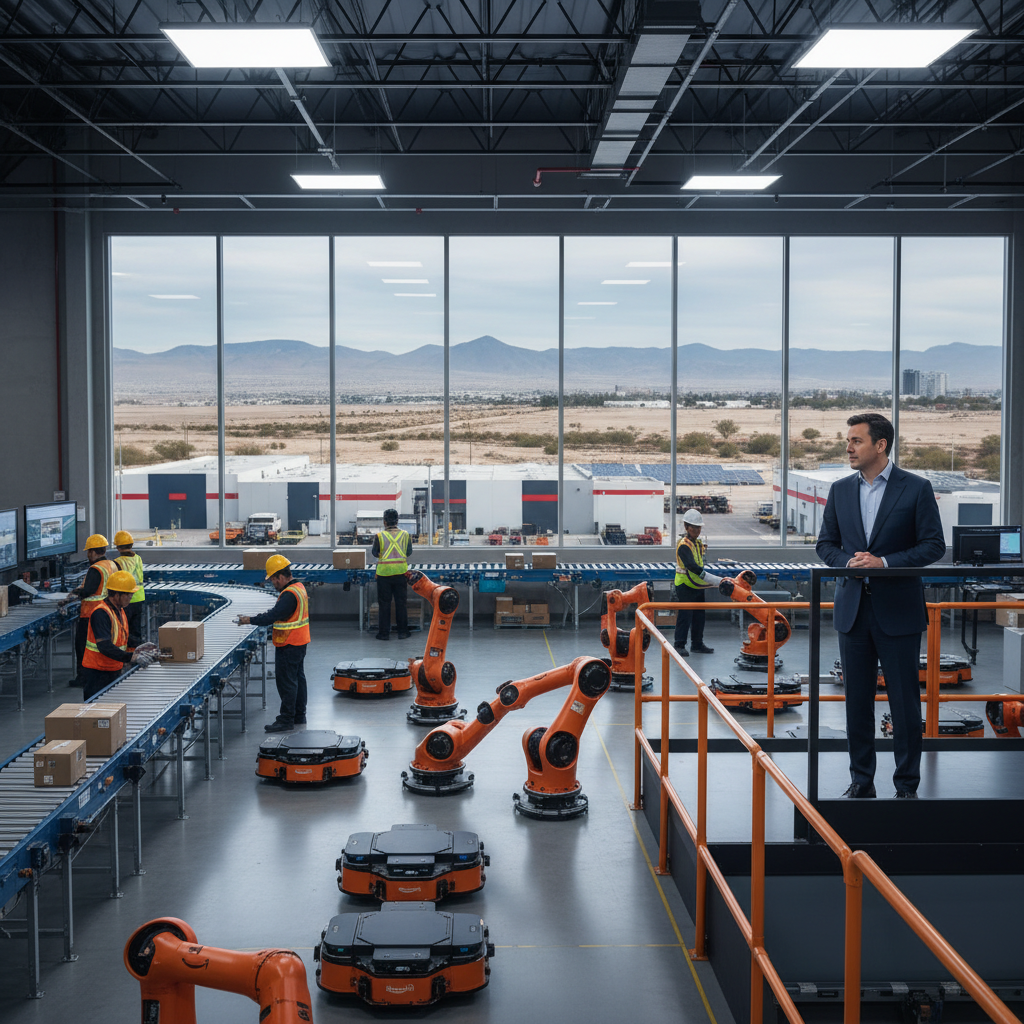

Walk into an Amazon fulfillment center today, and you might think you've stepped onto the set of a sci-fi movie. Gone are the days of endless rows of human pickers navigating miles of shelves. Instead, you're greeted by a ballet of Kiva robots, now known as Amazon Robotics drives, scurrying across the floor, lifting entire shelving units, and delivering them to human associates. This isn't just automation, it's a deeply integrated AI-powered ecosystem, a testament to what happens when compute scaling meets real-world operational challenges. For developers, data scientists, and technical professionals, understanding the underlying architecture and algorithms is key to grasping its true impact.
The technical challenge Amazon faces is colossal: how do you efficiently manage billions of items, process millions of orders daily, and deliver them to customers often within hours, all while optimizing costs and minimizing errors? Imagine a massive, multi-dimensional Tetris game playing out in real time, but with millions of pieces, each with its own velocity, weight, and destination. Traditional warehouse management systems, even advanced ones, simply buckle under this complexity. The sheer scale of Amazon's operations, particularly across its vast network of facilities in the USA, demands an AI solution that can learn, adapt, and predict.
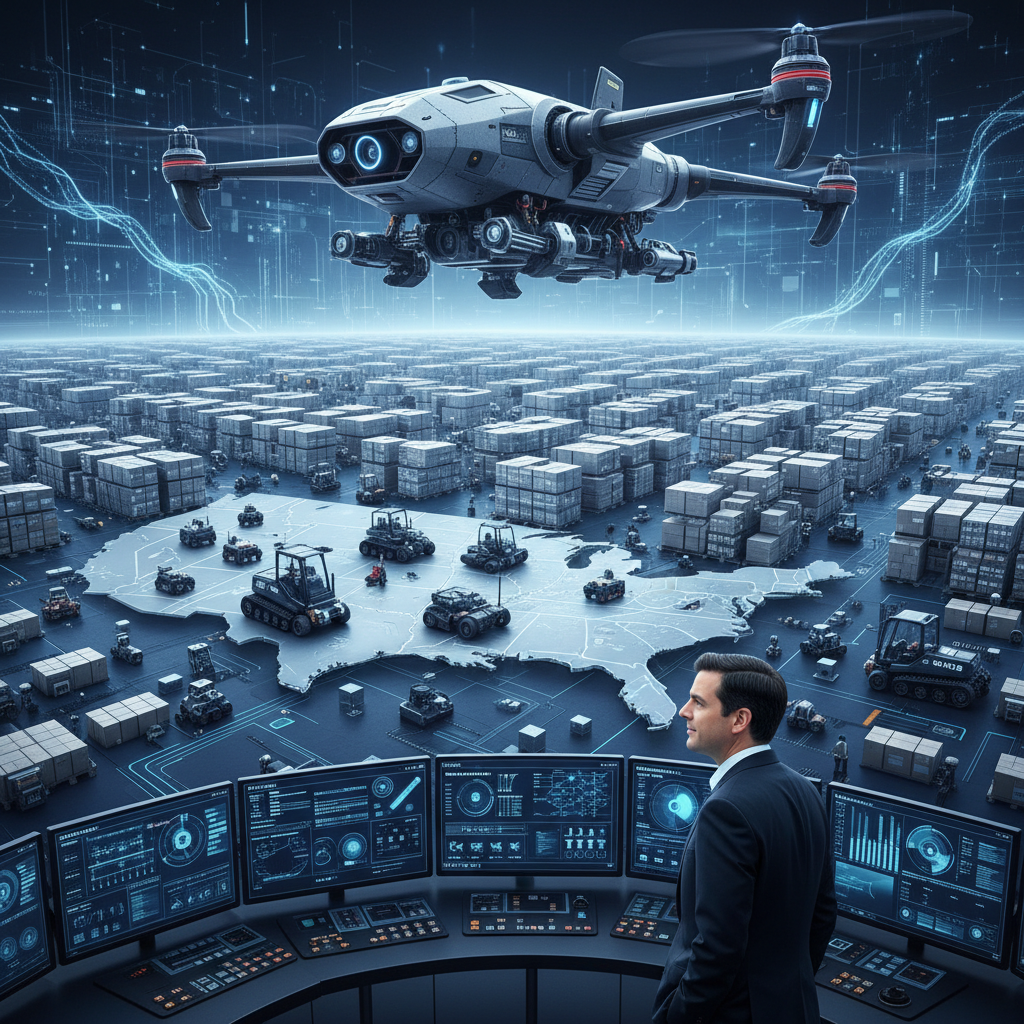
At its core, Amazon's AI-driven logistics system is a distributed, hierarchical architecture. It's not a single monolithic AI, but rather a constellation of specialized AI agents and optimization algorithms working in concert. Think of it like a city's traffic control system, where individual traffic lights and navigation apps communicate to keep everything flowing. At the highest level, a demand forecasting system, often leveraging deep learning models like LSTMs or Transformer networks, predicts customer orders with remarkable accuracy. This prediction feeds into inventory placement algorithms, which decide where to store items across hundreds of fulfillment centers. This is where the magic begins. Lower down, within each fulfillment center, a real-time orchestration layer takes over.
Here's what's actually happening inside Amazon's fulfillment centers: Each Amazon Robotics drive is equipped with sensors and communicates with a central control system. This system, often running on a distributed computing framework like Apache Spark or Kubernetes clusters, uses a combination of path planning, task allocation, and multi-agent reinforcement learning. Path planning algorithms, such as A* search or its variants, ensure robots navigate efficiently without collisions, dynamically updating routes based on real-time obstacles. For task allocation, a critical component is the use of combinatorial optimization. When an order comes in, the system determines the optimal sequence of tasks: which robot should retrieve which shelf, and in what order, to minimize travel time and maximize throughput. This is a classic NP-hard problem, tackled with heuristics and sophisticated approximation algorithms.*
Let me decode this for you. Imagine a scenario where a customer in New York orders a book, a coffee maker, and a pair of headphones. The system doesn't just send three robots to three different locations. Instead, it might assign a single robot to pick up the book and coffee maker from adjacent shelves, then a second robot for the headphones, ensuring both robots arrive at the packing station at roughly the same time. This is achieved through algorithms that continuously re-evaluate the state of the warehouse, the location of every robot, and the pending tasks, making millions of micro-decisions per second. The architecture tells the real story: it's a layered approach, from global network optimization down to individual robot movements, all interconnected.
Key Algorithms and Approaches:
-
Multi-Agent Reinforcement Learning (marl): This is crucial for coordinating hundreds or thousands of robots simultaneously. Each robot can be considered an agent learning optimal policies (e.g., movement, speed, task selection) by interacting with the environment and receiving rewards (e.g., reduced travel time, successful delivery). Techniques like Q-learning or Policy Gradient methods are adapted for multi-agent settings, often with centralized training and decentralized execution. The challenge is managing the 'curse of dimensionality' as the number of agents grows.
-
Constraint Satisfaction Problems (CSPs) and Mixed Integer Programming (MIP): For task assignment and scheduling, especially when considering human-robot interaction points, CSPs and MIPs are heavily utilized. They define variables (e.g., robot assignments, task start times), constraints (e.g., robot capacity, collision avoidance, human availability), and an objective function (e.g., minimize total time, maximize throughput). Solvers like Gurobi or Cplex are often employed for these computationally intensive problems.
-
Computer Vision for Quality Control: As items are picked and packed, advanced computer vision systems, often powered by convolutional neural networks (CNNs), perform quality checks. They verify item identity, detect damage, and ensure correct quantities. This reduces human error and speeds up the packing process significantly. Think of it as a digital eagle eye, constantly scanning for discrepancies.
Implementation Considerations: The sheer volume of data generated by sensors, robot movements, and order flows requires a robust data infrastructure. Amazon Web Services (AWS) provides the backbone, leveraging services like Kinesis for real-time data streaming, S3 for storage, and SageMaker for model training and deployment. Latency is a critical factor; decisions need to be made in milliseconds. This often necessitates edge computing, where some AI models run directly on the robots or on localized servers within the fulfillment center, reducing reliance on central cloud processing for immediate actions.
Benchmarks and Comparisons: While Amazon keeps its specific performance metrics proprietary, the industry standard for warehouse automation often focuses on 'picks per hour' and 'storage density.' Amazon's systems consistently outperform traditional manual warehouses by orders of magnitude in both. For example, a human picker might achieve 60-100 picks per hour, while an Amazon Robotics system can enable human associates to process hundreds of items per hour by bringing the shelves to them. Competitors like Walmart and Target are investing heavily in similar automation, but Amazon's decade-plus head start and integration depth remain a significant advantage. The scale of their operations is simply unparalleled, making direct comparisons difficult without considering the entire ecosystem.
Code-Level Insights: While proprietary, the underlying principles often involve Python for scripting and data science, C++ for high-performance robot control, and Java or Go for distributed services. Frameworks like TensorFlow or PyTorch are used for deep learning models, while libraries like SciPy and NumPy are essential for numerical optimization. For real-time scheduling, custom-built solvers or highly optimized open-source libraries are likely in play. The emphasis is on fault tolerance, scalability, and robust error handling, given the 24/7 operational demands.
Real-World Use Cases:
- Kiva Systems (Amazon Robotics): The most visible application, these mobile robots transport shelving units to human 'pickers' or 'stowers,' drastically reducing human travel time and increasing throughput. They are deployed in hundreds of Amazon fulfillment centers globally, including major hubs in Kentucky, Texas, and California.
- Sortation and Packaging: AI-powered systems use computer vision and robotic arms to sort packages by destination and pack items efficiently, minimizing box size and material waste. This is where advanced manipulation algorithms come into play.
- Inventory Management: Predictive AI models analyze sales data, seasonality, and external factors to optimize inventory levels, reducing overstocking and stockouts. This is a continuous, dynamic process that ensures products are available when and where customers need them.
- Last-Mile Delivery Optimization: Beyond the warehouse, AI optimizes delivery routes for vans and even drones, considering traffic, weather, and customer preferences. This is a complex traveling salesman problem at scale, solved using sophisticated graph algorithms and real-time data feeds.
Gotchas and Pitfalls: The complexity of these systems introduces several challenges. One major 'gotcha' is the 'brittleness' of highly optimized systems. A single sensor failure or a slight deviation from expected conditions can cascade into significant disruptions. Robust error detection, self-healing mechanisms, and human-in-the-loop oversight are crucial. Another pitfall is the ethical consideration of human-robot collaboration. Ensuring worker safety, designing intuitive interfaces for human interaction, and addressing the impact on employment are ongoing challenges. As Dr. Kate Darling, a leading expert on human-robot interaction at MIT, often states, "The future of robotics isn't just about building better machines, it's about building better relationships between humans and machines." MIT Technology Review has extensively covered these societal implications.
Moreover, the initial capital expenditure for such advanced automation is enormous, making it a viable strategy primarily for companies with Amazon's scale and resources. Smaller players often struggle to justify the upfront investment, though the cost of robotics is steadily decreasing. The sheer volume of data required to train and maintain these models is also a significant hurdle, demanding sophisticated data pipelines and governance.
Resources for Going Deeper: For those looking to dive further, exploring academic papers on multi-agent reinforcement learning, combinatorial optimization, and robotic path planning is a great start. Journals like Science Robotics and conferences such as Icra (International Conference on Robotics and Automation) provide cutting-edge research. For practical implementation, understanding distributed systems and cloud architecture, particularly AWS services, is invaluable. Companies like Boston Dynamics and Agility Robotics are pushing the boundaries of physical robot capabilities, while the software orchestration remains the true brain of operations. You can also find excellent resources on real-time data processing and large-scale machine learning on ArXiv and through various online courses. The journey from a simple warehouse to an AI-orchestrated symphony of logistics is a fascinating one, and Amazon continues to lead the charge, redefining what's possible in the world of supply chain management.