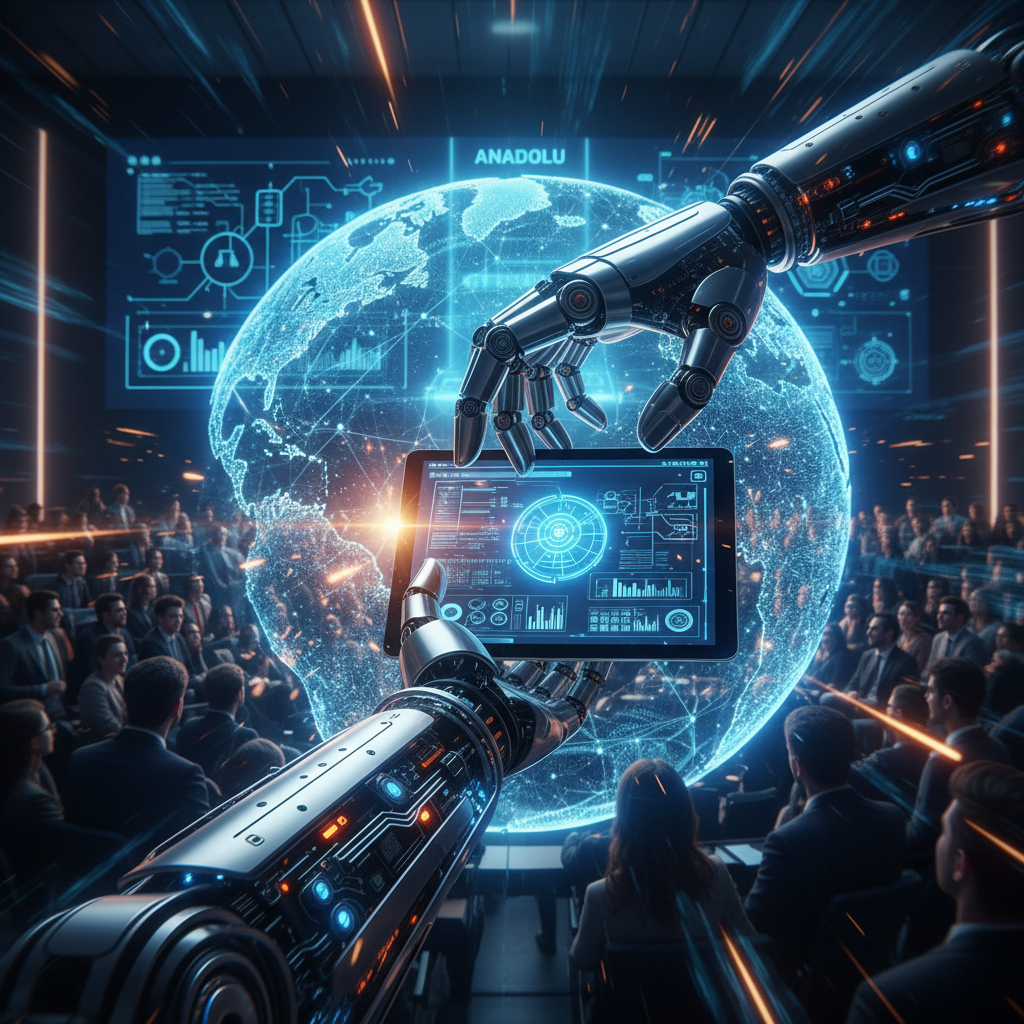
The morning air in Istanbul, usually thick with the scent of simit and strong coffee, today carries a different kind of buzz: the hum of a revolution. Not a political one, not an economic one, but something far more profound for the soul of a nation. Anadolu EdTech Group, a name that has quietly been building an empire in digital learning, has just launched 'Akıl Hocası' (The Mind Mentor), an AI-powered personalized learning platform that promises to fundamentally reshape education for Turkey's 19 million students. This isn't merely an upgrade; it's a complete reimagining, a bold declaration that Turkey is building the future at the crossroads, not just observing it.
For decades, we have spoken of personalized learning as a utopian dream, a luxury for the privileged few. Today, Anadolu EdTech, a company whose roots are as deep in Turkish soil as the ancient olive trees of Anatolia, has made it a tangible reality for the masses. Akıl Hocası, powered by a bespoke large language model trained extensively on Turkish curricula, pedagogical approaches, and even regional dialects, offers every student an individualized learning path, adapting in real time to their strengths, weaknesses, and even their emotional state. It's like having a private tutor, a wise elder from the village, guiding each child through the labyrinth of knowledge, but available 24/7 and infinitely scalable.
The announcement, made from the historic halls of Istanbul Technical University, was met with a mix of awe and cautious optimism. Dr. Elara Demir, CEO of Anadolu EdTech Group, spoke with a passion that resonated deeply. "For too long, our education system, like many around the world, has been a one-size-fits-all garment," she declared, her voice echoing through the grand hall. "Akıl Hocası changes that. It understands that a child in Diyarbakır learns differently from a child in Izmir, and both deserve an education tailored to their unique brilliance. We are not just teaching subjects; we are nurturing minds, fostering curiosity, and preparing a generation to lead." She emphasized that the platform is designed to complement, not replace, human teachers, freeing them from repetitive tasks to focus on mentorship and deeper engagement.
The implications are staggering. Imagine a student struggling with calculus receiving instant, tailored explanations and practice problems, not just generic textbook examples. Picture another, excelling in literature, being challenged with advanced texts and creative writing prompts that push their boundaries. Akıl Hocası uses multimodal AI, integrating text, voice, and even visual learning modules, making it accessible across diverse learning styles. Its adaptive algorithms continuously assess progress, identify learning gaps, and recommend resources, from interactive simulations to virtual field trips across Turkey's rich historical sites.
Official reactions have been overwhelmingly positive. The Ministry of National Education has already announced a pilot program to integrate Akıl Hocası into 5,000 public schools across the country by late 2026, with plans for nationwide rollout by 2028. "This is a monumental step for our nation's future," stated Minister of Education, Professor Ahmet Can Yılmaz. "We believe Akıl Hocası will not only improve academic outcomes but also foster critical thinking and problem-solving skills, essential for the global economy. This is the Ottoman approach to AI empire-building, using innovation to empower our people." The Minister highlighted that the platform also includes modules for vocational training and digital literacy, crucial for a rapidly evolving job market.
Experts, while impressed, also raised important questions. "The scale of this deployment is unprecedented," noted Dr. Leyla Karahan, a leading AI ethicist from Boğaziçi University. "The data privacy implications, the potential for algorithmic bias, and the digital divide must be addressed with utmost transparency and care. We need robust regulatory frameworks to ensure equity and protect our children's digital well-being." Her concerns are valid; a system this powerful demands rigorous oversight. Anadolu EdTech has stated they are working closely with national and international bodies to establish best practices for data governance and ethical AI deployment.
What happens next is the true test. Can a nation of nearly 85 million people, with its diverse socio-economic landscape, truly embrace such a transformative technology? The initial data from early trials is promising. In a pilot involving 50,000 students across various regions, participants using Akıl Hocası showed a 15% improvement in standardized test scores and a 20% increase in reported engagement and motivation. This is not just about numbers; it is about the spark in a child's eye when they finally grasp a difficult concept, the confidence gained from personalized success.
The economic impact alone could be staggering. A more educated, skilled workforce will undoubtedly attract further foreign investment and spur local innovation. Istanbul's tech ambitions are massive and realistic, and this initiative is a cornerstone of that vision. As we look towards the next decade, the ability to rapidly upskill and reskill our population will be paramount. Akıl Hocası, with its flexible and adaptive learning pathways, could be the engine that drives this transformation, ensuring that Turkey remains competitive on the global stage.
This isn't just a story about technology; it's a narrative about aspiration, about a nation's commitment to its youth. It's about leveraging the power of artificial intelligence to unlock human potential on an unprecedented scale. The world has watched Silicon Valley for its innovations, but today, the eyes of the educational world should turn towards the Bosphorus. The future of personalized learning, it seems, is being forged right here, in the heart of Turkey. For more insights into how AI is reshaping global industries, you can explore Reuters Technology or MIT Technology Review. This is a story that will define a generation, a chapter in Turkey's journey to becoming a true AI powerhouse. The bell has rung, and the lesson has begun. For deeper dives into AI's societal impact, Wired's AI section offers extensive coverage.