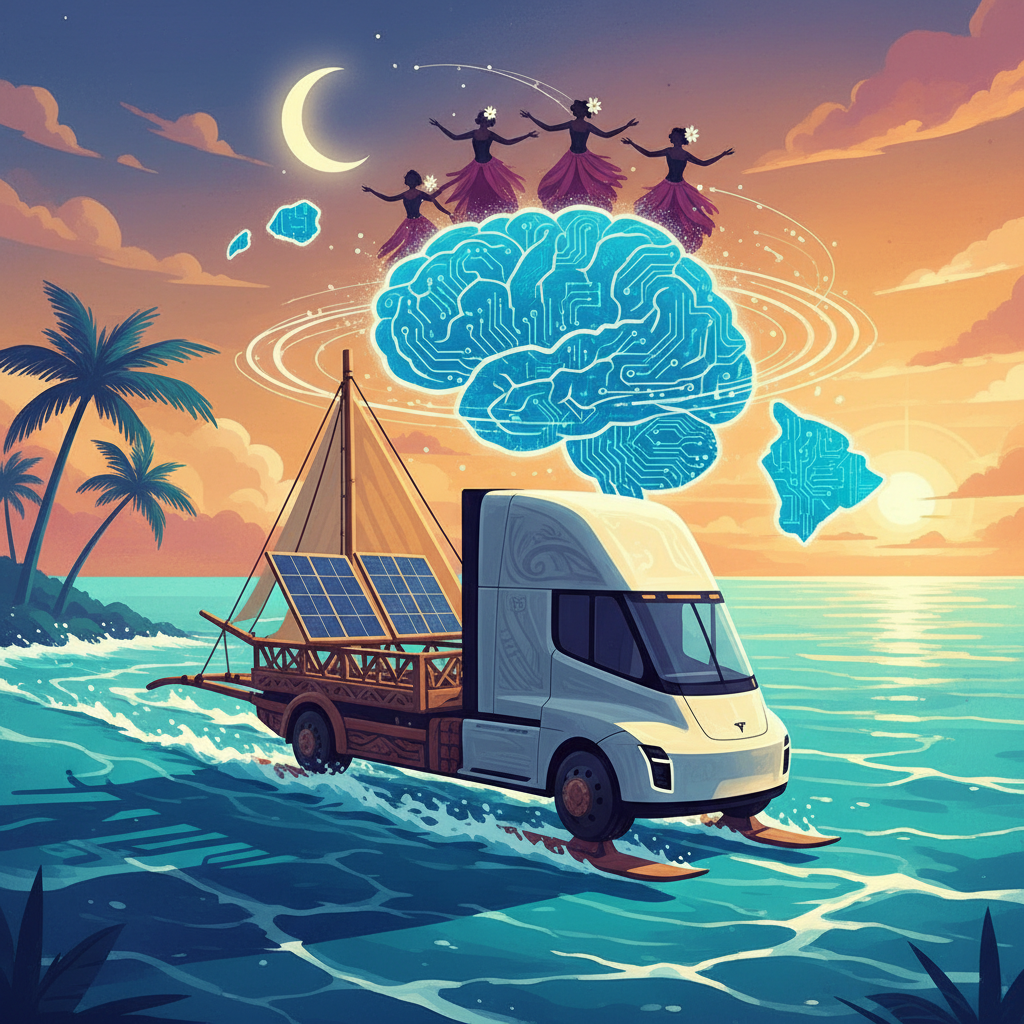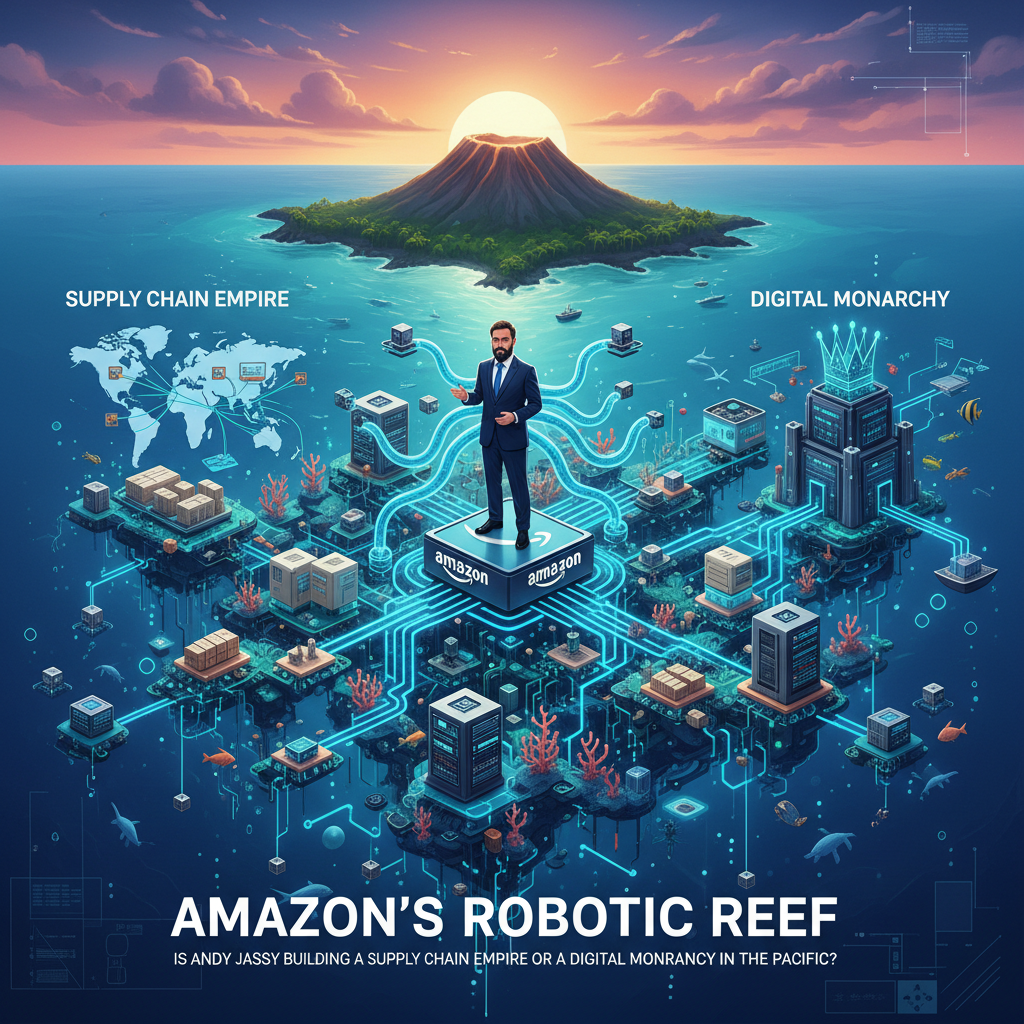

Walk into an Amazon fulfillment center today, and you might think you've stepped onto a different planet. The whirring, clicking symphony of Kiva robots, the precise movements of robotic arms, the data streams predicting your next purchase before you even think it: it's a ballet of silicon and steel, all orchestrated by artificial intelligence. This isn't just about faster package delivery, my friends, it's about a fundamental re-engineering of how goods move across the globe. But from my vantage point here in Hawaii, sitting at the crossroads of Pacific and Silicon Valley, I have to ask: Is Amazon's AI-powered logistics revolution a rising tide that lifts all boats, or is it building a digital monarchy that will leave our island economies gasping for air?
For decades, the rhythm of commerce was largely human. From the bustling docks of Honolulu to the remote atolls of Micronesia, goods moved on ships, then trucks, then hands. The efficiency gains were incremental, often tied to infrastructure improvements or labor practices. Then came the internet, then e-commerce, and now, the AI-driven automation wave. Amazon, under the leadership of Andy Jassy, has been at the forefront, pouring billions into robotics and AI. They've acquired companies like Kiva Systems for nearly a billion dollars back in 2012, a move that, in retrospect, looks like a steal. They've developed their own fleet of robots, like Proteus, which can navigate human-centric spaces, and Sparrow, designed for picking individual items. The goal is clear: reduce costs, increase speed, and eliminate human error. It's a compelling vision for a company built on customer obsession.
Today, Amazon operates over 750,000 robotic drive units globally, a staggering number that has more than doubled in just five years. These robots work alongside humans, but the trend is undeniably towards greater automation. According to a recent report from The Verge, Amazon's investment in AI and robotics for its supply chain is projected to exceed 100 billion dollars by 2030. This isn't just about moving boxes; it's about predictive analytics, optimizing routes, managing inventory in real time, and even anticipating demand with unnerving accuracy. Their AI models, leveraging vast datasets of consumer behavior, weather patterns, and global events, are making decisions that were once the domain of thousands of human logistics experts.
But what does this mean for us, out here in the middle of the largest ocean on Earth? We are, by nature of our geography, reliant on robust, efficient, and affordable supply chains. When Amazon's AI streamlines its operations on the mainland, does that translate to cheaper goods for our isolated communities, or does it simply consolidate power and remove local opportunities? My opinion, informed by the wisdom of our ancestors, is that we must look beyond the immediate convenience and consider the long-term impact on our social fabric and economic resilience.
I recently spoke with Dr. Leilani Kai, a professor of Supply Chain Management at the University of Hawaii at Manoa. She expressed a cautious optimism, saying, “Amazon’s advancements certainly offer potential for improved efficiency in the final mile, even for remote areas. However, the critical question for Hawaii and other Pacific islands is whether these technologies are adaptable to our unique logistical challenges, like interisland shipping and limited infrastructure, or if they simply widen the gap between us and mainland markets. We need solutions that respect our scale and our environment, not just scaled-down versions of continental systems.” Her point is well taken: a one size fits all approach rarely works in the Pacific.
Then there's the human element. While Amazon often emphasizes how robots free up humans for more complex tasks, the reality on the ground can be different. “The push for automation is relentless,” observed Keoni Pua, a longshoreman with decades of experience at Honolulu Harbor. “We see the writing on the wall. While some jobs change, others disappear. My concern is for the next generation. What will their opportunities be if every step of the supply chain is automated by a machine controlled from Seattle?” This isn't just about jobs, it's about dignity and purpose, about the ability to provide for one's family through honest work. Aloha means more than hello because it's a framework for ethical AI, and that framework demands we consider the human impact of these technological shifts.
I also reached out to Maria Tapa, a small business owner in Fiji who relies heavily on imported goods. “We already pay a premium for everything because of shipping costs,” she told me. “If Amazon's AI makes their own operations cheaper, will they pass those savings on, or will they just use their dominance to outcompete local distributors even more aggressively? We need fair access to these efficiencies, not just to be consumers at the end of a very long, very automated chain.” Her words echo a common sentiment across the Pacific: the fear of being marginalized by global giants whose priorities lie far from island shores.
From the perspective of Silicon Valley, the narrative is usually one of progress and inevitable change. I recall a conversation with a former Amazon executive, now at a prominent AI startup, who wished to remain anonymous. He put it bluntly: “The market demands efficiency. If you can move a package from warehouse to doorstep in hours, not days, at a fraction of the cost, you do it. The economic benefits are undeniable, and the technology will only get better. It’s not about if, it’s about when every aspect of logistics is AI-driven.” This perspective, while pragmatic, often overlooks the nuanced social and cultural costs that can be borne by communities far from the tech hubs.
So, is Amazon's AI-powered logistics revolution a fad or the new normal? My verdict is clear: this is the new normal, and it's accelerating faster than many realize. The sheer scale of investment, the sophistication of the AI, and the relentless pursuit of efficiency mean there’s no turning back. However, the nature of this new normal, particularly for places like Hawaii and the broader Pacific, is still very much in flux. We cannot afford to be passive recipients of this technological wave. We must actively engage, demand transparency, and seek equitable integration. The future is being built on volcanic rock, and we have a say in its foundation.
For us, the challenge is to harness these powerful tools in a way that aligns with our values of malama aina, caring for the land, and aloha, mutual respect and compassion. This means advocating for AI solutions that are not just efficient but also resilient, sustainable, and inclusive. It means nurturing local tech talent and fostering indigenous data rights, ensuring that the benefits of this revolution are shared, not hoarded. We must ask: can Amazon's AI be a tool for empowerment, or will it simply reinforce existing power structures? The answer, I believe, lies in our collective ability to shape its trajectory, not just react to it. We need to ensure that this digital reef, built by AI, becomes a vibrant ecosystem for all, not just a fortress for a few. For more on how AI is impacting global economies, you can check out coverage on Reuters Technology. The conversation around AI's societal impact is ongoing, and it's one we must all be part of.