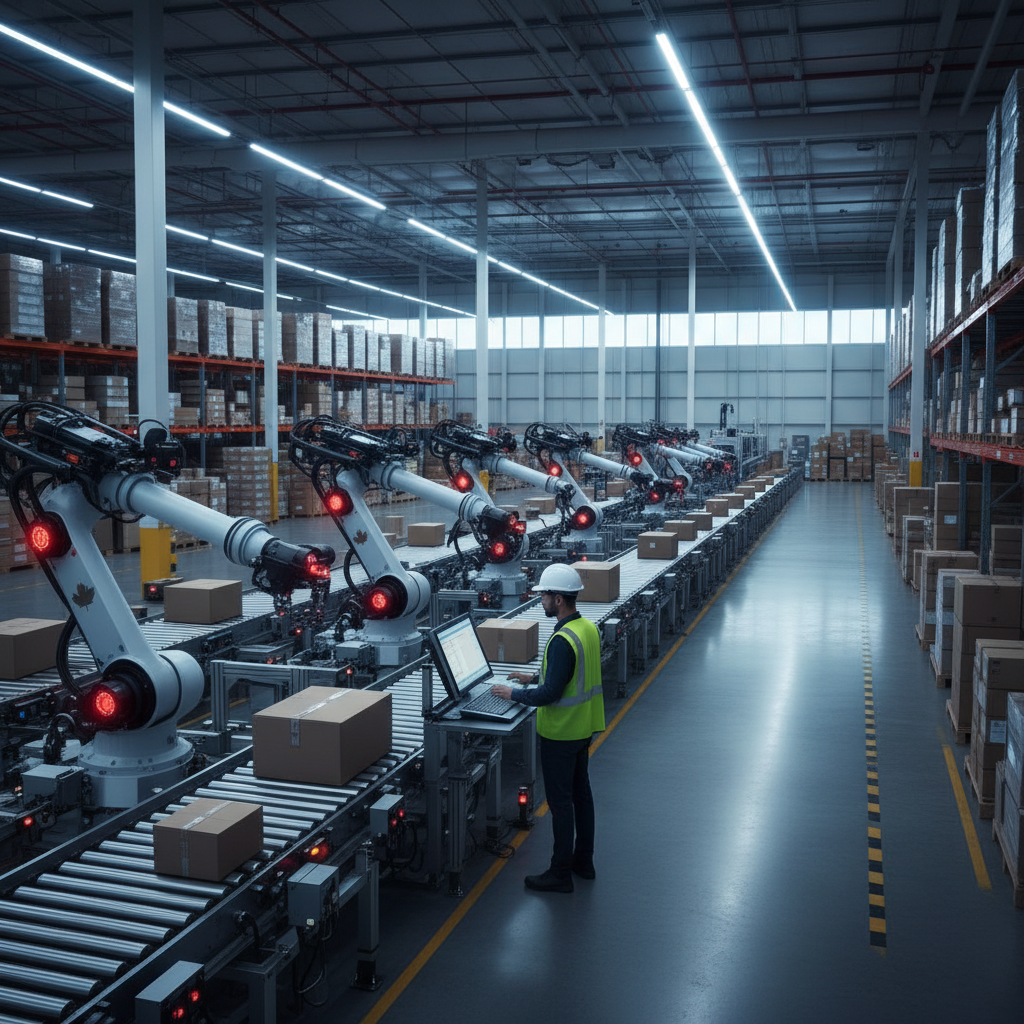

The hum of automated machinery is growing louder in warehouses across Canada, a testament to Amazon's aggressive push into artificial intelligence and robotics. From its sprawling fulfillment centers in Brampton, Ontario, to the newer facilities in Balzac, Alberta, the e-commerce giant is deploying sophisticated AI systems and an army of robots to optimize every facet of its supply chain. This technological pivot is touted as a leap forward for efficiency, speed, and cost reduction, yet a closer look reveals a more nuanced reality, particularly for the Canadian workforce.
Amazon's investment in robotics is substantial. The company reported deploying over 750,000 robotic drive units globally by late 2023, a figure that continues to climb. These machines, often working in concert with advanced AI algorithms, manage inventory, sort packages, and even assist in picking items, fundamentally reshaping the nature of warehouse work. The stated goal is to reduce repetitive tasks, enhance safety, and accelerate delivery times, a critical competitive advantage in Canada's vast geographic landscape.
However, the narrative of seamless progress often overlooks the human element. For years, labor advocates and economists have raised concerns about the impact of automation on employment. While Amazon frequently asserts that automation creates new, higher-skilled jobs, the data suggests a different conclusion for many entry-level positions. "We've seen a clear trend where the introduction of advanced robotics in Canadian distribution centers correlates with a shift in the labor market, not necessarily an expansion," states Dr. Anya Sharma, a labor economist at the University of Toronto. "The new roles often require specialized technical skills, leaving a significant portion of the existing workforce vulnerable or necessitating extensive, often company-funded, retraining programs that are not universally accessible."
Consider the case of a fulfillment center in British Columbia. Before a major robotics upgrade in 2024, the facility employed approximately 1,500 associates for various picking and packing roles. Post-upgrade, the number of human workers directly involved in these tasks decreased by 20 percent, while the number of robotics technicians and data analysts increased by a mere 5 percent. This net reduction in overall human employment, particularly for lower-skilled roles, is a pattern observed in multiple locations. The Canadian approach deserves more scrutiny when we analyze these shifts.
Amazon's AI systems, such as those powering its Kitting and Consolidation Robotics or its Automated Storage and Retrieval Systems, are designed to learn and adapt, continuously improving efficiency. These systems utilize machine learning to predict demand, optimize storage layouts, and even plan the most efficient routes for human and robotic movement within a facility. The theoretical benefits are undeniable: reduced errors, faster processing, and potentially lower operational costs. However, the practical implications for human workers are often less rosy.
"Let's separate the marketing from the reality," urges Jean-Pierre Dubois, President of the Canadian Logistics Workers Union. "Amazon claims these robots are 'assisting' workers, but in many instances, they are replacing them or intensifying the pace of work for those who remain. The pressure to keep up with automated systems can lead to increased stress and higher rates of injury. We need robust data on worker well-being in these highly automated environments, not just efficiency metrics."
Indeed, reports from various labor organizations, including the Canadian Centre for Occupational Health and Safety, indicate a rise in musculoskeletal injuries in highly automated warehouses, attributed to the repetitive nature of tasks that remain and the increased speed demands. While robots handle heavy lifting, human workers often perform precise, rapid movements to interact with the automated systems, leading to different, but equally concerning, ergonomic challenges.
Moreover, the data privacy implications of these AI systems warrant attention. Every movement, every pick, every pause by a human worker can be tracked and analyzed by Amazon's proprietary AI. This data is used not only for efficiency improvements but also for performance management. While companies argue this is for productivity and safety, critics contend it creates a surveillance culture that erodes worker autonomy and privacy. "The granular data collection within these facilities raises serious questions about worker rights and the potential for algorithmic management to become overly punitive," noted Dr. Elena Petrova, a technology ethicist at McGill University, in a recent panel discussion. "Canadian privacy regulations, such as Pipeda, need to be rigorously applied and potentially updated to address the specific challenges posed by pervasive AI surveillance in the workplace."
Beyond the immediate impact on employment and working conditions, there is the broader economic question for Canada. While Amazon's efficiency might benefit consumers through faster deliveries, the long-term effects on local economies and job creation are complex. If a significant portion of the logistics sector automates, what happens to the communities that have historically relied on these jobs? The federal government and provincial authorities are beginning to grapple with these questions, exploring retraining initiatives and discussions around universal basic income, but concrete solutions remain elusive.
Companies like Amazon, alongside other tech giants such as Google and Microsoft, are at the forefront of AI development. Their internal applications, like those in logistics, often serve as proving grounds for technologies that eventually permeate other industries. The lessons learned, both positive and negative, from Amazon's Canadian operations could provide valuable insights for other sectors contemplating similar automation strategies. For a deeper dive into the broader implications of AI in industry, readers might find this TechCrunch article insightful.
The future of work in Canada's logistics sector is undoubtedly intertwined with AI and robotics. While the allure of hyper-efficiency is strong, it is imperative that we, as a society, critically evaluate the trade-offs. The narrative cannot be solely about technological advancement; it must also encompass worker welfare, economic resilience, and ethical considerations. As these systems become more sophisticated, driven by advancements from companies like NVIDIA in specialized hardware and OpenAI in advanced algorithms, the need for robust policy frameworks becomes ever more urgent. The question is not if automation will continue, but how Canada will navigate its complexities to ensure a future that benefits all its citizens, not just corporate bottom lines. For more on the societal impact of AI, Wired often provides excellent analysis.
Ultimately, the revolution in Amazon's Canadian warehouses is a microcosm of a larger global transformation. As AI permeates more aspects of our lives, from personalized recommendations to autonomous vehicles, the need for a balanced, evidence-based approach to its adoption becomes paramount. We must demand transparency, accountability, and a commitment to human-centric solutions, ensuring that progress serves humanity, rather than merely replacing it.