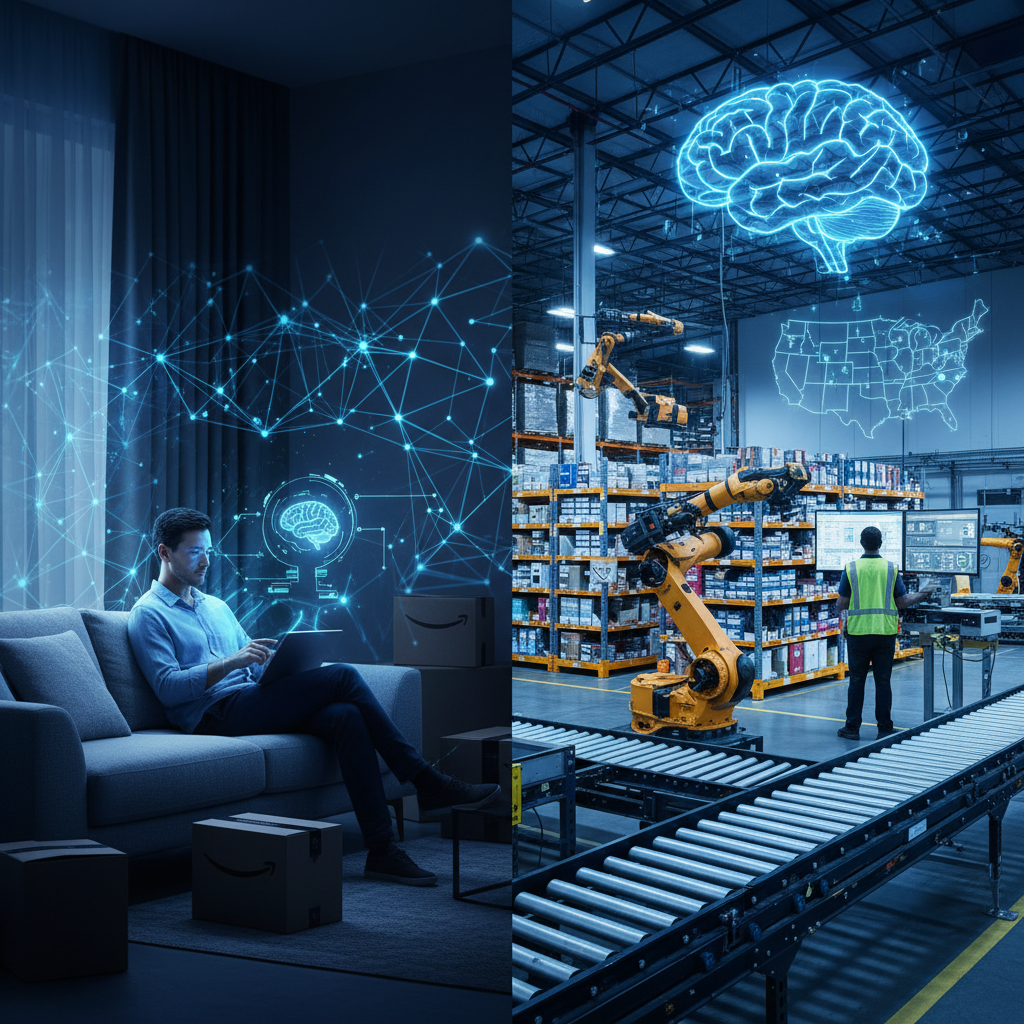

Man, I gotta tell you, I just saw the future and it's incredible. We're talking about a retail landscape so smart, so intuitive, it feels like something out of a sci-fi flick, but it's unfolding right now, in real time, across the United States. And guess who's leading the charge, not just with dazzling front-end experiences, but deep in the guts of the supply chain? None other than Amazon, and their AI brain is getting sharper by the minute, fueled by data from every 'Alexa, order more coffee' and 'Prime, what's my delivery status?'
For years, we've talked about AI in retail like it's some distant dream. Now, it's the bedrock of operations for giants and a game-changer for smaller players too. The big story right now, the one everyone in the industry is buzzing about from Seattle to Sarasota, is how AI is fundamentally transforming demand forecasting, inventory optimization, and personalized shopping. This is going to change everything, from how your local boutique stocks its shelves to how massive distribution centers manage billions of items.
Let's break it down. Demand forecasting used to be a dark art, a mix of historical sales data, gut feelings, and a prayer. Now, AI models, particularly those leveraging machine learning and deep learning, are gobbling up colossal datasets. We're talking about historical sales, yes, but also real-time trends, social media chatter, local weather patterns, economic indicators, even news cycles. Amazon, with its unparalleled access to consumer behavior data from its e-commerce platform, Alexa interactions, and Prime Video viewing habits, is in a league of its own. Their AI can predict not just what will sell, but when and where, with an accuracy that was unimaginable just a few years ago.
Think about it: every time you ask Alexa a question, every product you browse on Amazon, every movie you stream, it's all feeding into an intricate web of data points. This isn't just about recommending another pair of sneakers. This data is being crunched by sophisticated algorithms to anticipate regional spikes in demand for, say, rain gear in the Pacific Northwest or barbecue supplies in the South during a heatwave. It’s hyper-local, hyper-seasonal, and incredibly dynamic. "The sheer volume and diversity of data Amazon collects gives them an almost unfair advantage in predictive analytics," noted Dr. Anya Sharma, a leading AI ethicist and data scientist at the University of California, Berkeley. "Their models are learning from billions of daily interactions, creating a feedback loop that continually refines their forecasting capabilities."
This precision in forecasting directly translates into inventory optimization, which is where the real money is saved and the customer experience truly shines. For retailers, inventory is a tightrope walk. Too much and you're stuck with dead stock, eating up warehouse space and capital. Too little and you miss sales, disappointing customers. AI steps in as the ultimate tightrope walker. It ensures that the right products are in the right place at the right time, minimizing both overstock and stockouts. Imagine a future where that hot new gadget or that limited edition sneaker is always available when you want it, without stores having to guess. That's the AI promise.
Companies like Walmart and Target are also investing heavily, deploying AI systems to manage their vast physical store networks and e-commerce operations. Walmart, for instance, has been vocal about using AI to optimize everything from shelf stocking to delivery routes, aiming to reduce waste and improve efficiency. According to recent reports, AI-driven inventory management can reduce carrying costs by up to 30% for large retailers. That's a massive win for their bottom line, and ultimately, it means better prices and availability for us, the consumers.
But the magic doesn't stop in the warehouse. Personalized shopping, once a clunky 'customers who bought this also bought that' suggestion, has evolved into something truly bespoke. AI is creating shopping experiences that feel tailor-made for each individual. When you visit a retailer's website, AI is working behind the scenes, analyzing your past purchases, browsing history, even your social media activity, to curate a storefront just for you. It's like having a personal shopper who knows your style, your preferences, and your budget better than you do.
Take Stitch Fix, for example. While not Amazon, their entire business model is built on AI-driven personalization, sending curated clothing boxes to subscribers. But now, that level of sophistication is becoming mainstream. Major fashion brands are using AI to recommend outfits, suggest sizes, and even offer virtual try-ons. "The future of retail is less about pushing products and more about anticipating desires and fulfilling them seamlessly," stated Mary Barra, CEO of General Motors, during a recent tech conference, highlighting how even non-retail giants are observing and adopting these AI-driven consumer insights. "It's about creating a frictionless journey from discovery to delivery."
And it's not just online. In physical stores, we're seeing pilot programs with AI-powered smart mirrors that suggest complementary items, or mobile apps that guide you to products based on your preferences as you walk through the aisles. The data from your online interactions, your Alexa queries, your Prime purchases, it's all converging to create a unified, intelligent shopping experience, whether you're clicking a mouse or strolling through a mall in Miami.
Of course, with all this data collection and personalization comes the inevitable conversation about privacy. It's a valid concern, and one that regulators and tech companies are grappling with. Consumers are becoming more aware of their digital footprints, and there's a growing demand for transparency and control over personal data. However, the convenience and efficiency offered by AI-powered retail are incredibly compelling, creating a fascinating tension. As consumers, we're constantly weighing the benefits of personalization against our privacy concerns. For more on this evolving landscape, you need to pay attention to discussions around data governance and consumer rights, often covered by outlets like MIT Technology Review.
This isn't just about Amazon getting richer, although they certainly are. This is about a fundamental reshaping of how goods move from producer to consumer. It means less waste, more efficient logistics, and a shopping experience that feels like it was designed just for you. From the sprawling warehouses of the Midwest to the bustling streets of New York City, AI is the silent engine driving this retail revolution. It's an exciting time to be a consumer, and an even more exciting time to be watching this technology unfold. The next time you effortlessly find exactly what you need, remember the invisible AI working behind the scenes. It's truly mind-blowing, and it's only just getting started.