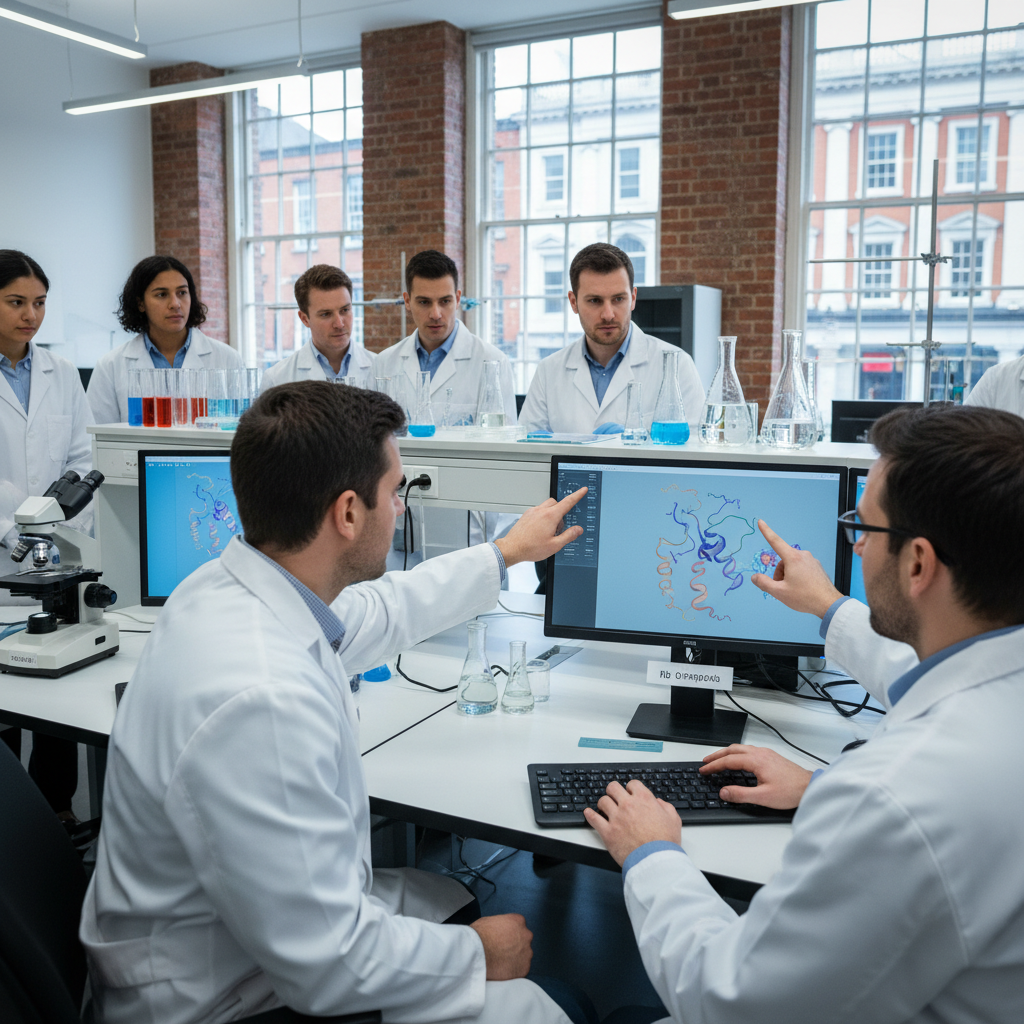

Well, isn't this a fine kettle of fish. For years, the boffins in white coats have been scratching their heads over proteins, those fiddly little molecular machines that make us, well, us. They fold themselves into shapes so intricate, so specific, that trying to predict them was like trying to guess the exact trajectory of a buttered scone falling off a table, every single time. A fool's errand, many thought. Then along came AI, and suddenly, the impossible looks rather… possible.
We're talking, of course, about the seismic shifts in protein folding prediction, largely spearheaded by Google DeepMind's AlphaFold. For those not steeped in the molecular mysteries of life, understanding how a protein folds from a linear chain of amino acids into its complex 3D structure is absolutely crucial. It dictates everything, from how our bodies fight disease to how we might design new materials. For decades, this was a painstaking, often impossible, experimental process. Now, AI models are doing it with accuracy that would make a seasoned biochemist weep with joy, or perhaps a touch of existential dread, depending on their disposition.
This isn't just some academic parlour trick, mind you. This is the kind of breakthrough that rewrites textbooks before the ink is even dry. The implications for drug discovery are nothing short of monumental. Imagine designing drugs that precisely target a faulty protein, knowing its exact shape and how it interacts with its environment. No more fumbling in the dark, hoping something sticks. We're talking about a future where drug development cycles, which currently cost billions and take over a decade, could be dramatically shortened and made more efficient. This isn't just about making a bit of extra cash for Big Pharma, it's about tackling diseases that have plagued humanity for centuries, from cancer to Alzheimer's, with a precision previously unimaginable.
And it's not just medicine. Materials science is also getting a good shake-up. Think about designing enzymes for industrial processes, creating new biomaterials with specific properties, or even engineering proteins for sustainable energy solutions. The potential is vast, frankly, and a bit dizzying to consider over a pint. The world's scientific community, and indeed the investment community, has taken notice. Venture capital poured over $20 billion into biotech and pharma startups in 2023 alone, with a significant chunk of that directed towards AI-driven platforms, according to reports from Bloomberg. That's a lot of zeroes, even by Silicon Valley standards.
So, where does Ireland, this small island nation with a disproportionately large tech footprint, fit into this grand scheme? Ah, now that's where the story gets interesting. Dublin's Silicon Docks have a story to tell, and it's not just about data centers and corporate tax rates anymore. We've quietly been cultivating a vibrant ecosystem of biotech, medtech, and deep tech startups, often flying under the radar compared to our flashier neighbours across the pond.
Take, for instance, the burgeoning research coming out of institutions like University College Dublin and Trinity College Dublin. They're not just watching from the sidelines, they're actively engaged in the computational biology space. We have a solid foundation in pharmaceutical manufacturing, with many of the world's largest pharma companies having a significant presence here. This means we have the talent, the infrastructure, and the regulatory understanding that's absolutely critical for translating these AI breakthroughs into tangible products and treatments. It's a natural fit, really, like a good Irish stout and a packet of Tayto crisps.
One of the key players in this space, albeit a global one, is Google DeepMind, whose AlphaFold model has been a game-changer. Their work has effectively solved a 50-year grand challenge in biology. The open-sourcing of AlphaFold's code and its database of over 200 million predicted protein structures has democratized access to this technology, allowing researchers worldwide, including those in Ireland, to leverage its power. This means smaller labs, startups, and academic institutions can now conduct research that was previously the sole domain of well-funded behemoths. It's a leveling of the playing field, and it's brilliant.
I recently spoke with Dr. Fiona O'Connell, a computational biologist at a Dublin-based startup focused on AI-driven drug discovery for rare diseases. She put it rather eloquently, saying, "AlphaFold has accelerated our initial research phases by years, not months. We can now hypothesize and test potential drug candidates with a level of confidence and speed that was simply unthinkable even five years ago. It's like having a crystal ball for molecular interactions." Her company, though still in its early stages, has already attracted significant seed funding from European investors, a testament to the potential they're tapping into.
This isn't just about direct applications either. The methodologies developed for protein folding are inspiring new approaches in other scientific domains. The underlying principles of how these neural networks learn complex spatial relationships and predict outcomes from vast datasets are being adapted for everything from materials design to understanding complex biological systems beyond just proteins. It's a cross-pollination of ideas, a truly exciting intellectual ferment.
However, it's not all rainbows and shamrocks. The sheer computational power required to train and run these advanced AI models is immense. NVIDIA's GPUs, for example, are the workhorses behind much of this research, and access to these resources can be a bottleneck. Furthermore, while AI can predict structures, experimental validation remains crucial, and that still requires significant time and resources. There's also the ever-present ethical question of what we do with such powerful predictive capabilities. As we gain the ability to design life's building blocks, the responsibility grows exponentially.
Despite these challenges, the momentum is undeniable. Ireland, with its strong academic base, a growing startup scene, and a long-standing relationship with the pharmaceutical industry, is perfectly positioned to be a significant contributor to this new era of AI-driven scientific discovery. The government, through initiatives like Science Foundation Ireland, has been investing heavily in deep tech and AI research, recognizing the strategic importance of these fields. This proactive approach ensures that we're not just a passive observer, but an active participant in shaping this future.
Only in Ireland would you find this blend of ancient history and cutting-edge technology, a place where you can discuss the intricacies of protein folding over a traditional music session. The craic is mighty in Irish AI, and it's not just about the craic, it's about serious science with global implications. As these AI models continue to evolve, becoming even more accurate and efficient, the line between computational prediction and experimental reality will blur further. We're on the cusp of a revolution, and it's thrilling to watch it unfold, quite literally, right here on our doorstep. The future of medicine and materials might just have a distinct Irish accent, and that's a thought worth raising a glass to. For more on the latest in AI innovation, you can always check out TechCrunch. The world is changing, and Ireland is right there in the thick of it, doing what we do best: innovating with a bit of wit and a lot of heart.