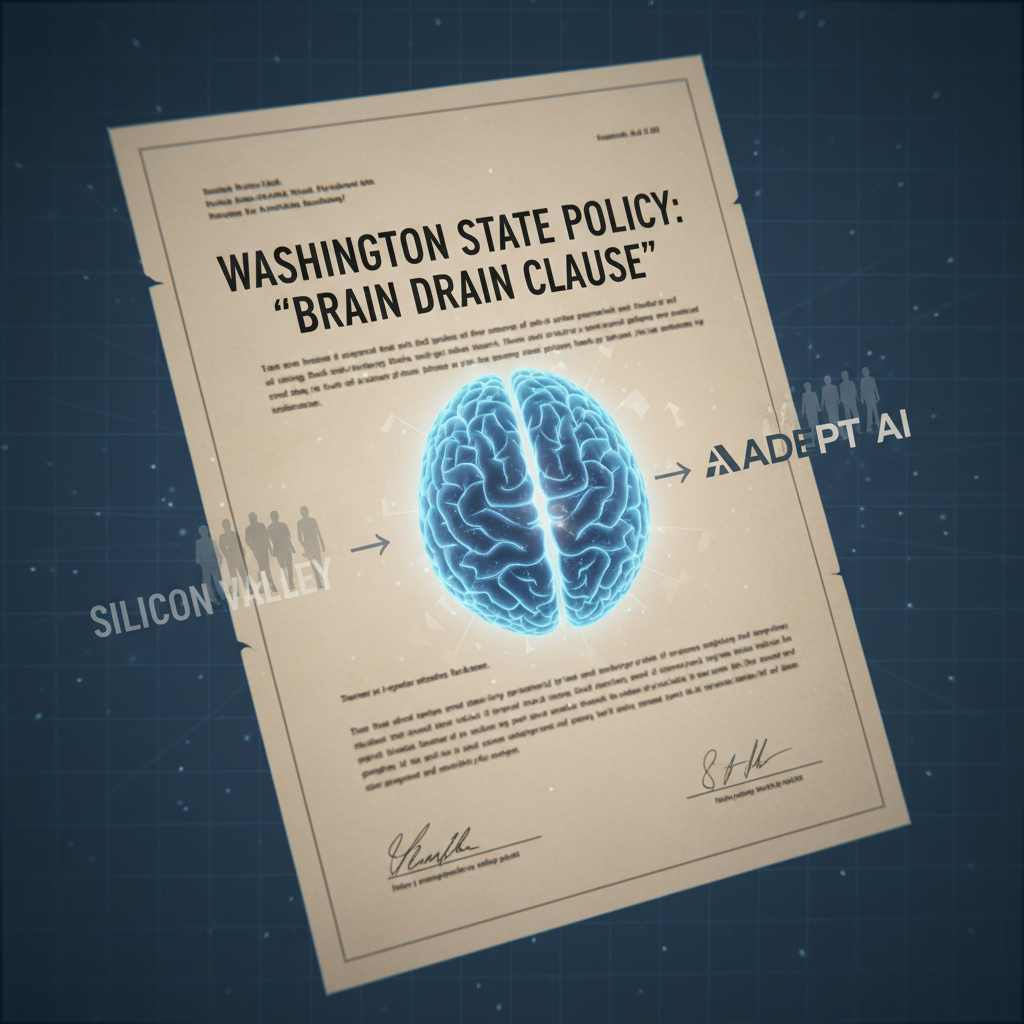

The news hit like a San Francisco fog rolling in: Adept AI, once a darling of the AI agent space with a vision to automate complex tasks, was acquired not for its product, but primarily for its exceptional talent. This wasn't a failure, but a strategic pivot in the face of an increasingly complex regulatory landscape, specifically Washington's new 'AI Talent Retention and Governance Act' or Atrga. This act, signed into law just last month, is already reshaping the very fabric of how frontier AI companies operate, especially those in the agentic AI domain.
Let me decode this for you. For years, the AI sector, particularly in the Bay Area, has been a wild west of innovation. Brilliant minds, often fresh out of Stanford or MIT, would coalesce, raise astronomical sums from venture capitalists, and chase ambitious, sometimes audacious, goals. Adept AI was a prime example, aiming to build AI agents capable of understanding and executing multi-step commands across various software applications, essentially creating a digital colleague. Their early demos were nothing short of breathtaking, promising a future where AI could truly act as an extension of human will.
The Policy Move: Washington's 'Brain Drain Clause'
The Atrga, spearheaded by a bipartisan coalition in Congress, represents a significant shift from the previous hands-off approach. At its core, the Act introduces stringent regulations on the development and deployment of 'highly autonomous AI systems' which it defines as systems capable of independent goal setting, planning, and execution without continuous human oversight. It mandates rigorous safety testing, transparency requirements, and, crucially, establishes a national AI talent registry. The part that directly impacted Adept AI, and has been colloquially dubbed the 'brain drain clause,' is Section 301. It stipulates that any AI company developing systems deemed 'critical national infrastructure AI' or 'frontier autonomous AI' must secure specific federal approval for key personnel movements, particularly acquisitions or foreign recruitment, to prevent talent concentration or loss that could compromise national security or economic competitiveness. The idea is to keep top-tier AI talent within the USA's strategic orbit, especially when their work touches on potentially transformative or dual-use technologies.
Who's Behind It and Why?
This legislative push didn't come out of nowhere. It's the culmination of growing anxieties in Washington, D.C., about the rapid advancement of AI, particularly after events like OpenAI's GPT-5 release and the subsequent public debate around its potential for misuse. Lawmakers, defense strategists, and even some prominent AI ethicists have been vocal about the need for guardrails. Senator Evelyn Reed, a Democrat from California and a key architect of Atrga, put it bluntly during a recent hearing: "We cannot afford a future where the most powerful AI capabilities are concentrated in the hands of a few unregulated entities, or worse, fall into the wrong hands. This Act is about securing America's technological leadership and ensuring responsible innovation." Her Republican counterpart, Representative David Chen from Texas, emphasized the economic angle, stating, "Our goal is to foster a robust, secure domestic AI ecosystem. Protecting our talent from predatory acquisitions or foreign poaching is paramount to our economic sovereignty." The National Security Council and the Department of Commerce played significant advisory roles, highlighting concerns about intellectual property flight and the potential for advanced AI to be weaponized.
What It Means in Practice: A New Reality for Startups
For companies like Adept AI, the Atrga created a new reality. Building truly autonomous AI agents requires not just cutting-edge research, but also a specific kind of talent: researchers adept at reinforcement learning, large language model fine-tuning, and complex systems engineering. The Act's provisions meant that if Adept AI continued its trajectory, its most valuable asset, its team, would become subject to federal oversight regarding future employment or acquisition. This added a layer of complexity and potential delay to any exit strategy, making a pure acquisition of the company as a standalone entity less attractive. Instead, the acquiring company, a major tech player with deep ties to government contracts, opted for a talent acquisition, effectively absorbing Adept's engineers and researchers into its existing, federally compliant AI divisions. This move allows the talent to continue their work under the umbrella of a larger, more regulated entity, bypassing some of the more onerous startup-specific compliance burdens.
"The compliance burden for a small startup was becoming untenable," explained Dr. Lena Hanson, a former lead researcher at Adept AI, now a principal scientist at the acquiring firm. "We were spending more time on regulatory paperwork and legal consultations than on actual research. The acquisition offered a path to continue our work, albeit under different strategic directives and with a much larger legal team to navigate the Atrga." This sentiment is echoed by many in the startup community. The Act, while well-intentioned, has inadvertently created a 'big tech' advantage, where only companies with immense resources can afford the legal and compliance infrastructure necessary to operate at the frontier of AI development.
Industry Reaction: A Mixed Bag of Relief and Resignation
The industry's reaction has been, predictably, a mixed bag. Larger players like Microsoft, Google, and Amazon, already accustomed to navigating complex regulatory environments, see the Atrga as a necessary evil, perhaps even a competitive advantage. They have the resources to comply and can leverage the Act to absorb promising startups. "We view the Atrga as a framework for responsible innovation," stated Alex Chen, Head of AI Policy at Google, in a recent press briefing. "It provides clarity and helps ensure that cutting-edge AI development aligns with national interests." This sounds like corporate speak, but the architecture tells the real story: these giants are already building out specialized compliance teams and integrating Atrga requirements into their R&D roadmaps.
Smaller startups, however, are feeling the squeeze. Many fear that the Act will stifle innovation by making it harder for nimble, independent teams to take risks. "It's a chilling effect, plain and simple," commented Sarah Jenkins, CEO of a promising AI startup in Boston focused on medical diagnostics. "The capital required for compliance alone is astronomical for a Series A company. It pushes us towards acquisition by larger players, rather than independent growth. It's like building a toll booth on the information superhighway before anyone has even driven on it." This sentiment suggests a potential consolidation of AI power, moving away from the decentralized, open innovation model that characterized early Silicon Valley.
Civil Society Perspective: Balancing Safety and Progress
Civil society organizations, particularly those focused on AI ethics and public interest, generally welcome the intent behind the Atrga, but express concerns about its implementation. "We absolutely need robust governance for autonomous AI," said Maria Rodriguez, Director of the Digital Rights Foundation, based in Washington, D.C. "However, we must ensure that these regulations don't inadvertently create monopolies or stifle diverse voices in AI development. The 'brain drain clause' risks centralizing power and expertise in a few hands, which could lead to less diverse and potentially biased AI systems." She emphasized the need for independent oversight and mechanisms to support public interest AI research that might not fit neatly into corporate or national security agendas. There's a fear that if all the best minds end up under the umbrella of a few mega-corporations, the public loses its ability to scrutinize and influence the direction of AI development.
Will It Work?
So, will the Atrga work as intended? The answer, like most things in AI, is complex and probably somewhere in the middle. On one hand, it undeniably creates a more structured environment for frontier AI development, forcing companies to prioritize safety and national security considerations from the outset. It also signals a clear intent from the U.S. government to play an active role in shaping the future of AI, moving beyond mere observation. This proactive stance could be crucial in an increasingly competitive global AI landscape.
However, the Act's immediate impact, as seen with Adept AI, suggests a potential for unintended consequences. The consolidation of talent within larger, established entities could reduce the diversity of approaches and foster a less dynamic innovation ecosystem. It might also push some of the most ambitious AI research underground or offshore, as brilliant minds seek environments with fewer regulatory hurdles. The challenge for policymakers now is to fine-tune the Atrga, ensuring it protects national interests without stifling the very innovation it seeks to secure. We need a regulatory framework that is agile enough to keep pace with AI's exponential growth, yet robust enough to instill public trust. The Adept AI acquisition is just the first tremor; the real earthquake of AI governance is still unfolding, and its aftershocks will define the future of American innovation for decades to come. It's a high-stakes game, and we're all watching to see if Washington can truly thread this needle. For more on the evolving landscape of AI policy, you can check out TechCrunch's AI section or MIT Technology Review for deeper analysis of these trends.